E-Vision Intelligence Report
February 2024
EV Sales Volume Grew 50% in 2023; Can Trend Continue?
Key Findings
- EVs Accounted for a Significant Portion of Retail Growth in 2023: Industry-wide, automobile sales and lease retail volumes rose 8% in 2023 from 2022, totaling approximately 13 million units. With roughly one million in total volume for the year, EV sales and leases grew 50%, while gas-powered vehicles grew 2%.
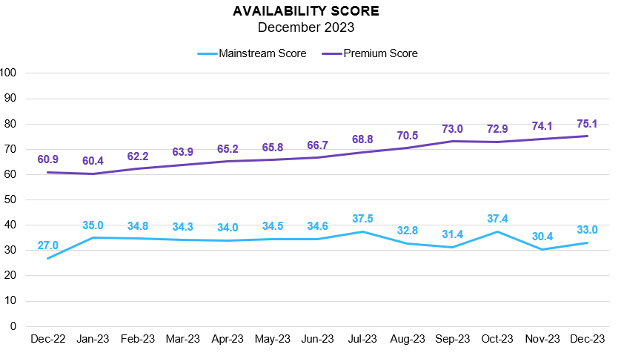
- Mainstream EV Availability Continues to Lag: The JD Power EV Index availability score for premium market EVs has climbed to 75.1 (on a 100-point scale), which means that more than three-fourths of premium market buyers currently have a viable EV alternative to comparable gas-powered vehicles. In the mass market, however, the availability score is just 33, which means that one-third of mass market buyers have a viable EV alternative. That number has declined from 37.5 in July 2023 as manufacturers have struggled with production delays.
- JD Power EV Market Share Forecast Revised Down for 2024: JD Power has revised its EV market share forecast down 0.8 percentage points to reflect delayed vehicle launches, production issues, restrictions associated with the Clean Vehicle Credit, slowing adoption patterns in some states and plateauing shopper interest driven largely by concerns about public charging. Our current forecast is 12.4% EV market share in 2024, with new EV market share projected to top the 50% mark in 2031.
Executive Summary
While some EV-related news coverage has taken a pessimistic tone recently, the data on EV sales and lease volumes for 2023 is telling a much different story. In fact, EV sales grew 50% year over year in 2023, accounting for 37% of total auto sales growth in the United States. Sales of gas-powered vehicles, by contrast, rose just 2% for the year. The EV marketplace is still facing headwinds, however, as a combination of production delays, a notable lack of mass market vehicles and complicated tax credits are keeping the segment firmly entrenched in the early adopter phase.
This E-Vision Intelligence Report dives into key data points trending in each monthly EV Index update, along with other data points gathered from JD Power studies and pulse surveys, to spotlight emerging trends and important shifts in EV consumer sentiment.
One Million Reasons Why EVs Are Important to Manufacturers
EVs were a significant contributor to the overall growth rate of the automobile industry in 2023. All told, the industry sold approximately 13 million units last year, up 8% from 2022. Within that total were more than 10 million gas-powered vehicles and one million EVs. While gas-powered vehicle sales rose 2% in 2023, EV sales were up 50% over the previous year, ultimately accounting for 37% of the industry’s total growth rate.
The biggest contributors to the overall EV growth rate in 2023 were Tesla (56%), BMW (8%) and Mercedes-Benz (7%).

Mass Market Availability Lags Premium Market
One of the central challenges keeping EVs from significant growth in the mainstream marketplace is a notable lack of availability of mass market vehicles. The JD Power EV Index availability score tracks the percentage of shoppers with a viable EV alternative to a gas-powered vehicle by evaluating a range of criteria including vehicle type, price point, origin of manufacture and other variables. Based on these variables, premium market shoppers have a lot more EV options than mass market shoppers.
In the premium vehicle segment, availability climbed steadily during 2023, reaching a high of 75.1 in December, meaning that 75% of buyers in the market for premium vehicles have viable EV alternatives from which to choose. In the mass market segment, however, availability trended down in 2023, with just 33% of mass market shoppers currently able to purchase an EV that checks all the boxes that a gas-powered vehicle would.
2024 EV Sales on Track for 12.4% Market Share
The decline in mass market availability has been driven by a confluence of factors that includes manufacturing delays (e.g., the GMC Sierra and Chevrolet Equinox EVs); production cuts (e.g., those initiated by Ford with its F-150 Lightning); continued complexity surrounding Clean Vehicle Tax Credits; and slowing adoption rates in numerous states, a dynamic to which stagnating shopper interest and concerns about public charging are contributing.
Regarding Clean Vehicle Credit, starting in 2024, eligibility requirements have tightened and now include new restrictions surrounding battery and component manufacturing. Specifically, at least 60% of a vehicle’s battery components must be produced or assembled in America and 50% of minerals used in the battery must be extracted from a free-trade agreement country in order for vehicles to qualify for the full tax credit. These restrictions are negatively affecting overall EV availability, particularly in the price-sensitive mainstream marketplace where vehicles such as the Ford Mustang Mach-E, Nissan LEAF and Chevrolet Blazer EV no longer qualify.
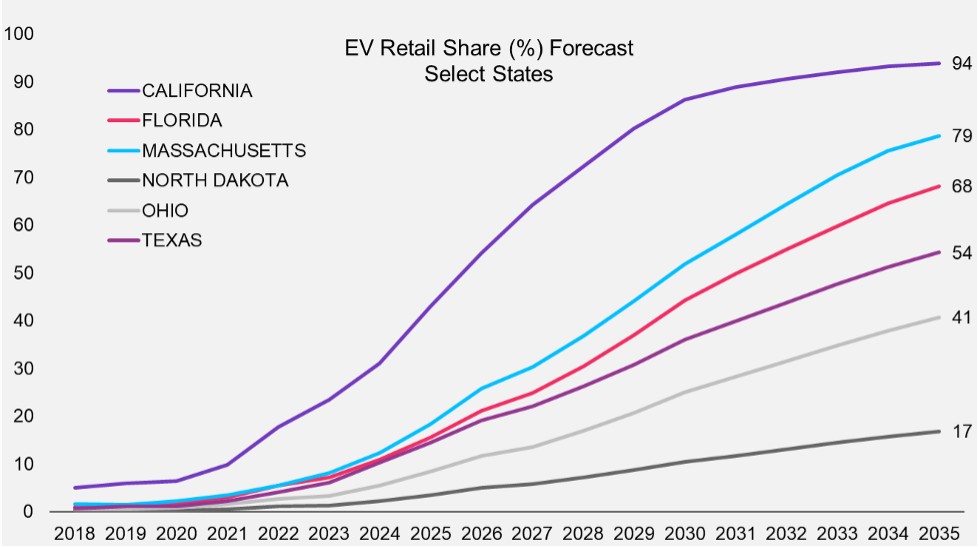
Accordingly, JD Power has revised down its EV sales forecast by 0.8 percentage points to 12.4% market share for calendar year 2024. At this rate, we project new vehicle EV market share to top 50% in 2031. The strongest growth is anticipated in California, but will vary significantly state to state.
Methodology
This JD Power E-Vision Intelligence Report is based on data and insights from the JD Power EV Index, the JD Power EV Retail Share Forecast, the JD Power 2023 U.S. Electric Vehicle Experience (EVX) Public Charging Study and the JD Power U.S. Electric Vehicle Consideration (EVC) Study. The JD Power EV Index is an analytics tool to benchmark the growing EV market in the United States. It tracks millions of data points aggregated into six categories—interest, availability, adoption, affordability, infrastructure and experience—to evaluate the progress to parity of EVs with gas-powered vehicles in the U.S. Each month, the JD Power electric vehicle practice will analyze these data points, and others to spotlight emerging trends and important shifts in consumer sentiment that are helping to define the fast-moving EV marketplace.
Find out More
This report was authored by Elizabeth Krear, vice president, electric vehicle practice; Brent Gruber, executive director, electric vehicle practice; Stewart Stropp, executive director, electric vehicle practice; and Kristen Richter, senior manager, electric vehicle practice. The JD Power E-Vision initiative is a company-wide program focused on maximizing JD Power industry-leading EV data, analytics, insights and solutions. Please contact us at the numbers below to connect with the authors or to learn more about the underlying research.
Media Contacts
Shane Smith; East Coast; 424-903-3665; [email protected]
Geno Effler, JD Power; West Coast; 714-621-6224; [email protected]