Disasters Become a Fact of Life for Many U.S. Electric Utility Customers
Utilities Intelligence Report
October 2025
Disasters Become a Fact of Life for Many U.S. Electric Utility Customers
Extreme Weather to Blame for Half of all Outages Reported in First Half of 2025
Disasters, such as the Los Angeles wildfires and severe spring and early summer thunderstorms that caused flash floods throughout many parts of the United States, have contributed to more than $131 billion in global losses in the first half of 2025. They have also created a new set of challenges for the nation’s electric utilities—and their customers—who were already straining under the weight of rising costs, aging infrastructure and an uncertain economy.
In response to the increased frequency and severity of extreme weather events, JD Power expanded its U.S. Electric Utility Residential Customer Satisfaction Study methodology to better understand the impact of weather-related power outages and service disruptions on customers. This Utilities Intelligence Report dives into key data points gathered from JD Power studies to chart the scope of power disruptions throughout the first half of 2025 and identify strategies utilities can use to help mitigate the negative effects of extreme weather on their customers. Data collected in this report is from 2025 and includes weather events from 2024 and 2025.
Longer Outages Affecting More Regions of the Country
Overall, 45% of utility customers nationwide say they have experienced a power outage in the first half of 2025. Of those outages, 48% were due to extreme weather such as a hurricane, ice or snowstorm, thunderstorm, wind or tornado or fire. These extreme weather events were so violent that 17% of customers who were affected by a natural disaster say they had to evacuate their homes.
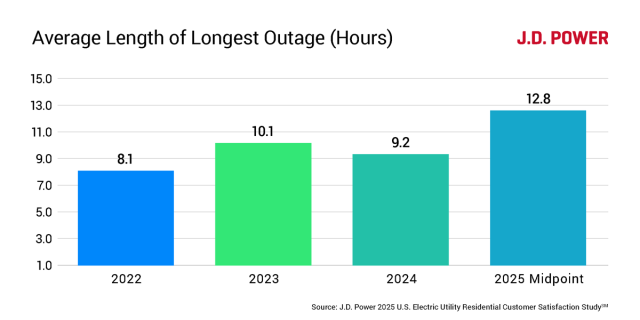
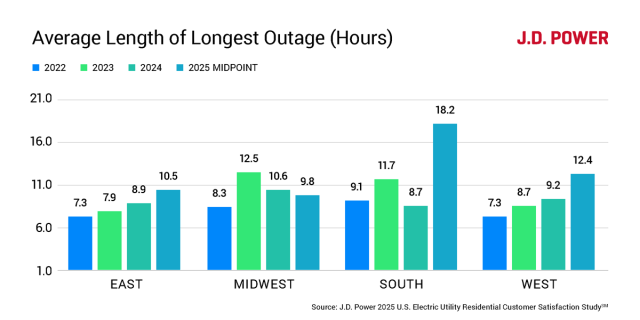
Accordingly, the average length of the longest power outage in the U.S. has increased in all regions since 2022. Customers in the South of the United States report the longest outages (18.2 hours), followed by the West (12.4 hours).
Southern U.S. in the Eye of the Storm
The majority of customers who are affected by a recent disaster are in the South, double the national average. And when the South experiences a disaster, it has bigger energy ramifications than any other region. Customers in the South experienced more electricity loss than any other region (77%) in the aftermath of extreme weather events. Its average outage length when the outage is caused by extreme weather is 95.2 hours. They also had the most property damage (36%) and the second-highest rate of evacuation (17%).

Wildfire Plagues the West
In the West, 4% of the region experienced an outage due to fire. What’s more, 6% of the region experienced an outage due to a proactive shutoff by the utility.

Maintaining Customer Satisfaction Under Duress
The overall customer satisfaction scores for all electric utilities nationwide is 504 (on a 1,000-point scale) through the first half of 2025. Despite widespread outages, the South leads the nation with a score of 530—surpassing the national average and outperforming the East (477), Midwest (516), and West (481).
Strong customer satisfaction scores among utilities in the Southern U.S. are being driven by high marks in safety, reliability, ease of service, trust, and digital experience. Overall, more than half (57%) of customers feel their electric utility is the entity most responsible for educating the public on electric safety, and the region had the highest marks of customers receiving information from their utility on how to prepare for the disaster via text message (29%). This suggests that easy, accessible communication can move the needle on customer satisfaction, even in the face of loss of power, property and displacement.

Controlling the Controllables
Given the increase in disasters, how can customer satisfaction stand up in times of increasingly frequent events and ensure service reliability and customer safety? Utilities in the South have shown it can be done, provided utilities understand what customers truly value.
When extreme weather strikes, customers are on the hunt for reliable and accessible channels to get information. Many assume that electrical utilities will be that channel, as 44% of customers say they want electric safety information from their utility that will help them prepare for a storm/weather event, and 35% want to know what to do in the event of an extensive outage. What’s more, when a utility reaches out directly in the aftermath of an outage, customer satisfaction increases dramatically.

The South is acting as a benchmark on how building trust, providing accessible digital tools and maintaining effective communication can positively impact customer satisfaction. While the South has plenty of weather variables to contend with, many of the region’s utilities have found a way to provide that guidance and boost overall customer satisfaction. With weather events as unpredictable as ever, utilities will need to find a way to control what they can. That starts with a better flow of information – before and after an extreme weather event.
Find out More
This Utilities Intelligence Report is based on insights from the JD Power U.S. Electric Utility Residential Customer Satisfaction Study, the JD Power U.S. Electric Utility Brand Appeal Index Study, the JD Power U.S. Utility Digital Experience Study and the JD Power U.S. Sustainability Index. It was authored by Mark Spalinger, director of utilities intelligence at JD Power. Please contact us at the numbers below to connect with Mr. Spalinger or to learn more about the underlying research.
Media Contacts
Brian Jaklitsch; East Coast; 631-584-2200; [email protected]
Joe LaMuraglia, JD Power; East Coast; 714-621-6224; [email protected]