Utilities Intelligence Report
January 2026
Key Insights
- Midterm elections will fan flames of rate debate: Average monthly residential electric utility costs have surged 34% since 2020, reaching $189 for the full year 2025—the highest annual average ever measured by JD Power. This will make an easy talking point for politicians running for midterm elections and a palpable pain point for customers who are struggling to pay their bills.
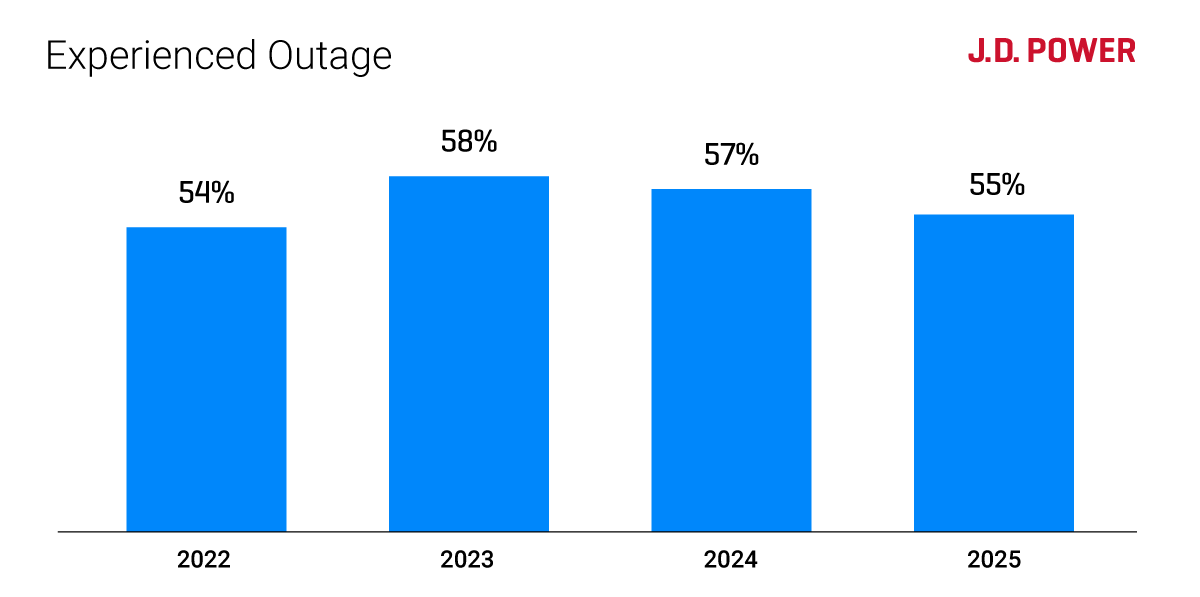
- Extreme weather and outages put spotlight on communication: More than half (55%) of utility customers nationwide experienced a power outage in 2025, putting increased pressure on utilities to deliver proactive communication before, during and after power restoration.
- Cannot afford to ignore technology: More customers than ever are turning to utility websites and apps as their first line of communication, yet nearly one-in-five (19%) encounter problems with slow or poorly organized websites and nearly one-third (28%) of utilities still do not offer mobile apps.
Executive Summary
The nation’s electric, gas and water utilities have their work cut out for them in 2026. A combination of record-high rates, widespread outages and evolving customer expectations for how to access important information and engage with service providers are challenging the status quo. In many cases, utilities have become high-profile consumer brands and that makes them subject to an increased level of public scrutiny, especially when things do not go as planned.
This Utilities Intelligence Report dives into key data points gathered from JD Power studies and proprietary market data to offer a data-driven perspective on the biggest issues confronting utilities as we head into 2026.
Affordability Now Frames Every Conversation
Monthly utility bills have come to occupy a significant share of consumers’ recurring household expenses, with the average monthly electricity bill reaching $189, the average monthly gas bill at $122 and the average monthly water bill hitting $101 through 2025. Electric bills in particular hit record highs in 2025, and customers are feeling the pain, with 22% indicating they are unable to pay their full bill or currently owe an outstanding amount to their utility.
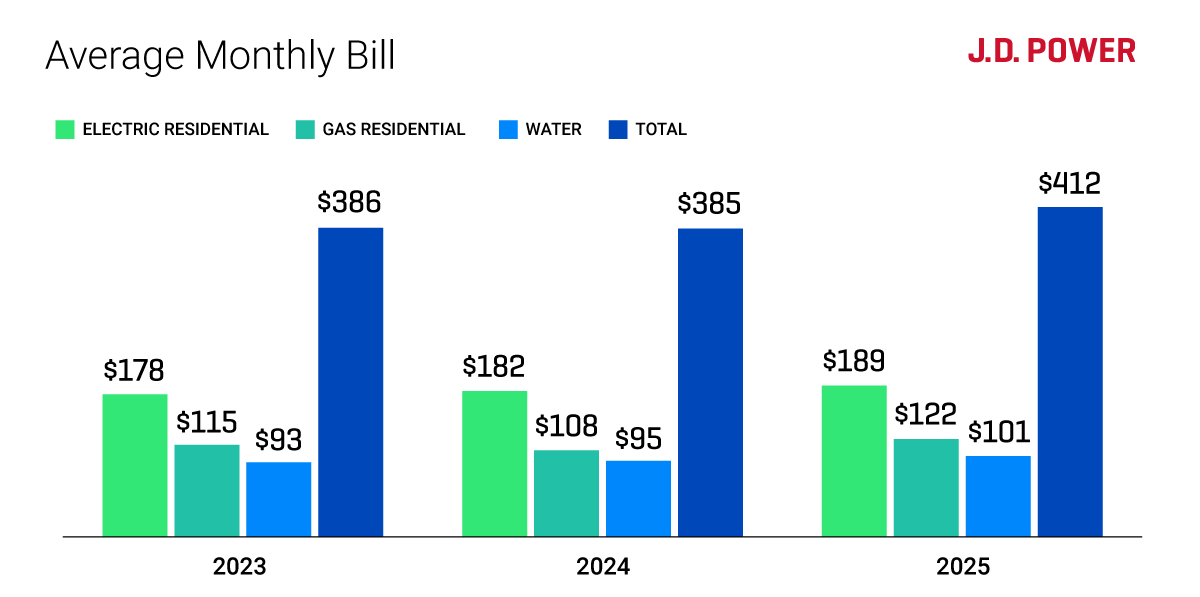
These rising household costs have already become a major talking point for politicians running for midterm elections and will continue to make headlines following rate cases and key economic data releases. To counteract this negative attention, utilities will need to strengthen their affordability initiatives, proactively communicate upcoming rate changes with explanations for why changes are occurring, and expand assistance programs to support financially stressed customers. JD Power data shows that when utilities have strong brand appeal perceptions, 37% of their customers trust them to set fair rates. Meanwhile, when utility brand appeal is weak, only 10% of customers trust them to set fair rates. Utilities will need to highlight the steps they are taking to help customers manage affordability challenges in 2026.
Right or Wrong, More Customers Blame AI for High Electric Costs
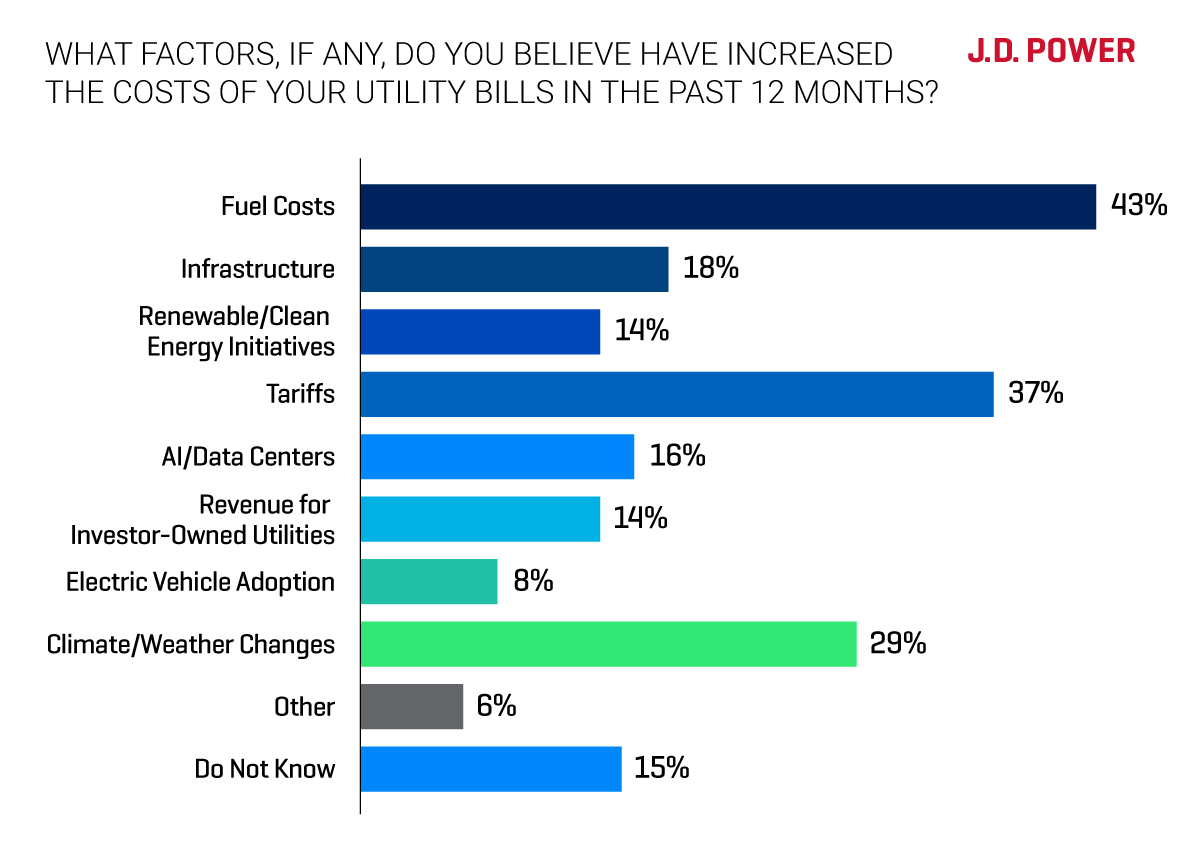
Rising raw materials costs, natural disasters and increased demand are some of the reasons for the steady rise in residential electric utility bills over the past several months, but one culprit in particular has increasingly sparked customer ire: the rapid expansion of data centers to support AI.
In fact, data centers in the United States accounted for 4%1 of total power demand in 2025. While that is a marked increase over the past five years, it does not translate directly to higher rates at every local electric utility in the nation. Still, 16% of electric utility customers say they feel AI/data centers have played a role in increasing their utility bills in the past year. For the most part, electric utilities have not been communicating with their customers about the factors driving increased demand, but that needs to change. In the absence of proactive communication that clarifies data centers aren’t the sole reason for rising rates, speculation will continue to grow.
Extreme Weather and Service Disruptions Create Sense of Urgency
Overall, 55% of utility customers nationwide say they have experienced a power outage in 2025. Of those outages, 47% were due to extreme weather such as a hurricane, ice or snowstorm, thunderstorm, wind or tornado or fire. These extreme weather events were so violent that 17% of customers who were affected by a natural disaster say they had to evacuate their homes.
Customer satisfaction with residential electric utility providers is significantly higher when customers receive timely, accurate outage information. Utilities that proactively communicate about power outages earn satisfaction scores that are 52 points higher (on a 1,000-point scale), on average, than utilities that do not proactively communicate with their customers. Similarly, utilities that proactively reach out to their customers to share information about infrastructure investment and improvements being made to the grid have overall satisfaction scores that are 82 points higher than those that do not.
Utilities should enhance proactive communication strategies, invest in accurate outage maps and ensure customers receive timely alerts. Proactive, multi-channel communication (text, email, phone) will be essential for building trust and improving reliability perceptions, particularly in response to unpredictable events.
Digital Engagement and Self-Service Become Critical
More customers than ever are turning to utility websites and apps as their first line of communication when it comes to questions about billing, service disruptions and other customer service issues, yet nearly one-in-five (19%) encounter problems with slow or poorly organized websites and nearly one-third (28%) of utilities still do not offer mobile apps.
Among water utility customers, for example, just 20% say they have recently reached out to their utility via phone, while 37% say they have used an app or gone to their water utility’s website seeking information. Moreover, customers who use digital channels have overall satisfaction scores that are 43 points higher (on a 1,000-point scale) than those who use the phone.
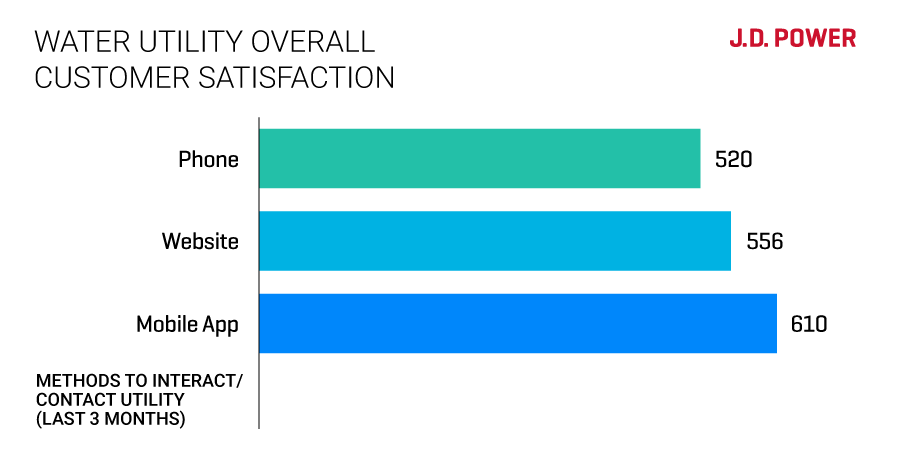
As more customers continue to pursue digital means of problem resolution as their first line of communication, many utilities will need to strengthen their customer support technology to keep pace with rising expectations.
Find out More
This Utilities Intelligence Report is based on data and insights gathered across all JD Power Utilities Intelligence studies conducted during 2025. It was authored by Andrew Heath, vice president, Utilities and TMT Intelligence; Chris Oberle, managing director; John Hazen, managing director; and Mark Spalinger, director of Utilities Intelligence at JD Power.
Please contact us at the numbers below to connect with the team or to learn more about the underlying research.
Media Contacts
Brian Jaklitsch; East Coast; 631-584-2200; [email protected]
Joe LaMuraglia, JD Power; East Coast; 714-621-6224; [email protected]
1 Pew Research Center, “What we know about energy use at U.S. data centers amid the AI boom,” October, 24, 2025 https://www.pewresearch.org/short-reads/2025/10/24/what-we-know-about-energy-use-at-us-data-centers-amid-the-ai-boom/