It’s been nearly 18 months since the world’s largest asset manager, BlackRock, announced that it would put environmental, social and governance (ESG) goals at the center of its investment strategy. That day seemingly foretold a grand portfolio migration to ESG investments, with wealth managers and investors throwing their weight behind more responsible corporate endeavors.
But a year and a half later, it seems that the greater public has very little quantifiable information on which brands deliver on the promises of greener, more equitable corporate citizenship.
In order to get a sense on how effectively corporations have been communicating their ESG strategies, and how important this information is to investors, the latest JD Power Wealth Management Pulse survey asked respondents about the importance ESG, and their awareness of corporations that are making these efforts.
Roughly one-quarter (23%) of respondents couldn’t come up with any brands that are the top-three for investments in ESG/corporate citizenship. Among respondents that did name a company, Amazon, Apple, and Nike were among the most frequently mentioned, despite each of these brands having struggled publicly with environmental or corporate citizenship issues.
Americans Place High Value ESG
While investors and consumers may struggle to find solid information on corporate ESG performance, the majority agree that it should be a critical factor in investment decisions.
When presented with the economist Milton Friedman’s famous “Friedman Doctrine,” which states: “A company has no social responsibility to the public or society; its only responsibility is to its shareholders,” 74% of respondents said they either disagreed or strongly disagreed with the sentiment.
When evaluating the component parts of ESG, 38% of respondents said environmental issues were the most important criteria influencing the perception of a company, followed by social (32%) and governance (30%).

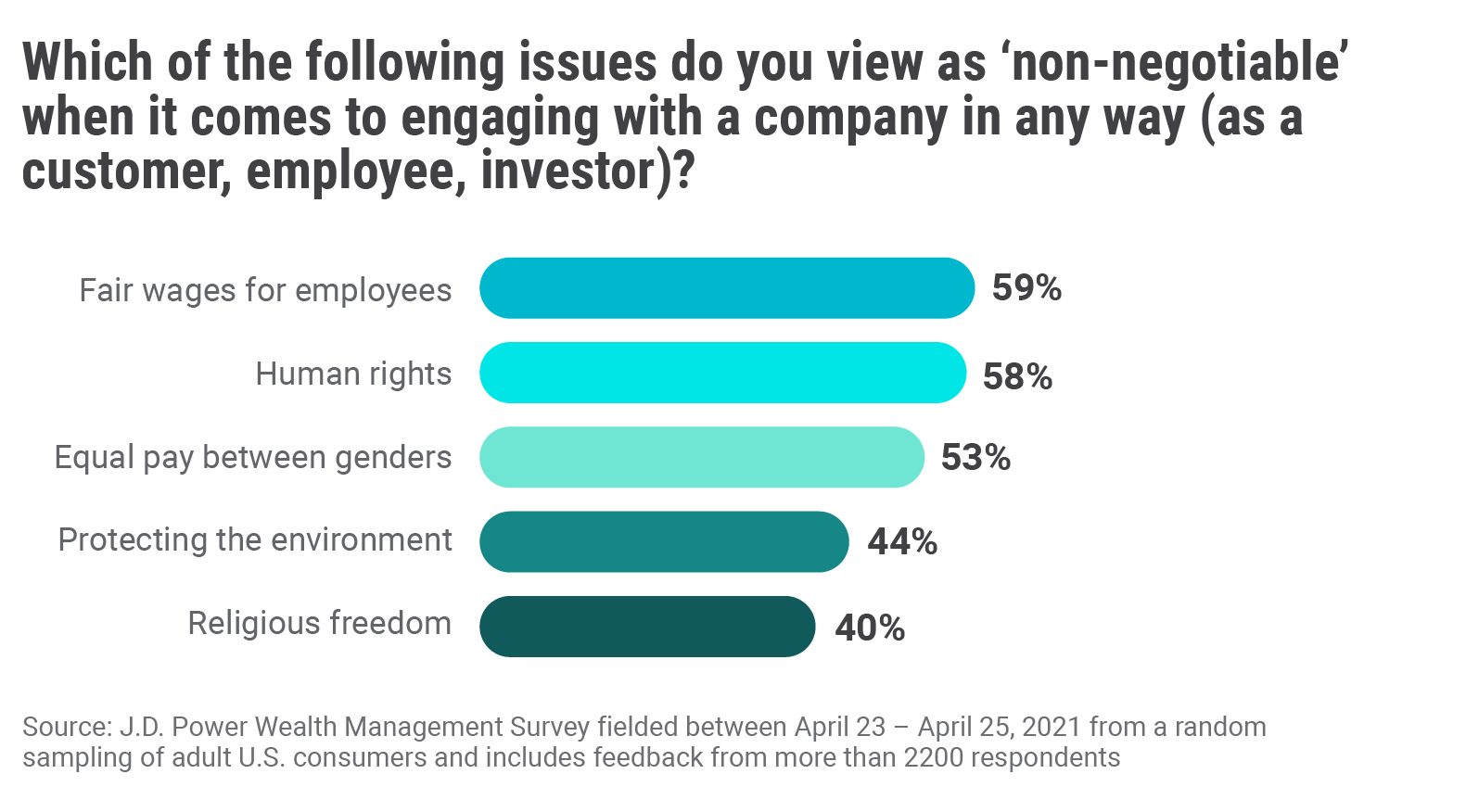
Respondents also indicated that some ESG-related issues were “non-negotiable” to them as a customer, employee, or investor. These included fair wages to employees (59%), human rights (58%), equal pay between genders (53%), and protecting the environment (44%).
The sentiment even extended to the world of professional sports. In what has been a polarizing topic since former San Francisco 49ers quarterback Colin Kaepernick’s National Anthem protest sparked the modern social movement, respondents were virtually split down the middle on whether they thought professional sports leagues and athletes should use their platform to further political and social goals: 48% said yes, 52% said no.
Reliable ESG Information is Hard to Find
In spite of how important ESG seems to be to most consumers, they readily admit they haven’t looked very hard to find out which firms are actually delivering on these metrics. And when they have, the information has been hard to come by.
Overall, 29% of respondents said they have never looked for a company’s corporate citizenship activities, while 41% said that information could be either somewhat or very difficult to find. Part of that problem could be the source of information.
When asked where they got most of their information regarding a company’s ESG activities, 42% said social media and 38% said company websites, with more traditional, legacy media lagging behind, with newspapers and magazines at 33% and TV at 28%. Just over one-quarter (26%) said word-of-mouth.

Empowering Investors to Act on ESG Instincts
The burning question is: Does this professed dedication to ESG translate into a shift in consumer or investor habits? According to our data, it already has.
More than one-in-10 respondents (14%) said they currently have ESG-related investments. Nearly two-thirds of respondents (63%) said they have made changes in purchasing or investments in response to a corporation/brand’s actions. The most common action being to reduce spending (36%), while 17% said they changed investments in an organization based on its ESG profile. When the focus is narrowed to the more affluent ($100K+ in investable assets) category activism increases, with 68% taking some form of action, including 24% changing investments and 40% decreasing their spending.
Of course, this begs the question: If information on ESG is hard to find, and consumers and investors are largely dialed into owned social media channels and marketing copy from a brand’s website, is the intelligence they’re acting on reliable? And are the actions they have taken having their intended consequence?
That creates some complicated challenges for both corporations and financial advisors trying to navigate this rapidly moving shift in consumer and investor sentiment. A set of issues with the power to influence massive behavioral changes has become a core area of focus, but few best practices are in place and few clear-cut leaders have emerged to pave the way. What is clear is that proactive communication around ESG will be critical for the foreseeable future and companies that can distinguish themselves with clear, quantifiable ESG metrics that can be easily located and understood by consumers will be in the best position to benefit from increased investor appetite for companies that not only do well, but also do good.
Methodology
This JD Power Wealth Management Insight is based on data collected between April 23 – April 25, 2021 from a random sampling of adult U.S. consumers. It includes feedback from more than 2200 respondents.
Find out More
This JD Power Wealth Management Insight was authored by Craig Martin, managing director, Global Head Wealth & Lending Intelligence at JD Power. Please contact us at the numbers below to connect with Mr. Martin, or to learn more about the underlying research.
Media Contacts:
Brian Jaklitsch; East Coast.; 631-584-2200; [email protected]
Geno Effler; West Coast; 714-621-6224; [email protected]