Banking and Payments Intelligence Report
December 2024
The holidays have arrived, and with them the annual surge in consumer spending. But against the backdrop of the highest jump in consumer prices in seven months, and with many bank customers in the United States still reeling from the past two years of inflation, there are some big financial health concerns to contend with this holiday season. Are the nation’s banks up to the task of helping their customers through this challenging time? Many bank customers feel they are not.
According to JD Power data, 20% of customers say their bank does not offer any emergency services to support them during their challenging times, while only 36% feel completely confident that their bank provides financial education resources to help them manage their finances effectively.
With customers stretching their spending to meet the demands of the season, this puts the onus on banks to boost awareness around their emergency products to give their clients some peace of mind.
Financial Health Remains Stagnant
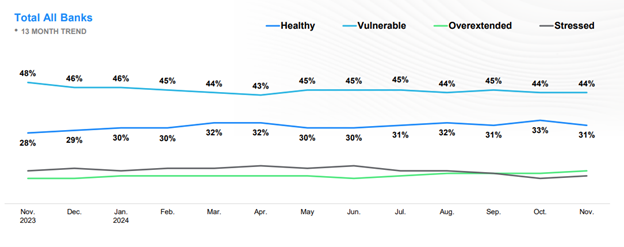
The number of customers who are financially healthy[1] decreased slightly in November to 31%, while 44% of bank customers fall into the vulnerable category. These levels have remained largely consistent for the bulk of 2024.
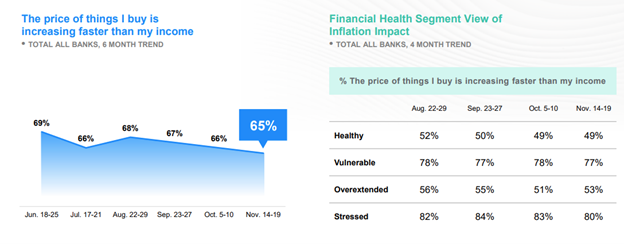
The number of bank customers who say the cost of goods is increasing faster than their income actually dropped slightly to 65%. Overextended customers saw a slight increase to 53%, while stressed customers dropped to 80% from 83%.
Bank Backup?
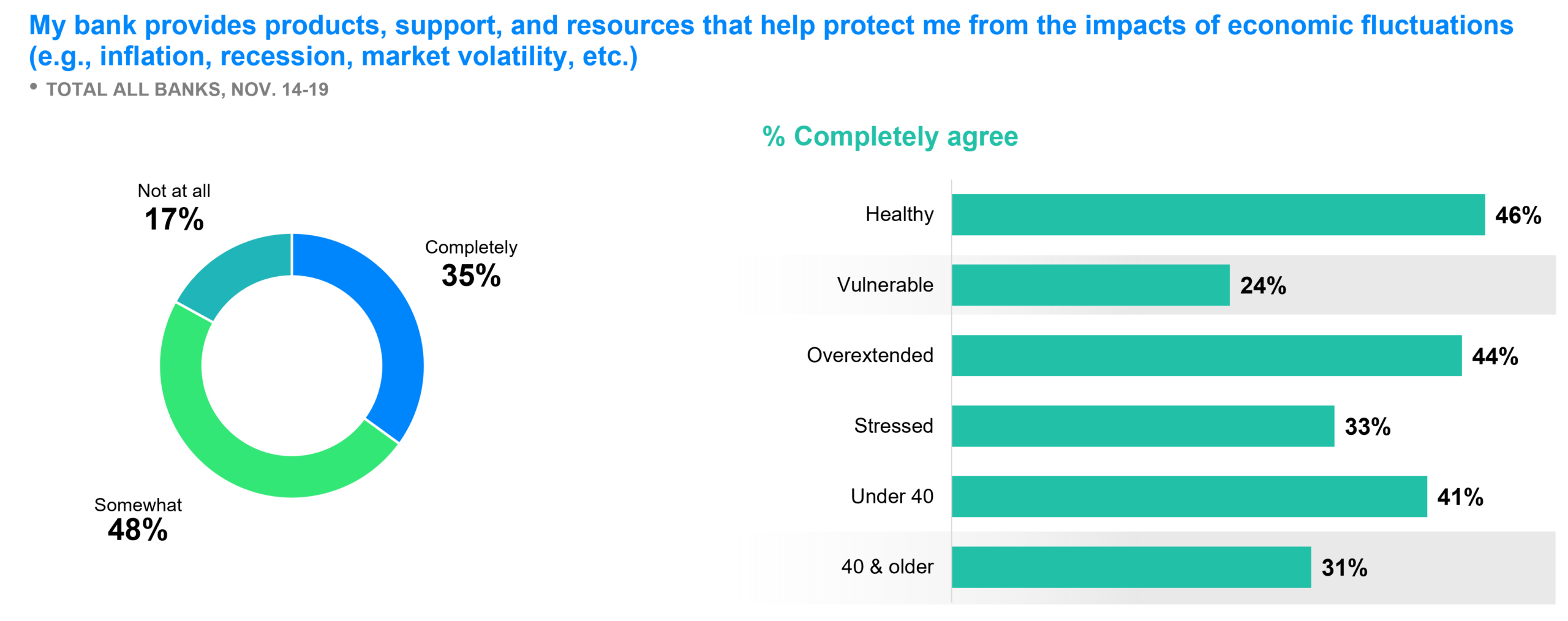
Amid this period of widespread economic uncertainty, it seems that many banks have struggled to instill confidence in their customers. Just 35% of customers say that their bank will completely help protect them against economic fluctuations, while 17% said banks will not protect them at all. Financially vulnerable customers and those over 40 years old were least likely to agree that banks would protect them.
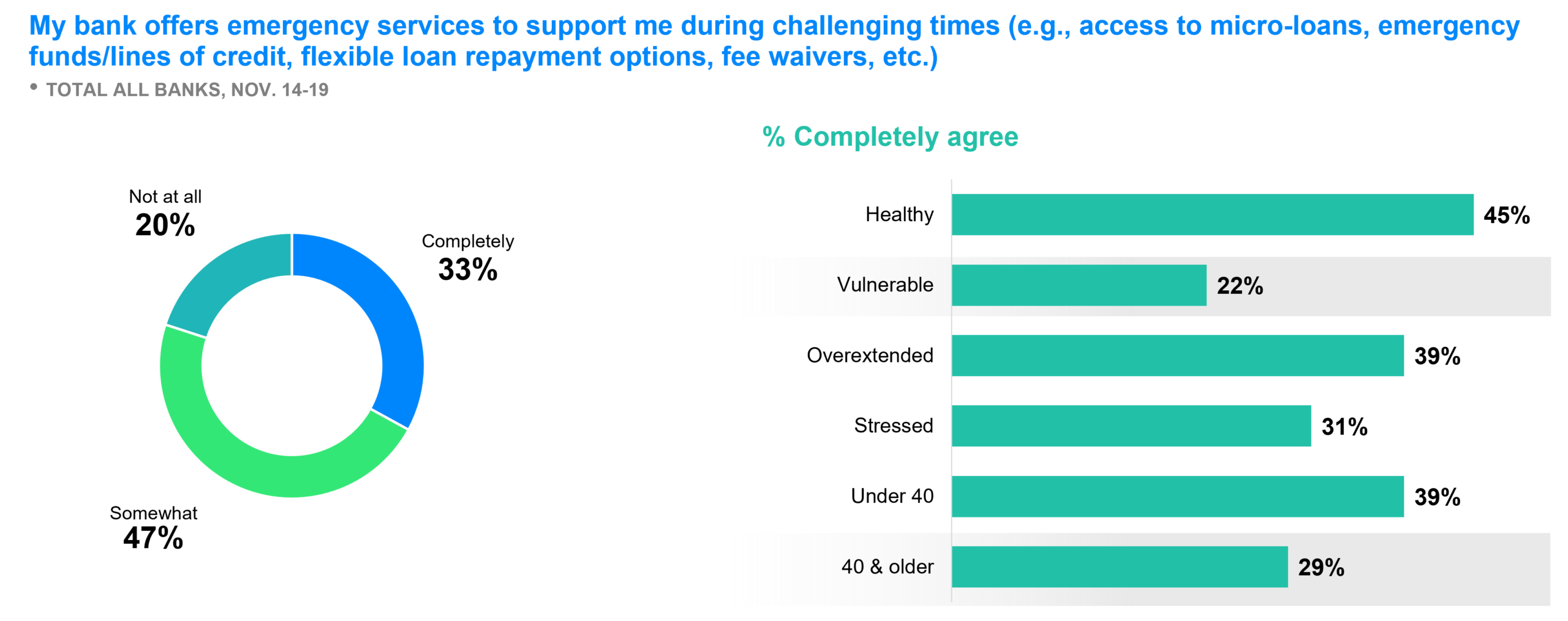
To address concerns like these, many banks and financial institutions have introduced emergency support services, such as payment assistance programs. However, only 33% of bank customers completely agree that their banks offer emergency support services, such as micro-loans, lines of credit and fee waivers, while 20% say their bank does not offer any help at all.
Customers are also dismissive of the notion that their banks empower them to meet life’s financial challenges. Just 31% completely agree that banks empower them, while 12% said not at all. More than half (57%) say somewhat, which implies there are customers in the middle that can be won over.

The Battle for Trust
If banks made an impression on customers during the era of 7% inflation, it certainly fails to resonate today. Many institutions built out huge awareness campaigns around emergency support services like fee waivers, but it’s clear that not all customers received the message. That means that banks need to go the extra mile now to win the hearts and minds they failed to on the first go-round.
No matter the economic conditions, customers’ financial health can ebb and flow throughout the year, and regardless of what the economic headlines say about topline inflation and economic recovery, many customers are still struggling with financial health. If banks can show the same kind of investment in helping customers out in an emergency before another tough stretch happens, it may resonate more than when customers are simply trying to keep their heads above water.
Find out More
This Banking and Payments Intelligence Report is based on responses from 4,000 retail bank customers nationwide and was fielded in November 2024. It was authored by Jennifer White, senior director of banking and payments intelligence at JD Power. Please contact us at the numbers below to connect with Ms. White or to learn more about the underlying research.
Media Contacts
Brian Jaklitsch; East Coast; 631-584-2200; [email protected]
Geno Effler, JD Power; West Coast; 714-621-6224; [email protected]
[1] JD Power measures the financial health of any consumer as a metric combining their spending/savings ratio, creditworthiness, and safety net items like insurance coverage. Consumers are placed on a continuum from healthy to vulnerable.