E-Vision Intelligence Report
June 2025
Key Findings
- Public Charging Concerns Remain Top Barriers to EV Adoption: Nationwide, 59% of vehicle shoppers say they are “very likely” or “somewhat likely” to consider purchasing an electric vehicle (EV)—a rate that is unchanged since 2024. Among the remaining 41% of shoppers who are unlikely to consider an EV, concerns related to public charging infrastructure continue to grow, while concerns about cost of ownership and reliability have begun to fade.
- Public Charging Reliability and Availability Increases Significantly: The percentage of public charging station visitors who were unable to charge their vehicles fell to 16% in the first quarter of 2025 from 20% in the fourth quarter of 2024, marking the largest quarterly improvement in charging station reliability. Customer satisfaction with the availability and speed of charging also improved in the first quarter of 2025.
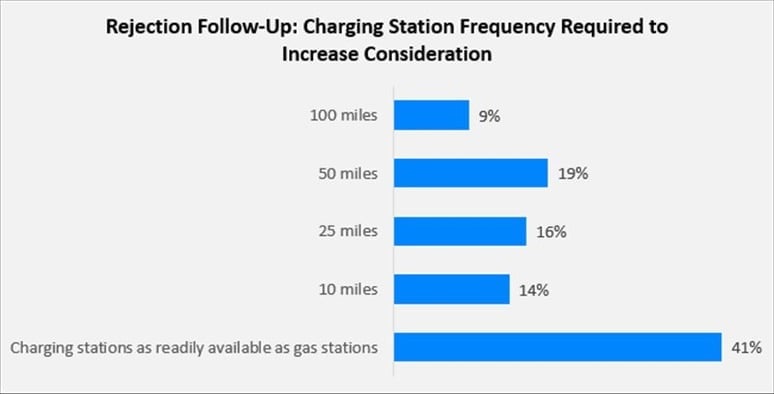
- Consumer Demand for Public Charging Availability Highlight Opportunities to Educate: Among EV rejectors who are unlikely to consider an EV based on public charging station availability, 44% said they would reconsider their decision if charging stations were available at least every 25 miles, which is the case in most populated areas of the U.S. today.
Executive Summary
The auto industry has some work to do to help consumers get over the stigma surrounding the U.S. public charging network if they want to sell more EVs. Even as public charging station availability and reliability continues to improve, and lingering consumer concerns about EV costs and reliability fade into the background, people who still reject the idea of owning an EV are largely motivated by fears that public charging infrastructure is just not where it needs to be. However, when these concerns are measured against real-world EV ranges and current patterns of EV charging, it becomes clear that the real stumbling block to wider EV adoption is consumer education.
This E-Vision Intelligence Report dives into key data points gathered from JD Power studies and pulse surveys, to offer a data-driven consumer perspective on the EV customer experience.
The Public Charging Stigma
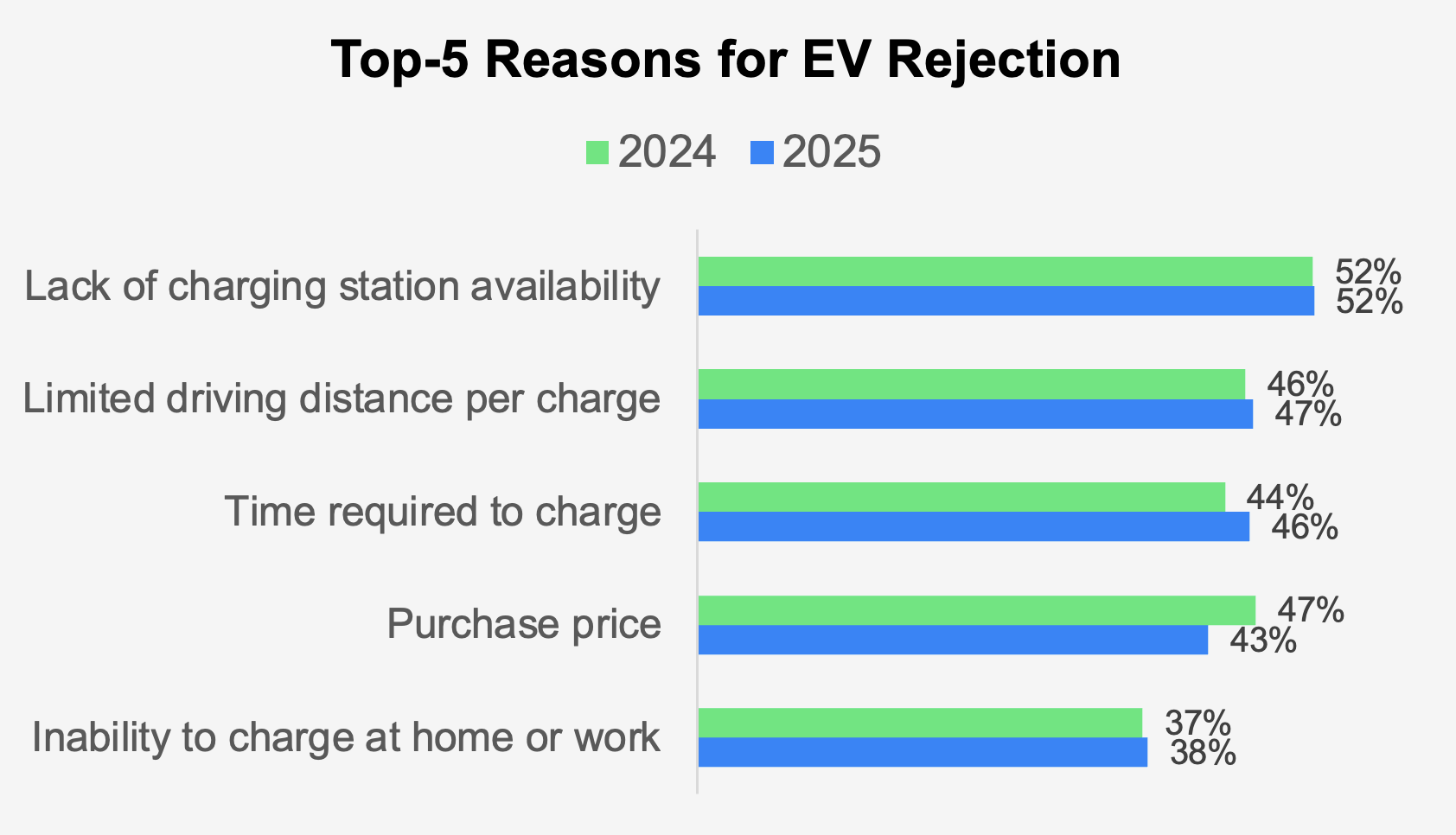
From the first moment EVs became widely available to consumers, two concerns have consistently surfaced as the top barriers to adoption: cost and range anxiety. Cost concerns seem to have reached an inflection point, with key criteria such as purchase price and total cost of ownership declining significantly as the top reasons for EV rejection. Concerns about public charging, however, continue to pose a problem.
Among the 41% of new-vehicle shoppers who say they are “very unlikely” or “somewhat unlikely” to consider an EV for their next purchase, lack of charging station availability, limited driving distance per charge and time required to charge continue to be top stumbling blocks.
Source: JD Power U.S. Electric Vehicle Consideration (EVC) StudySM
Infrastructure Improvements Not Enough to Offset Consumer Anxiety
Meanwhile, despite rising consumer concerns, public charging infrastructure has shown considerable improvement during the first three months of 2025 on a nationwide basis. Overall customer satisfaction with public DC Fast Charging increased 6 points (on a 1,000-point scale) in the first quarter of 2025, while satisfaction with Level 2 charging increased 8 points during the same period. This performance improvement was driven most notably by increased satisfaction with the availability of DC Fast Chargers and the speed of Level 2 charging.
EV drivers also experienced fewer issues using public chargers. The percentage of public charging station visitors who were unable to charge their vehicles declined to 16% in the first quarter of 2025, down from 20% in the fourth quarter of 2024. The improved public charging success rate has played out on a nationwide basis.

Source: JD Power U.S. Electric Vehicle Consideration (EVC) StudySM
Consumer Education is an Issue
The widespread—and growing—consumer concern about public charging exposes a disconnect between current perception among new-vehicle shoppers and the real-world experiences of EV owners. When asked about their reasons for not considering an EV for their next vehicle, 44% of EV rejectors said they would reconsider their decision if charging stations were available every 25-100 miles. Additionally, when asked about individual vehicle range, 66% of EV rejectors said they would need an EV to cover 500 or more miles on a single charge before they would consider purchasing one.
This public charging availability list and lofty range target exposes key aspects of the current consumer psyche that EV manufacturers and dealers will need to address if they want to win more customers. It also highlights some important opportunities to educate consumers on the evolution of the EV experience. In fact, there is currently a public charge point available every 41 miles across the country. Moreover, data from current EV owners shows that 81% of EV charging currently occurs on home chargers, and the majority (56%) of EV owners say their battery range “never” or “rarely” affects their driving habits. Despite those facts, EV rejectors are still not convinced they will not end up stranded on the side of the road.
Source: JD Power U.S. Electric Vehicle Consideration (EVC) StudySM
Consumer desire for 500 miles per charge may be more difficult for the industry to reconcile. The average real-world range cited by owners in the JD Power 2025 U.S. Electric Vehicle Experience (EVX) Ownership StudySM is 281 miles, and the average range for gasoline-powered vehicles is 403 miles.[1] While EV manufacturers continue to make gains in range with new battery formulations, the prospect of getting 500 miles per charge may not be a reality for several years.
Methodology
This JD Power E-Vision Intelligence Report is based on data and insights from the JD Power 2025 U.S. Electric Vehicle Experience (EVX) Ownership Study, the JD Power 2025 U.S. Electric Vehicle Experience (EVX) Public Charging Study and the JD Power 2025 U.S. Electric Vehicle Consideration (EVC) Study.
Find out More
This report was authored by Brent Gruber, executive director, electric vehicle practice. The JD Power E-Vision initiative is a company-wide program focused on maximizing JD Power industry-leading EV data, analytics, insights and solutions. Please contact us at the numbers below to connect with Mr. Gruber or to learn more about the underlying research.
Media Contacts
Shane Smith; East Coast; 424-903-3665; [email protected]
Geno Effler, JD Power; West Coast; 714-621-6224; [email protected]
[1] U.S. Department of Energy, https://www.energy.gov/eere/vehicles/articles/fotw-1221-january-17-2022-model-year-2021-all-electric-vehicles-had-median