Even as the national economic indicators seem to suggest a turning of the financial tide, the majority of bank customers in the United States remain worried that consumer prices will rise in the future.
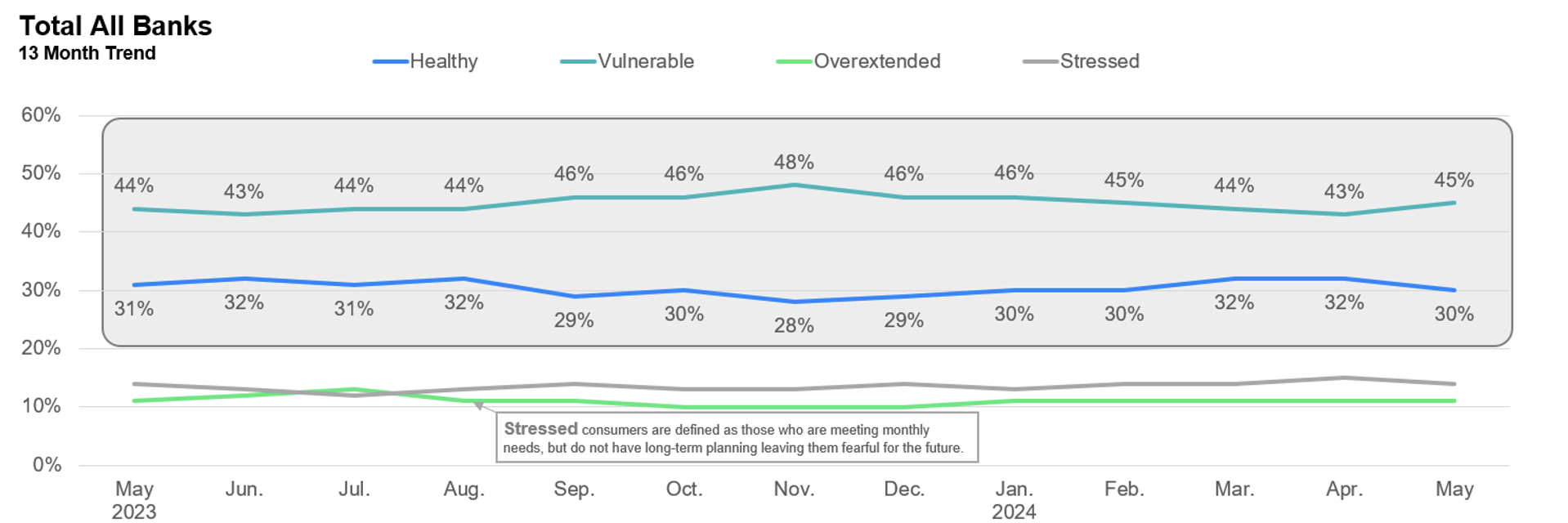
According to JD Power, the percentage of U.S. bank customers who are financially healthy[1] dropped slightly, leaving 70% of customers in some state of financial duress. What’s more, the specter of higher consumer prices seems to be looming, leaving many to wonder about their next move.
Accordingly, customers are counting every dollar out the door, and it’s put an increased demand on the budgeting and spending tools banks offer on their mobile apps and websites.
A Trend Reversal
After months of gradual improvement, the number of customers who are financially healthy dipped slightly to 30% in May 2024, while 45% fall into the vulnerable category.
The number of bank customers who say the cost of goods is increasing faster than their income decreased to 72%, but 88% are at least somewhat worried prices for goods they use every day will increase in the next three months.

Finding the Balance
With concern about high prices stubbornly persistent, customers are keeping a closer eye on their spending. Seven in 10 (72%) say that it is extremely important that their primary bank always shows an up-to-date available balance. Somewhat shockingly, 6% say that their bank’s mobile app or online banking website does not display their available balance, while 6% say they don’t know.

What’s more, 60% of customers say that their primary bank instantly updates their available balance when they make a transaction. Another 21% say it updates within a few hours, 7% say by the end of the day, while 8% say it takes the next business day. Interestingly, online-only banks do the best job of delivering up-to-date balances in a timely manner.

Customers are also increasingly open to financial aggregator tools, particularly as many have shifted funds to pursue higher yield accounts or get a loan from another institution. Three-fourths (75%) say it is useful that their bank shows the balances of their external accounts, rates that were notably high in customers under the age of 40 (88%) and among those in the overextended category (87%).

Controlling the Controllables
It is clear customers feel that some degree of their financial situation is out of their own control. They’re watching costs closely and trying to find ways to mitigate the effects of high prices with the tools at their disposal.
For banks, this means that they need to find a way to empower their customers to handle these ebbs and flows with confidence by bolstering the tools that they are working with in real time. Gone are the days where checkbooks were balanced by hand. Customers rely on the snapshot they get on their primary bank’s mobile app to be updated and comprehensive. Institutions that can do this will see fewer overdrafts and better budgeting management from their customers, which should in turn help customers seize more control over their financial health.
Find out More
This Banking and Payments Intelligence Report is based on responses from 4,000 retail bank customers nationwide and was fielded in May 2024. It was authored by Jennifer White, senior director of banking and payments intelligence at JD Power. Please contact us at the numbers below to connect with Ms. White or to learn more about the underlying research.
Media Contacts
Brian Jaklitsch; East Coast; 631-584-2200; [email protected]
Geno Effler, JD Power; West Coast; 714-621-6224; [email protected]
[1] JD Power measures the financial health of any consumer as a metric combining their spending/savings ratio, creditworthiness, and safety net items like insurance coverage. Consumers are placed on a continuum from healthy to vulnerable.