
The compact car segment might not be what it used to be, but it remains a popular choice for buyers who value efficiency, safety, and everyday practicality. In this important category, the Toyota Corolla and Honda Civic have established themselves as two of the most recognizable and closely matched models. Both cars have long histories, global reach, and strong reputations based on reliability and wide consumer appeal. Their ongoing rivalry remains one of the most enduring in the segment.
It is not surprising that the Corolla and Civic share many key similarities. Each offers sedan and hatchback styles, a range of traditional gasoline and hybrid engines, and a strong focus on safety features. Both are practical five-passenger vehicles designed to strike a balance between affordability and modern amenities, and they now span a broad price spectrum, from entry-level models to high-performance halo versions.
Where the two differ is more subtle. Toyota focuses on providing value across the Corolla lineup by offering competitive prices, good fuel economy, standard maintenance coverage, and a focus on long-term reliability. Honda, on the other hand, emphasizes variety and performance within the Civic family, offering higher-power engines, more cargo space, and enthusiast-oriented trims alongside its regular models.
This comparison examines how these differences sometimes play out across the attributes that both compact cars bring to the table. It is designed to let you explore all the factors to find the vehicle that is right for you.

2026 Toyota Corolla XSE
The 2026 Toyota Corolla lineup features sedan and hatchback models. The standard Corolla sedan comes in LE, SE, and XSE trim levels, with prices ranging from $24,420 for the LE to $30,135 for the XSE. The hybrid Corollas start at $26,270 for the LE and go up to $30,635 for the XLE. The Corolla hatchback costs from $25,875 for the SE to $28,870 for the XSE. Most Corollas are front-wheel drive (FWD), except for the LE and SE hybrids, which offer all-wheel drive (AWD) options. The GR Corolla—a high-performance model—begins at $41,415. All prices include the $1,295 destination charge.
Across the lineup, all 2026 Corollas come with standard ToyotaCare, which covers factory-recommended scheduled maintenance for two years or 25,000 miles, along with 24-hour roadside assistance for the same period. Each new Corolla includes trial access to Toyota connected services, such as Safety Connect (five years), Service Connect (five years), and Wi-Fi Connect (30 days/three gigabytes). Remote Connect is available with a one-year trial on select trims.
The 2026 Honda Civic lineup includes several distinct models spanning a wide price range. The Civic sedan is offered in LX and Sport trims, with a base price of $25,890. Hybrid variants in the sedan lineup start at $30,590 for the Sport Hybrid. Civic Hatchback prices begin at $29,090 and extend to $34,790 for the Sport Touring Hybrid. The performance-oriented Civic Si is priced at $32,690, while the Civic Type R tops the lineup at $48,090. All prices include the $1,195 destination charge.
For 2026, the Honda Civic comes with free 24-hour roadside assistance for the duration of its three-year/36,000-mile limited warranty. The Civic also qualifies for Honda Service Pass, which offers free factory-scheduled maintenance for one year or 12,000 miles, whichever comes first. For 2026, the Honda Civic features a tiered set of HondaLink connected services that differ by trim and body style. All 2026 Civic sedans and hatchbacks include HondaLink Basic, while Touring, Si, and Type R trims provide more comprehensive connectivity.
Advantage: Neither
Why? The Corolla and Civic are priced very competitively and provide similar features.

2026 Honda Civic Sedan Sport Touring Hybrid
The Toyota Corolla ranks highest in the Compact Car segment in the JD Power 2026 U.S. Vehicle Dependability Study (VDS), which assesses owner reported problems after three years of ownership.
The Corolla does not rank among the top three models in its segment in the JD Power 2025 U.S. Initial Quality Study (IQS), which tracks problems experienced by owners during the first 90 days.
The 2026 Toyota Corolla comes with a standard warranty of three years or 36,000 miles and a powertrain warranty of five years or 60,000 miles.
The Honda Civic ranks second in the Compact Car segment in the 2026 VDS, but it is not in the top three models in its segment according to the 2025 IQS. Its warranty coverage is identical to the Civic's.
Advantage: Toyota Corolla
Why? The Corolla outperforms the Civic in vehicle dependability, though only just.
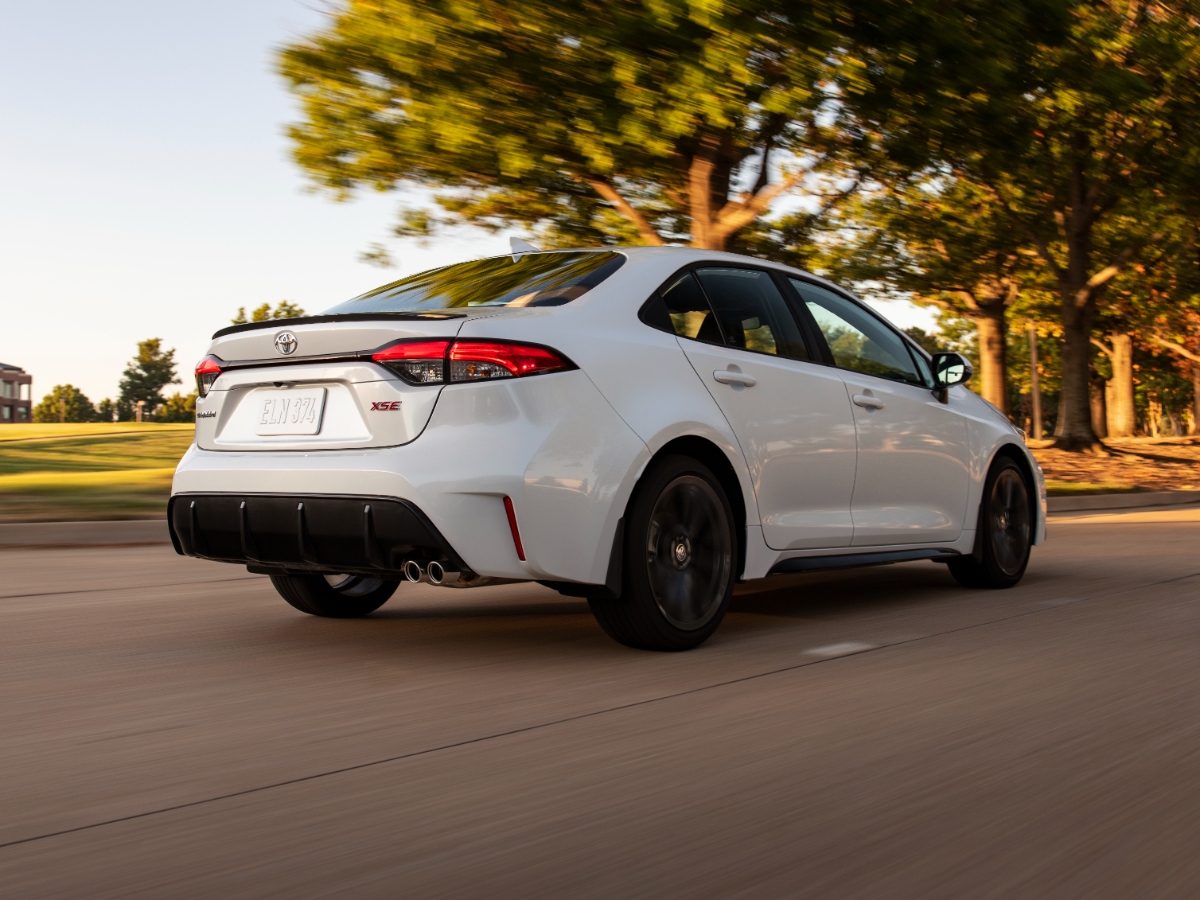
2026 Toyota Corolla XSE
Gas-powered 2026 Toyota Corolla sedans and hatchbacks feature a 2.0-liter four-cylinder engine that produces 169 horsepower, paired with a continuously variable automatic transmission (CVT). The hatchback also includes paddle shifters and a sport driving mode. The Corolla Hybrid uses a 1.8-liter engine paired with Toyota’s fifth-generation hybrid system, producing a combined 138 hp. The GR Corolla is in a different class, equipped with a 300-hp, turbocharged 1.6-liter three-cylinder engine and AWD.
The FWD Corolla Hybrid is the most fuel efficient in the lineup, with a 50 mpg combined estimate from the Environmental Protection Agency (EPA). Conventionally powered Corollas get around 35 mpg combined, while Toyota projects the GR Corolla will achieve about 24 mpg combined.
Except for the specialty GR, all Corollas seat five passengers, and most have a 60/40 split-folding rear seat. The Corolla sedan has a traditional trunk with 13.1 cubic feet of cargo space. The Corolla Hatchback emphasizes versatility, offering 17.8 cubic feet of cargo space behind the rear seats and up to 23.0 cubic feet with the rear seats folded.
The 2026 Honda Civic sedan and hatchback models offer either a 2.0-liter four-cylinder engine producing 158 hp or a turbocharged 1.5-liter four-cylinder engine producing 180 hp, both primarily paired with CVTs. Civic Hybrid models deliver a total system output of 200 hp. The Si uses a turbocharged 1.5-liter engine producing 200 hp, while the Type R employs a turbocharged 2.0-liter engine generating 315 hp. Both performance variants are equipped exclusively with six-speed manual transmissions.
You are probably not surprised to learn that Civic Hybrids are the top performers in fuel economy with a 49-mpg combined rating from the EPA. The base 2.0-liter Civics achieve up to 36 mpg combined, while the Civic hatchbacks have slightly lower fuel economy. The performance Si trim gets a 31-mpg combined rating, and the Type R an estimated 24 mpg.
The 2026 Civic Sedan features a traditional trunk with 14.8 cubic feet of cargo space. The Civic Hatchback provides 24.5 cubic feet of cargo space with the rear seats up and up to 46.2 cubic feet with the rear seats folded. Hybrid hatchback models also have somewhat less capacity. All hatchback models have a wide rear opening and a low floor, and higher trims include a power liftgate to enhance everyday cargo access.
Advantage: Honda Civic
Why? The Civic sedan and hatchback provide more cargo space than the equivalent Corollas.
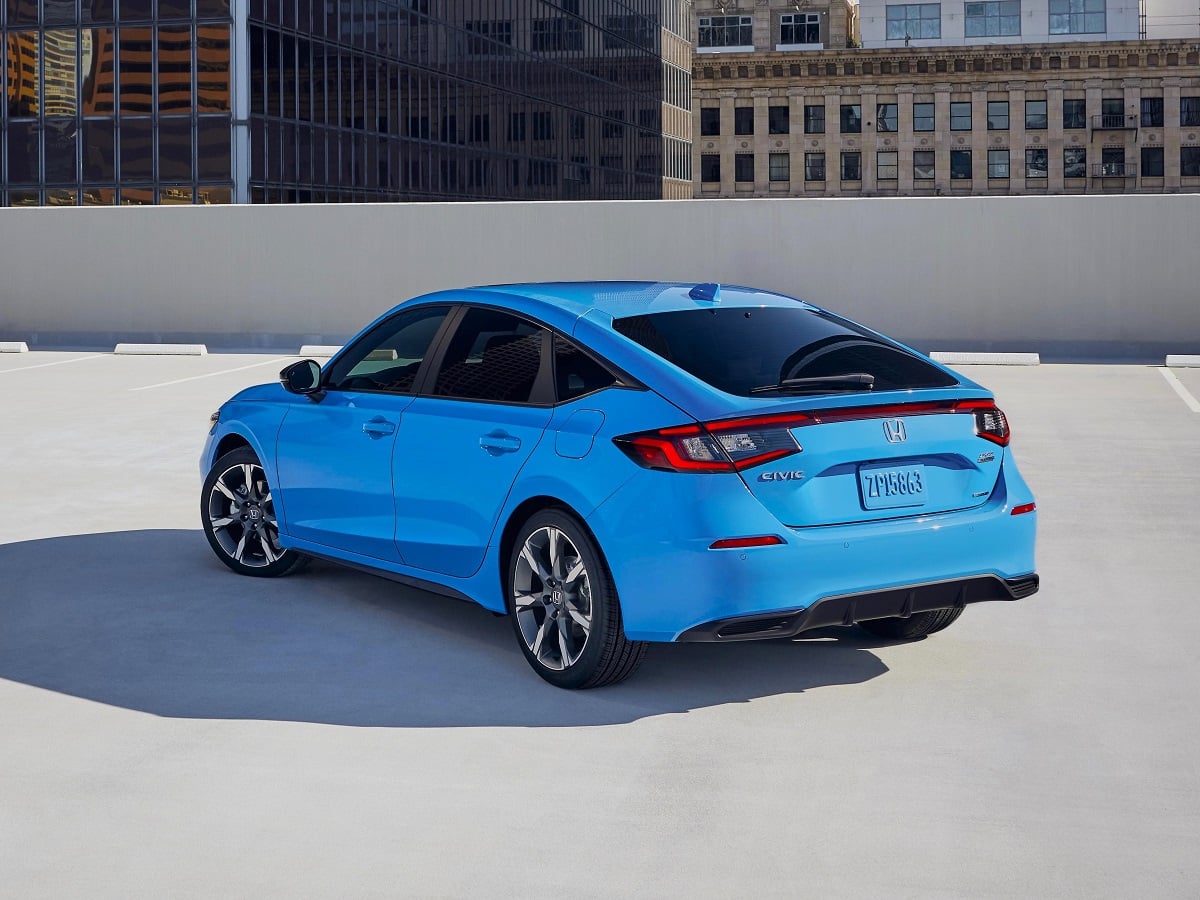
2026 Honda Civic Hatchback Sport Touring Hybrid
At this point, it is reasonable for any consumer to expect a brand new vehicle to include the following safety features:
So, how do the Corolla and Civic stack up? Let's take a look.
Every 2026 Corolla comes equipped with Toyota Safety Sense 3.0 (TSS 3.0) as standard. In addition to the previously listed systems, this package includes adaptive cruise control (ACC), traffic sign recognition, automatic high-beam headlights, and Proactive Driving Assist. Blind spot and rear cross-traffic warnings are also standard across the entire 2026 Corolla lineup.
The National Highway Traffic Safety Administration (NHTSA) gave the 2026 Corolla hatchback a maximum five-star overall safety rating, but has not yet rated any other Corolla variants. Meanwhile, the Insurance Institute for Highway Safety (IIHS) gave the 2026 Corolla a Good rating in the small-overlap front crash test. Still, it declined to name it a Top Safety Pick or a Top Safety Pick+ for the 2026 calendar year.
Every 2026 Honda Civic includes the Honda Sensing suite, which adds ACC with low speed follow and traffic sign recognition to the core systems. Blind spot and rear cross-traffic warnings come standard on most Sport trims and above, including all hybrid models, the Civic Si, and the Civic Type R, while they are optional or unavailable on base LX trims, depending on the body style. Front and rear parking sensors are standard on higher trims, such as Sport Touring Hybrid models and the Type R, and are available on other upper trims.
Except for the Type R variant, the NHTSA gave all 2026 Civic models a five-star overall safety rating. The IIHS named the 2026 Civic sedan a Top Safety Pick for the 2025 calendar year, and the 2026 Civic hatchback a Top Safety Pick for the 2026 calendar year.
Advantage: Honda Civic
Why? Although both models feature strong ADAS suites, the Civic holds better IIHS ratings.
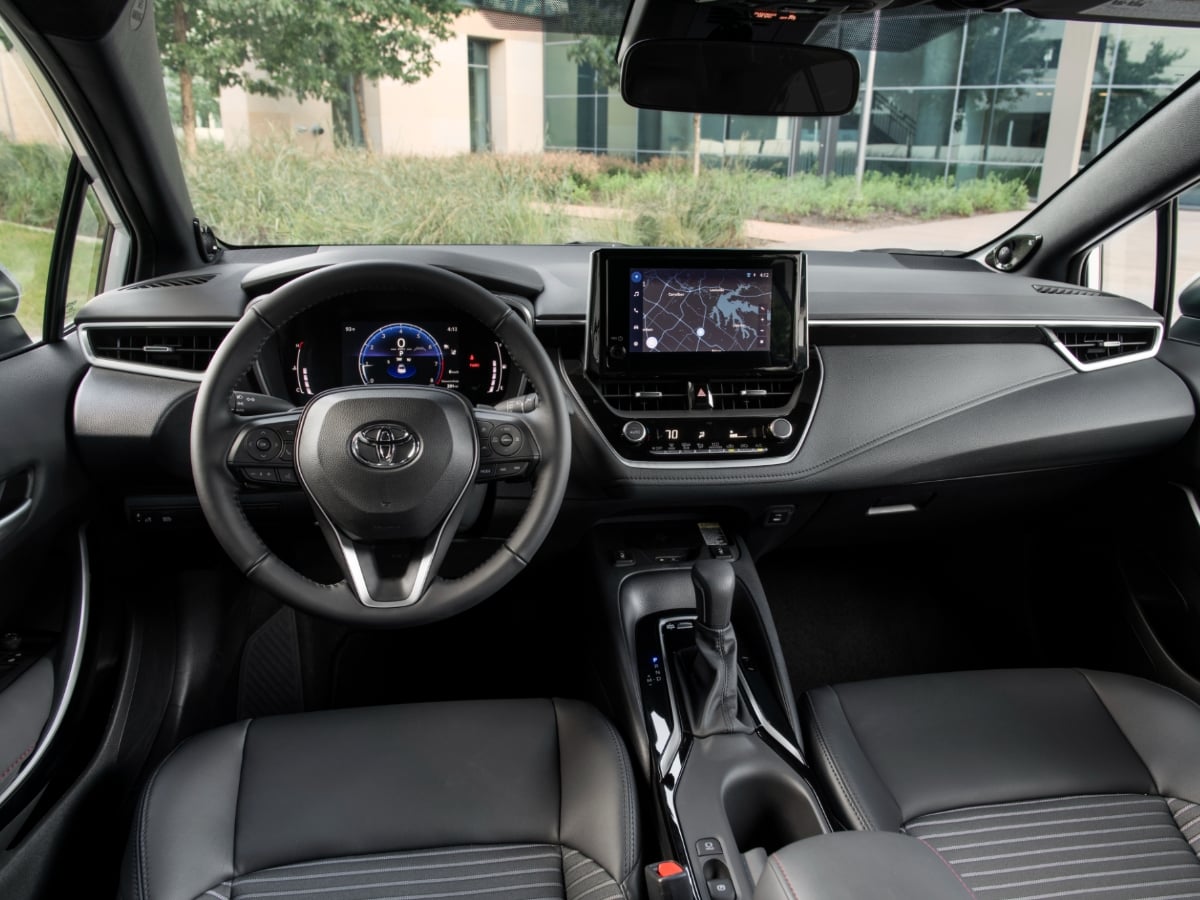
2026 Toyota Corolla XSE
The 2026 Corolla lineup features Toyota Audio Multimedia, with most trims equipped with an 8-inch touchscreen and some offering a larger 10.5-inch display. All support wireless Apple CarPlay and Android Auto smartphone mirroring, dual Bluetooth phone connectivity, HD Radio, and include a SiriusXM satellite radio trial subscription. With a Drive Connect subscription, drivers can use cloud-based navigation, receive over-the-air updates, and give voice commands through the “Hey, Toyota” assistant. Higher trims offer available JBL premium audio systems with extra speakers.
Under the Toyota Connected Services umbrella, the 2026 Corolla offers a range of connectivity features. Safety Connect provides emergency-focused options, including an SOS button, automatic collision alerts, and a stolen vehicle locator. Service Connect sends maintenance reminders. Remote Connect allows drivers to control their Corolla via a smartphone or smartwatch, with features such as door locking and unlocking. Wi-Fi Connect enables the vehicle to act as a Wi-Fi hotspot.
A technology that is uncommon in the compact car segment is Proactive Driving Assist, which comes standard on the 2026 Corolla as part of TSS 3.0. The system uses camera and radar data to provide gentle braking and steering support during everyday driving, such as keeping a safe distance from other vehicles and navigating curves.
The 2026 Civic’s infotainment features vary by body style and trim level. Most Civic sedans and hatchbacks come with a 7-inch touchscreen display, while higher trims and performance models upgrade to a 9-inch touchscreen. Apple CarPlay and Android Auto are supported, but lower trims require a wired connection. Some higher trims also include Google Built-in, enabling voice commands and cloud-based navigation. A Bose premium sound system with 12 speakers is available on certain trims.
For 2026, the Civic offers HondaLink services that vary based on trim and body style. All Civic sedan, hatchback, and performance models come with HondaLink Basic as standard. It provides vehicle status, maintenance reminders, recall alerts, and service scheduling at no charge. More advanced connected features, such as remote door lock and unlock, remote engine start, vehicle locator, and security alerts, are available on certain trims and usually include free trial periods. In-vehicle Wi-Fi hotspot capability is also offered.
Google Built-in is a unique feature available on select 2026 Honda Civics. Instead of relying on a paired smartphone, the system integrates familiar Google apps directly into the vehicle’s infotainment system, allowing for native voice control and navigation. Honda provides an unlimited three-year data plan to support these features, making the Civic one of the few compact cars to offer such a fully integrated infotainment experience.
Advantage: Toyota Corolla
Why? The fact that all Corollas support wireless Apple CarPlay and Android Auto outweighs the fact that the Civic features Google Built-in in some higher trims.

2026 Honda Civic Sedan Sport Touring Hybrid
The 2026 Toyota Corolla’s biggest strengths are value, efficiency, and long-term dependability. It offers a wide range of choices, including sedans, hatchbacks, hybrids, and high-performance GR versions, all at competitive prices. Standard ToyotaCare, which covers two years or 25,000 miles of scheduled maintenance and roadside assistance, enhances the value of ownership. The Corolla Hybrid provides excellent fuel efficiency, and all Corollas come with standard TSS 3.0, plus strong results in the 2026 Vehicle Dependability Study.
The Corolla’s main drawbacks are interior space and daily driving performance. Cargo capacity in both the sedan and hatchback is lower than that of the Civic, and interior volume is modest for its class. While standard ADAS are thorough, the Corolla does not earn top-tier IIHS safety awards for 2026. Aside from the expensive and rare GR Corolla, its performance remains conservative, with lower horsepower than similar Civic models, which limits its appeal to driving enthusiasts.
The 2026 Honda Civic stands out with its spacious interior, wider performance options, and enhanced safety features. It provides impressive cargo space in both sedan and hatchback versions, along with more powerful engines, including a high-output hybrid, a sporty Si, and the even hotter Type R. The Civic earns five-star overall NHTSA ratings across all variants. Features like Google Built-in and performance-oriented manual transmissions boost its appeal, while standard Honda Sensing offers a solid ADAS foundation.
The Civic’s weaknesses mainly involve value and price. Starting prices are higher than the Corolla’s, and top trims, especially the Type R, come with a big premium. Free maintenance is only for one year or 12,000 miles, which is less than what Toyota offers. Some advanced driver assistance and convenience features are only available on higher trims, and lower trims do not come with standard blind spot warning. While some Civics have advanced connectivity features, they are not available across the entire lineup.
Advantage: Honda Civic
Why? The Civic’s entry-level and mid-level trims are more fun to drive than the Corolla's, while also offering more space, which are key differences for me.
To learn more about these compact sedans, read our expert reviews of the 2025 Toyota Corolla and the 2026 Honda Civic. To see how consumers rate models in this segment, check out our ratings from verified vehicle owners.
Additionally, please note that while the information in this article was accurate and current as of March 30, 2026, it may have changed since then. Always verify product details and availability on the automaker’s website or with your local dealership.
Jack R. Nerad has reviewed cars, trucks, vans, and SUVs for over three decades. He also managed the editorial efforts of MotorTrend, JD Power, and Kelley Blue Book. Jack currently hosts the Sports Byline Network program “America on the Road,” available on Apple Podcasts, iHeart Radio, Spotify, Audacy, Amazon Music, and other platforms.


The Ford Transit is the automaker’s full-size cargo and passenger van offering, designed to serve a wide range of commercial and lifestyle applications. With 37 available configurations, the platform ...See More
Read the Full Article
The Chevrolet Tahoe is a full-size, three-row SUV with a standard V8 engine and available diesel power. Built on the same platform as the Chevrolet Silverado 1500 pickup, the Tahoe benefits from its ...See More
Read the Full Article
It is the end of the line for the Ford Escape. After 25 years as a fixture of Ford’s lineup, 2026 will be the compact SUV’s last model year.
Read the Full Article
The Colorado is Chevrolet’s midsize pickup. It ranks among the segment’s most capable trucks for payload and towing, and can be configured for both work and off-road adventures. For 2026, the ...See More
Read the Full Article