102 - 120
87 - 100
221 - 402
1 speed, Automatic
Electric
All Wheel Drive, Front Wheel Drive
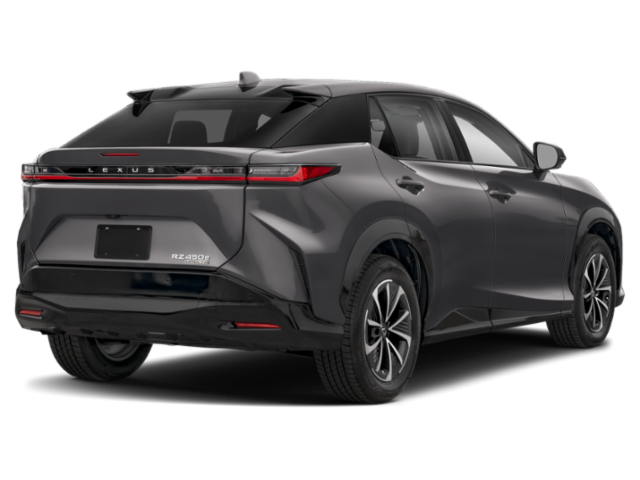
The biggest takeaway from the 2026 Lexus RZ is how fun it is to drive. It feels lighter and more agile than other electric vehicles (EVs) of its size, and its M Mode “gear” shifts and accompanying “engine” noises deliver the sort of character and engagement you will not find in most EVs. Unfortunately, most EVs offer far more range and better regenerative braking. The price is fair given those demerits, but its priorities seem out of whack.

Photo: James Riswick
The new-for-2026 550e becomes the RZ lineup’s most powerful, range-topping version, with exclusive access to the also new M Mode and F Sport styling elements. The same performance, range, and charging capability improvements are shared across the RZ lineup. Specifically, AC home charging increases from 7 kW to a more typical 11 kilowatts (kW), and a new, relocated charge port accepts the Tesla-style North American Charging Standard (NACS) plug. Additionally, the interior now offers unique animated ambient lighting.
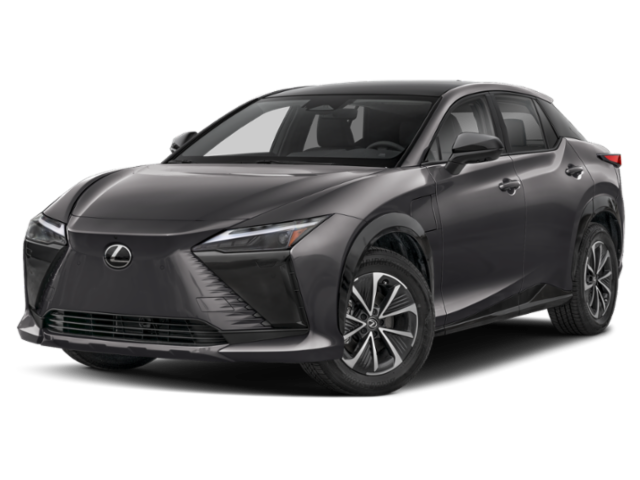
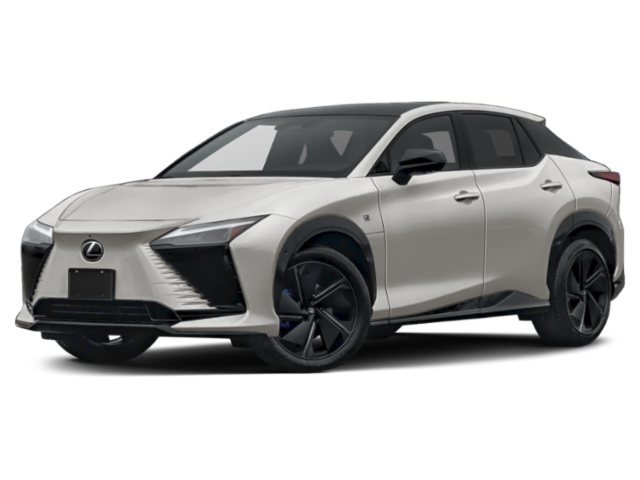
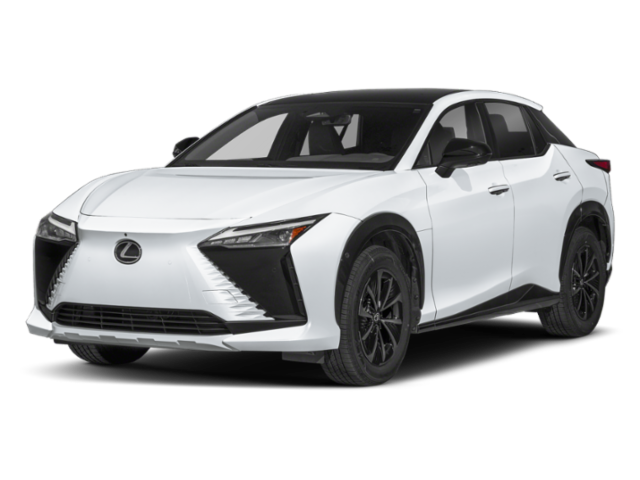
The 2026 Lexus RZ lineup consists of three model series with varying performance outputs: the rear-wheel-drive RZ 350e, the all-wheel-drive (AWD) RZ 450e, and the AWD, high performance RZ 550e. The 350e and 450e offer base and Premium trim levels, while the 450e adds the Luxury trim. The 550e is F Sport only. Prices range from $47,295 to $58,295, including the destination charge.
For this 2026 RZ review, Lexus provided an RZ 550e in F Sport trim equipped with the following options:
The test vehicle’s manufacturer suggested retail price (MSRP) was $62,184, including the $1,295 destination charge to ship the crossover SUV from the Toyota, Aichi, Japan, assembly plant to a local dealership. The price does not reflect any current rebates, incentives, or price adjustments since Lexus manufactured the test vehicle.
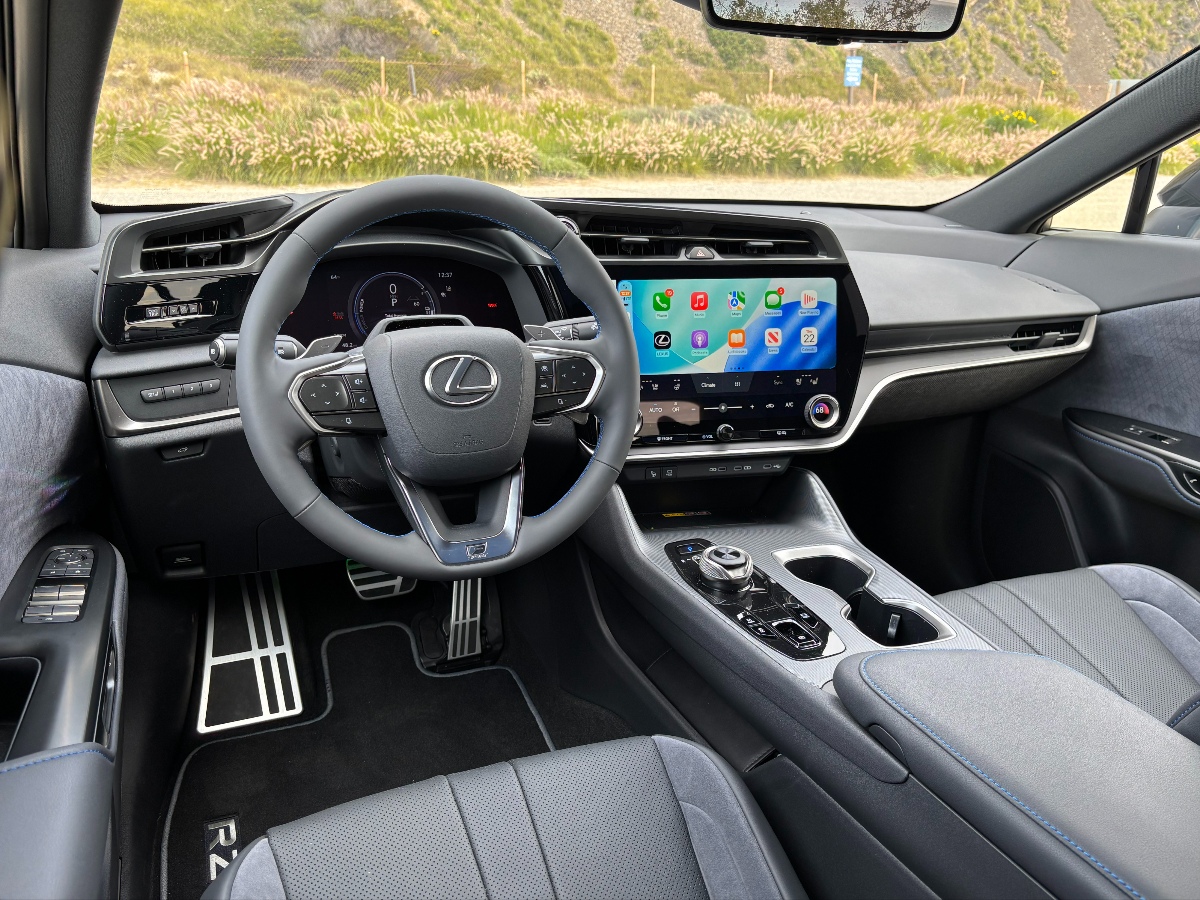
Photo: James Riswick
The RZ interior’s design, functionality, and quality are consistent with those of the NX and RX crossovers. It is not the most visually interesting cabin, especially when compared with the similarly priced Cadillac Optiq and Genesis GV60, but the materials and construction are impeccable.
There is also a very cool detail: the animated ambient lighting on the front doors after dark, resembling a bushel of long, pointed leaves that subtly rustle in a driver-selected color. It is unique, something more than just a multi-color glow, and thankfully not distracting.
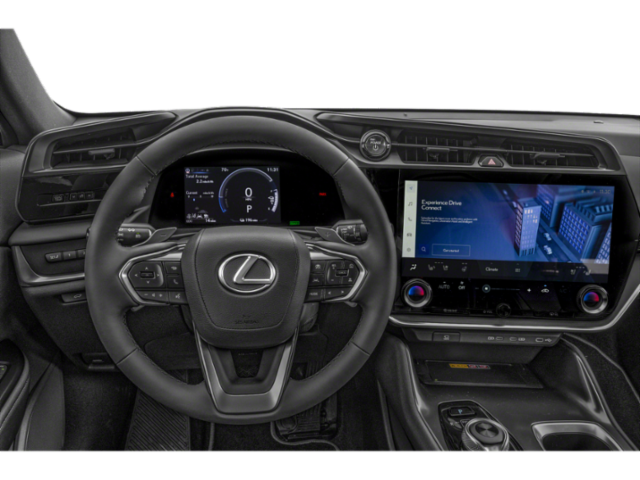
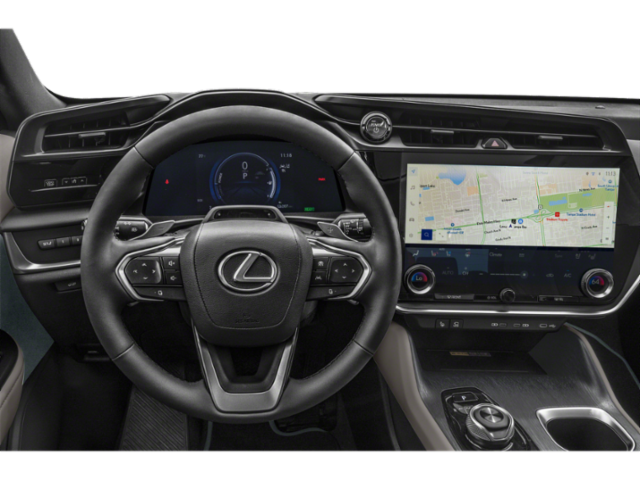
Interior controls are a mixed bag. The unmarked, multi-function steering wheel buttons rely on the instrument panel and head-up display (which washes out in polarized sunglasses) to show what you selected, making them a usability disaster. The climate controls have proper knobs, but everything else is virtual buttons permanently arranged in the lower third of the touchscreen. Aside from possibly cutting down on the manufacturing costs of buttons, how is that better?
That said, there are proper window, mirror, and steering wheel adjustment controls, which, thanks to Tesla, Volvo, and other EV makers, I must now commend.
Small item storage is disappointing. There is no glovebox, and the center console seems underutilized. The cupholders are a touch smaller than average. The door bottle holders are better. There is only a wireless smartphone charging pad and small bins under the armrest and the console. Storage in other EVs and in the Lexus RX is better.
The back seat offers plenty of headroom despite the panoramic sunroof, but the seat is notably lower than expected for a crossover. My son’s car seat was easy to install, and there was plenty of room for his legs without inconveniencing the front passenger.
Cargo space is very good. It measures 34.9 cubic feet behind the back seat, which is more than in the Optiq, GV60, Audi Q4 E-tron, and Volvo EX40. Furthermore, my real world testing showed that it has a considerable advantage over those and other non-luxury electric SUVs. It easily swallowed my standard collection of six suitcases, with room for more. The others did not.

Photo: James Riswick
The RZ’s Lexus Interface infotainment system relies on a 14-inch touchscreen, though about a third of its real estate is always devoted to the climate controls. As such, it is just OK and definitely not the show-stopping digital real estate provided by the Optiq and GV60. Similarly, the separate digital instrument panel and head-up display appearance and functionality are just average.
While the instrument panel and head-up display are difficult to use due to the aforementioned unmarked steering wheel buttons, the touchscreen is generally user friendly. The menu structure makes sense, it is easy to find what you are looking for, and the radio interface is standard. The voice controls are just average.
The system also includes wireless Apple CarPlay and Android Auto smartphone mirroring, SiriusXM satellite radio, connected services, five USB ports, a wireless smartphone charger, and a 10-speaker sound system. My test car had the optional 13-speaker Mark Levinson system, which is quite good. It also included digital key technology, which lets your phone act as the key fob.
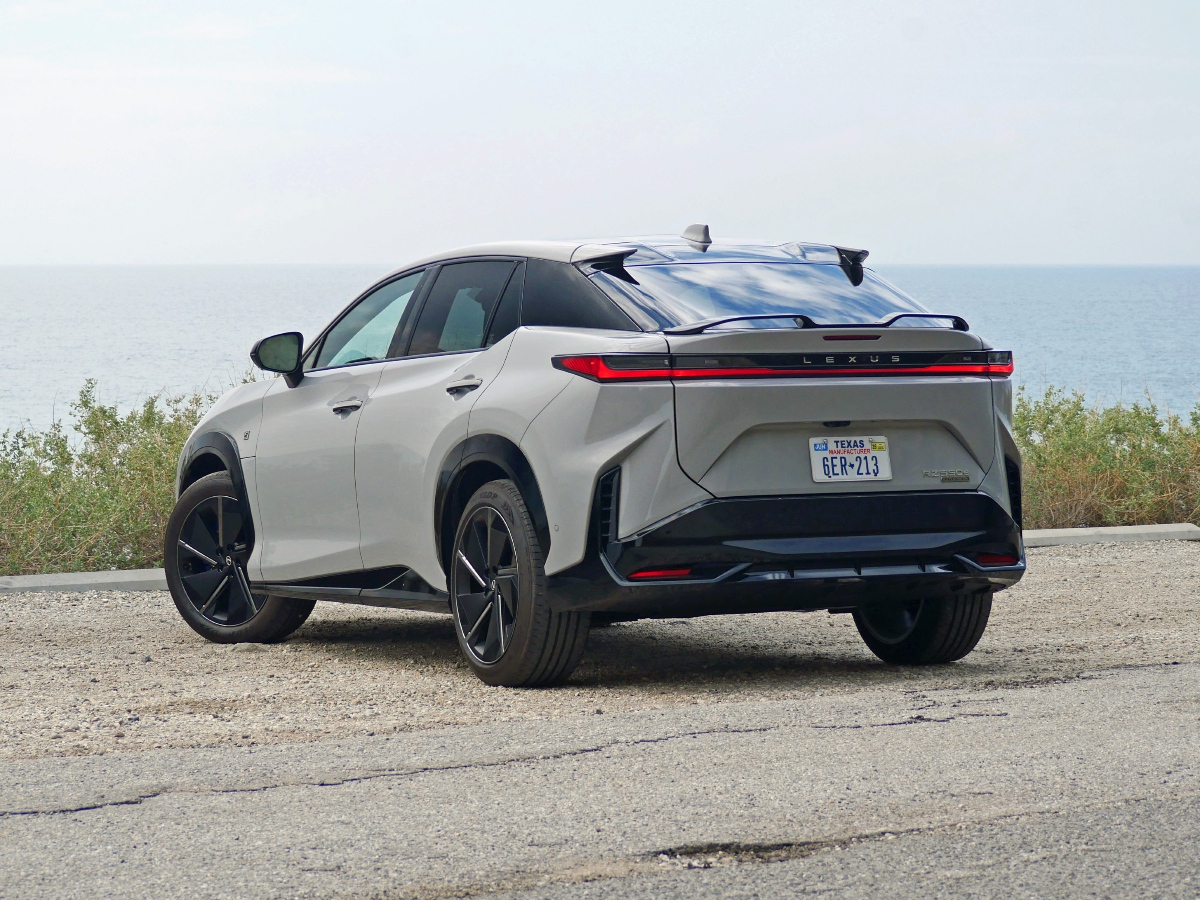
Photo: James Riswick
First, the bad news. While the base RZ 350e is estimated to travel 301 miles on a full charge with standard 18-inch wheels, it’s all downhill from there as motors, larger wheels, and extra performance are added. At the bottom of the pile is the RZ 550e, with an EPA-estimated 229 miles. My test car, however, showed only 218 miles on the gauge when the battery was full. A Cadillac Optiq, which I also charged to 100 percent using the same charger, showed 305 miles.
On my 75-mile mixed driving evaluation route, the RZ 550e averaged 3.3 miles per kilowatt hour (miles/kWh). That is better than the Environmental Protection Agency’s (EPA) efficiency estimate of 2.86 miles/kWh, so I would theoretically have exceeded the range estimates of both the EPA and the car’s curiously pessimistic trip computer. That said, the range is still likely to be lower than that of various luxury EV competitors.
At least the relocation of the charger input to the front right fender and the adoption of the Tesla-style NACS standard make it easier to recharge at Tesla Superchargers. Using other charging companies now requires a charge adapter, but that is a minor inconvenience.
It is important to note, though, that the RZ’s price reflects its limited range. The RZ 350e’s base price is far lower than those of the Optiq, GV60, Q4 E-tron, and Volvo EX40. The RZ 550e is also considerably cheaper than their priciest, high-powered versions. If you do not need a lot of range, perhaps because you have a second, gas-powered car, the RZ’s value proposition could make sense.
What you do get for the money, is a powerful and surprisingly fun electric car to drive. The RZ 550e’s pair of motors produces 402 total horsepower, and Lexus says it will accelerate from zero to 60 mph in 4.1 seconds. True, that is slower than the Optiq-V and GV60 Performance, but not by much, and it is still blazingly quick. Highway passing power is prodigious.
It also has M Mode, which lets the driver shift between eight simulated gear ratios. Paired with simulated motor noises, it makes the car sound and feel like it has a paddle-shifted transmission. Forget to downshift, and the car will bog. Forget to upshift, and you hit a rev limiter. While this fakery may seem contrived, much like the Hyundai Ioniq 5 N’s similar feature, it adds the sort of driver engagement and character that so many lament is missing in EVs.
That said, the Ioniq 5 N does it better. I often found myself in one “gear” higher than I would typically be with a manual transmission, and the ratios are too close together. You end up shifting way too frequently. The believability of the motor noises also depends on whether you are listening to the stereo. If the latter is on, the engine sounds appear real, as if coming from under the hood. If the audio system is off, the engine noise is way too loud and seems to be emanating from the ceiling.
The ride and handling are also exemplary. The RZ 550e feels low, light, and agile, especially compared with the competition. Perhaps that is not surprising, as it weighs hundreds of pounds less than the Optiq, Q4 E-tron, and GV60. Its “Direct4” AWD system also constantly adjusts the front and rear motor outputs to maximize cornering potential. It is more front-biased when turning a corner and can be as much as 100 percent rear-biased when powering out.
The steering is also very good, responsive on center, with real feel, and consistent weighting. Altogether, the RZ 550e is genuinely fun to drive, yet it is still as comfortable on the highway and around town as you might expect a Lexus to be.
Unfortunately, for those used to driving EVs, there is no one-pedal driving function. Even its heaviest regenerative braking setting, which annoyingly must be called up every time you start the car using the left paddle shifter, is far less than what you will find in most other EVs.

Photo: James Riswick
The RZ 550e comes standard with the Lexus Safety System+ 3.0, a suite of advanced driver assistance systems (ADAS). It includes an extensive number of features typical of EVs, which are:
In addition, the RZ includes blind spot warning, rear cross-traffic warning, a safe exit assistance system, and rear automatic braking. My test vehicle also had front cross-traffic warning and traffic jam assist, a hands-free highway driving assist system that works only at speeds up to 25 mph.
By contrast, the Optiq’s standard Super Cruise hands-free system works at full highway speeds. Otherwise, the RZ’s adaptive cruise and lane centering systems did a capable job of maintaining distance and steering around highway corners, albeit with a hand on the wheel. Unfortunately, like other Lexus test vehicles, it consistently ran one mph below my selected speed.
Also, as in other Lexus test vehicles, the driver monitoring system was so hyperactive that I shut it off, which defeats the purpose of such a system. You should be able to look at a pretty mountain on an open stretch of highway for a second or at the touchscreen while stopped in traffic without the car ding-ding-dinging you. Other ADAS in the RZ are thankfully not so persnickety, including the lane keeping assistance system.
According to the JD Power 2025 Initial Quality Study (IQS), the Acura RDX ranks highest in the Compact Premium SUV segment. The Lexus NX and the BMW X4 are the next highest-ranked models.
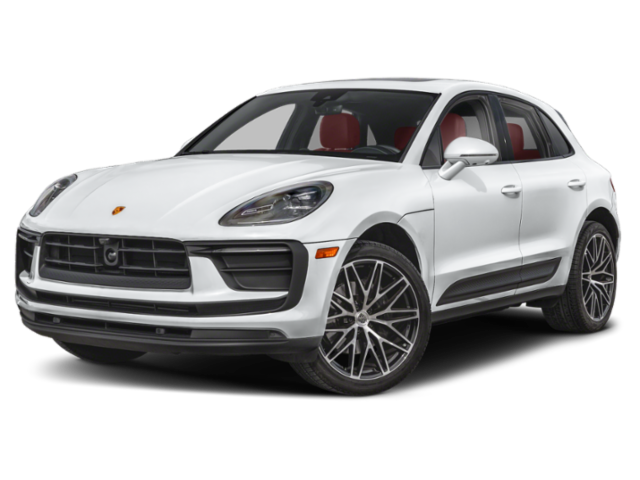
According to the JD Power 2025 Automotive Performance, Execution and Layout (APEAL) Study, the BMW X4 ranks highest in the Compact Premium SUV segment. The Porsche Macan and the Jaguar F-Pace are the next highest-ranked models.
According to the JD Power 2025 U.S. Electric Vehicle Experience (EVX) Ownership Study, the BMW iX ranks highest in the Premium Battery Electric Vehicles segment. The BMW i4 and the Rivian R1S are the next highest-ranked models.
Other 2026 RZ competitors include the Audi Q5, BMW X3, and Mercedes-Benz GLC.