
The 2026 Volvo EX30 Cross Country should be an incredibly likeable small electric SUV. It is a joy to drive, the stylish cabin is beautifully finished, and the rugged(ish) Cross Country trappings added to the EX30 sacrifice only a modest 26 miles of range. The price also seems reasonable. Unfortunately, the interior is plagued by so many poor functionalities and cost cutting choices that it torpedoes this otherwise likeable car’s overall appeal and value.

Photo: James Riswick
Like Volvo’s past Cross Country variants, the new EX30 version features standard all-wheel drive (AWD), dark fender cladding, and a modest ride height lift, rising to 7.5 inches from 6.7. It also includes skid plates, a band of dark trim across the liftgate, and a unique matte-black “grille” area etched with a topographic map of Sweden’s Kebnekaise mountain range. The interior is unchanged, except for two fewer color/upholstery choices.
Across the entire EX30 lineup, the rear-wheel drive Single Motor standard model and the AWD Twin Motor Performance are available in Plus and Ultra trim levels. The Cross Country shares the Twin Motor’s powertrain and is available only as an Ultra. Base prices range from $40,345 to the Cross Country’s $49,545, including the destination charge.
For this 2026 EX30 review, Volvo provided a Cross Country test vehicle paired with the only available trim level: the Ultra. The small crossover’s only option was the accessory combo of all-terrain tires and 18-inch wheels, for which pricing was not available at the time of writing. As such, it is unclear how much the accessory combo would have added to the Cross Country’s base price of $49,545. That price includes the $1,295 destination charge.
Volvo builds the EX30 Cross Country in Ghent, Belgium.
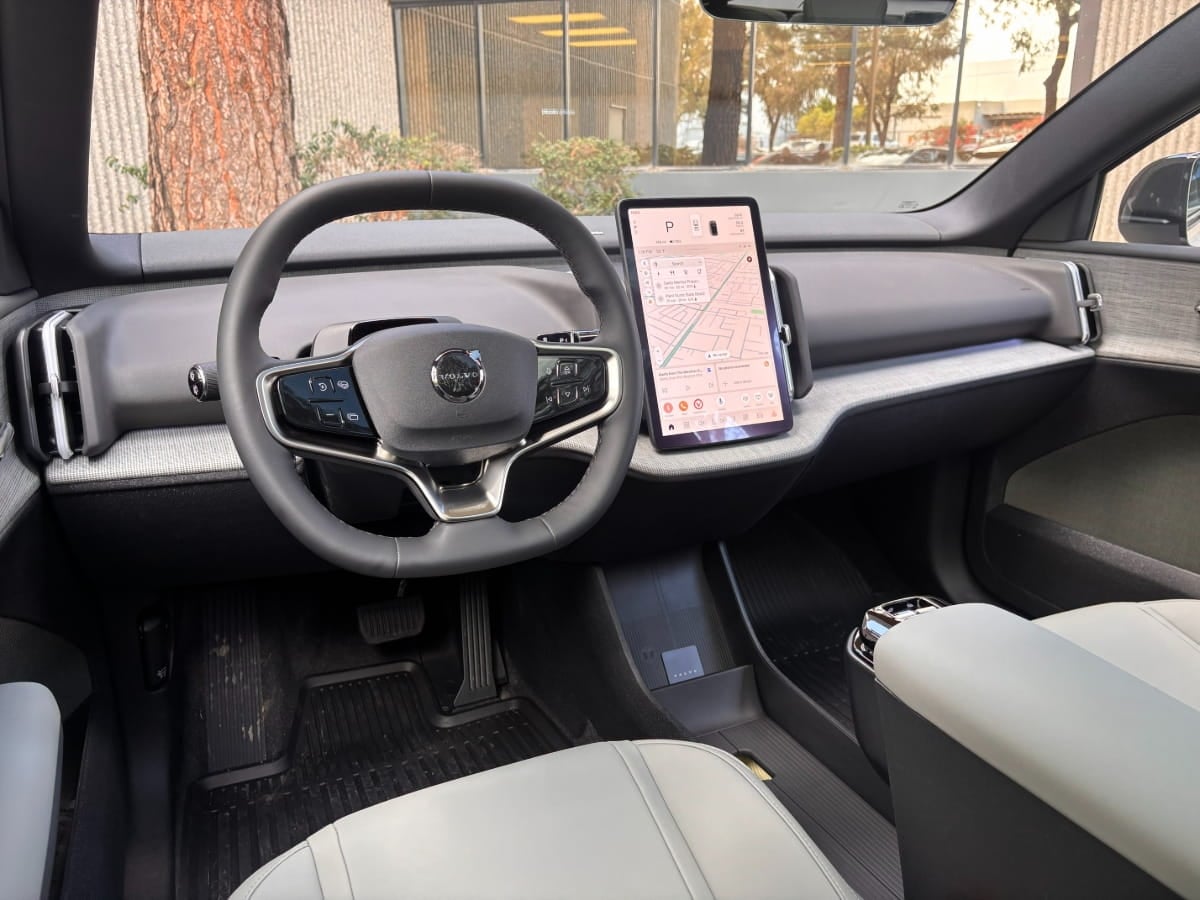
Photo: James Riswick
The EX30 Cross Country’s black roof and copious black exterior trim could be considered a cliché, but the topographical “grille” etching is an interesting, unique detail. I think the Cross Country looks cooler than other EX30s.
The interior is essentially identical, which, from an aesthetic and tactile standpoint, is excellent. The unique upholstery blend of “Nordico” simulated leather, paired with blue textile or green wool blend fabric, is stylish and feels expensive. The distinctive air vents and metal door pulls are similarly top-notch.
Now comes the enormous pile of bad news: Volvo stripped the cabin of many controls in favor of the touchscreen and multi-function wheel buttons, butchering functionality.
The unmarked, multi-function button on the steering wheel’s right spoke defaults to volume control, but it often does not respond. The alternative is to press an icon at the bottom of the touchscreen, wait for a volume display to pop up, and then tap the + or – buttons that eventually appear on screen. That unmarked, multi-function button is also used to adjust the mirrors once you click-click-click the touchscreen to call up that particular function.
The climate controls are minimized to the bottom of the screen and require you to first press buttons to open pop-ups for temperature and fan adjustment, or for settings such as air recirculation. This contrasts with pressing a button on the dashboard. Adjusting the driver's seat is done with a single square control with a button in the center that cycles through adjustments, which are shown on the touchscreen.
You want to lower the back windows from the driver's seat? You first need to press the “REAR” button next to the two window switches, located just ahead of the center armrest. Shockingly, the windshield wipers are activated by the usual turn signal switch, but the controls are unmarked. You must look at the touchscreen to see which setting you engaged.
Maybe some of this stuff, like the mirror controls, would be used once and rarely again. Perhaps you would even get used to all of it, but that does not make it a good user interface.
Thankfully, Volvo has not forgotten how to make incredibly comfortable and supportive seats with more than enough adjustment for tall drivers. That said, there was virtually no legroom behind me. This is a small car, though. Its compact size benefits the acceleration, handling, and maneuverability. As such, a cramped back seat is more of a trade-off than an outright negative. With average height folks up front, even I would be happy enough to ride in the back seat.
The cargo area is also on the small side, however, there is far more space than the minuscule 11.2-cubic-foot cargo volume spec would suggest. That is less than a Mini Cooper 4-door, and judging by the pictures, there is no way the EX30 has less than that. I suspect this discrepancy is due to Volvo publishing a measurement that differs from the industry norm.
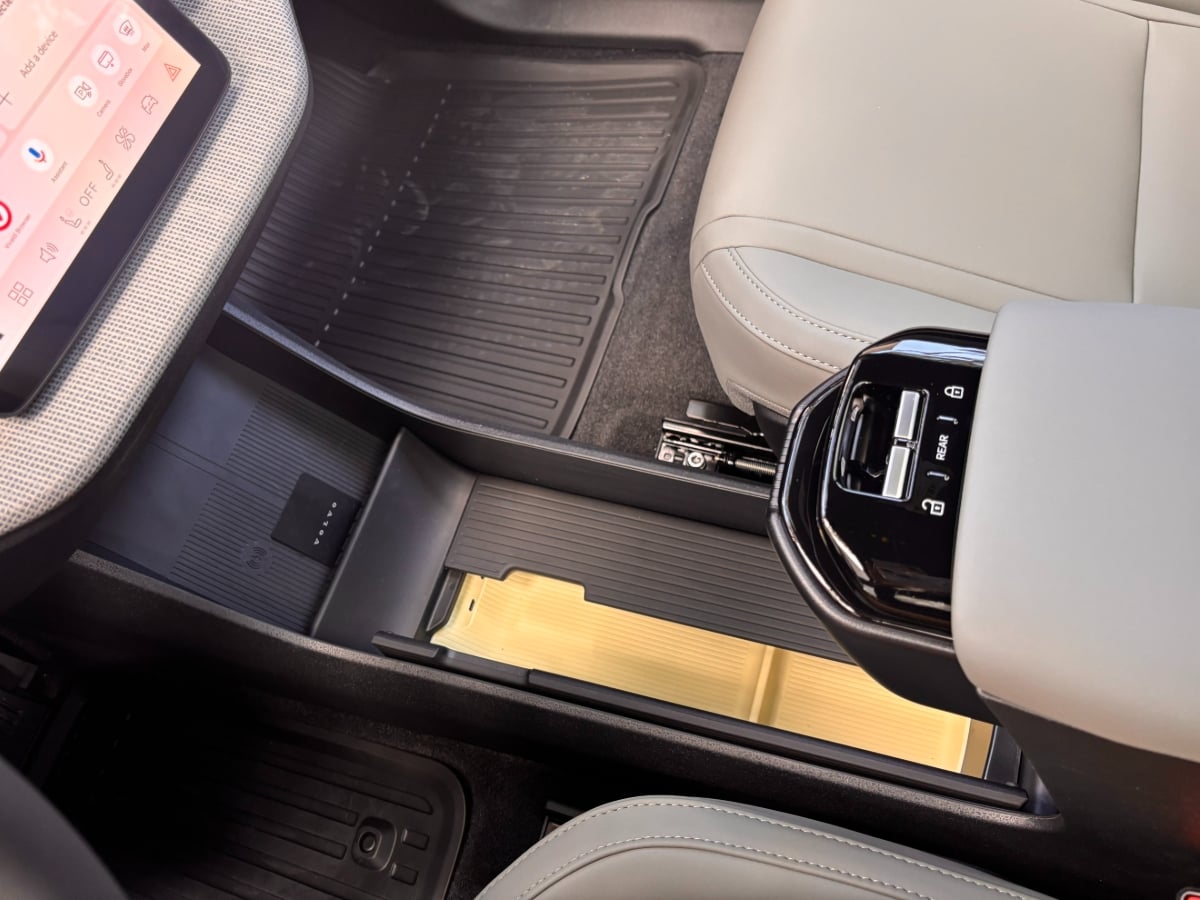
Photo: James Riswick
There is, however, absolutely no excuse for the poor interior storage. There are only two cupholders, period, which slide out of the center console. They are shallow and not very grippy. A metal water bottle that is usually secure in most cupholders was flopping around, and there are no bottle holders in the doors. My phone was also flopping around on the upright wireless charging pad, which lacks bumpers to keep it in place. It is like the pad was intended for a tablet.
There is also no bin under the armrest. Instead, there is a double-deck gutter of sorts between the seats, with bomb-bay-like doors between levels. Neither is grippy, so whatever you put in there will slide around. The glovebox, meanwhile, drops down from under the dashboard like an old ashtray. It can hold the owner’s manual and maybe a pair of glasses cases.
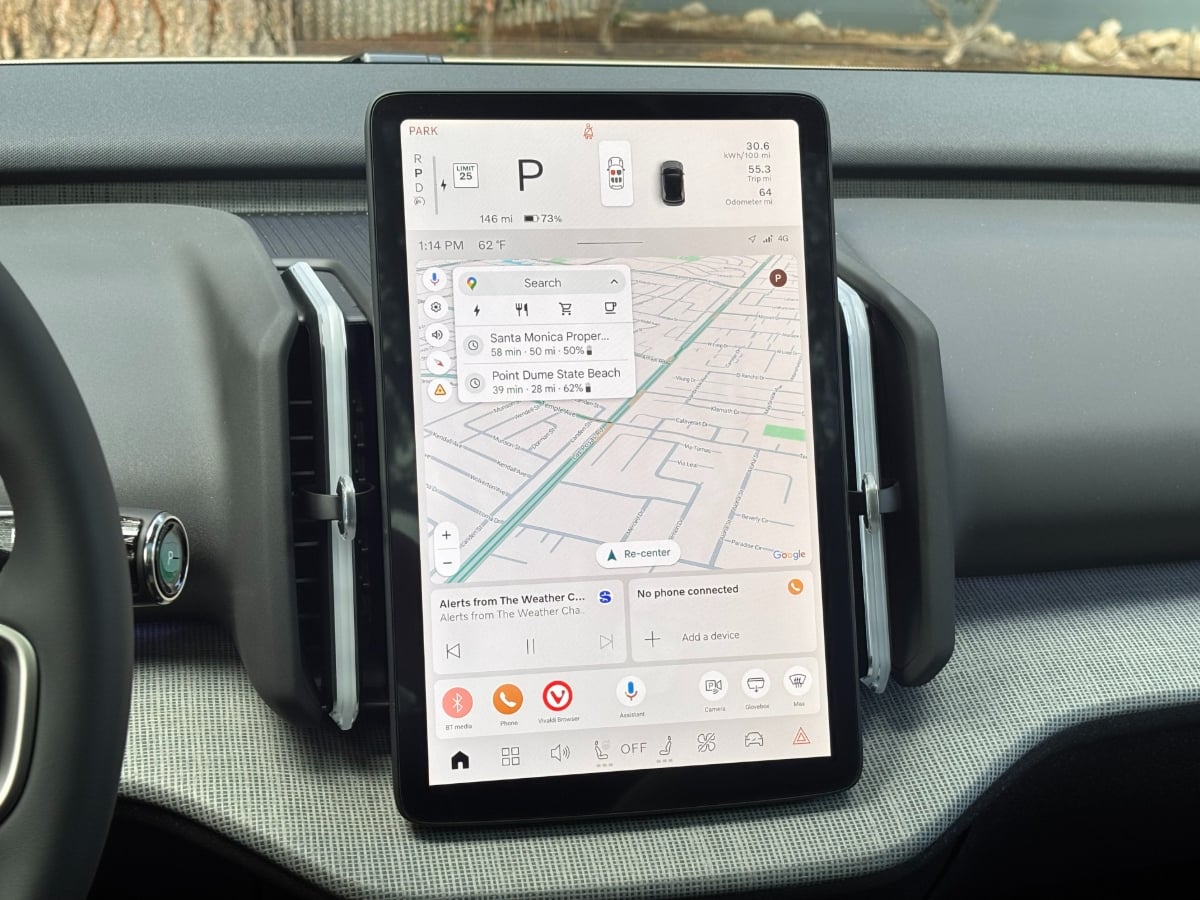
Photo: James Riswick
While Volvo may nickel-and-dime you for window switches, even the $40,000 base model comes with all the tech features shown below:
The touchscreen measures 12.3 inches, which sounds big, but the portrait orientation makes it seem quite small. So does the extra stuff usually found on separate instrument and climate control panels.
However, the infotainment areas are well-executed, easy to use, and feature the familiar Google Built-in functionality (integrated Google Maps, Google Assistant voice controls, and the Google Play Store). I very much like the three-tile Home screen option that can simultaneously display navigation, audio, and trip meter.
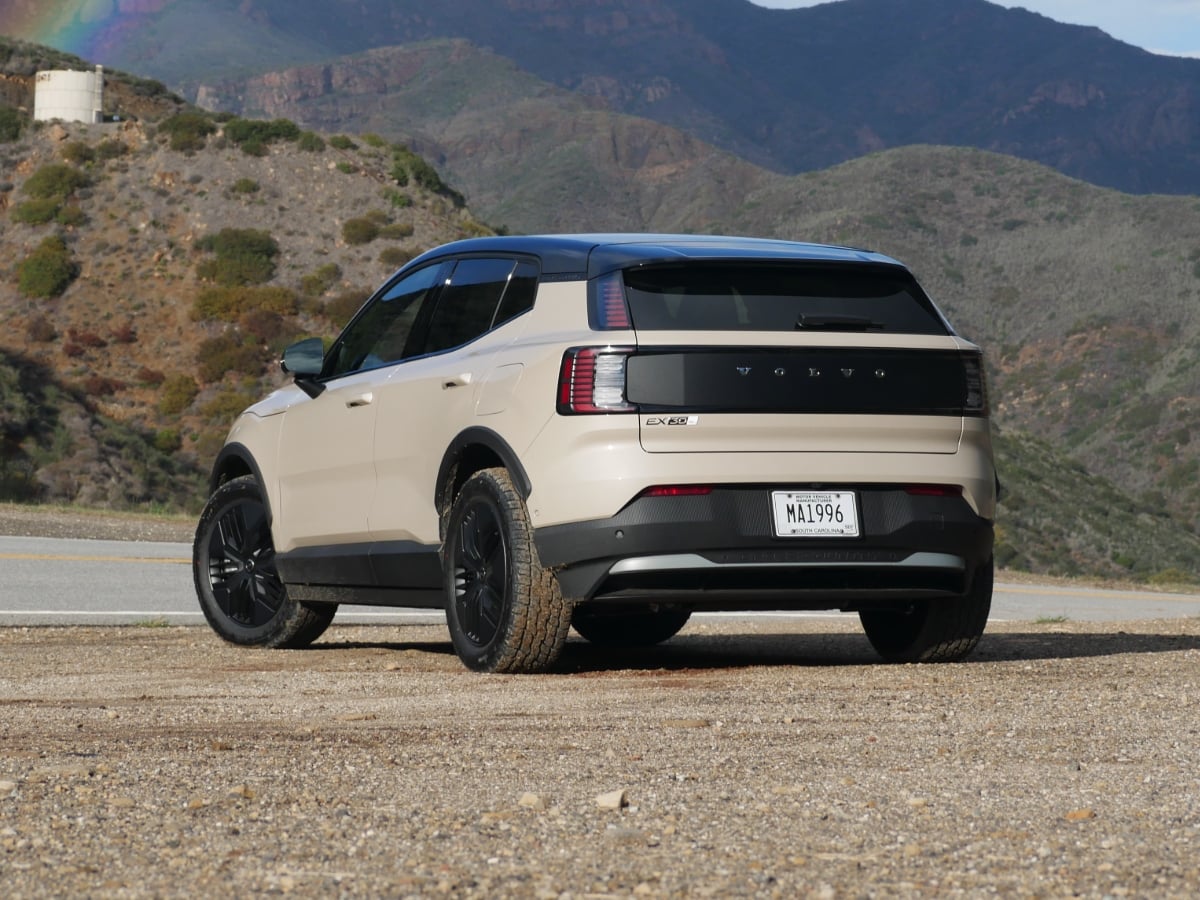
Photo: James Riswick
As grim as the interior section above was, this one will be mostly positive. Mostly. The EX30’s range is not great, and it can drop to “poor” when outfitted with the accessory all-terrain tire option on my test vehicle. An EPA-estimated 203 miles just is not competitive, and neither is the Cross Country’s standard 227-mile estimate. The standard EX30s are adequate: 253 miles for the Twin Motor Performance and 261 for the Single Motor.
Despite being in the EX30’s worst case range scenario, I theoretically did better than the EPA would suggest. I averaged 32.1 kilowatt-hours per 100 miles on an altered, 80-mile version of my typical evaluation route that includes interstate, rural highway, mountain road, and suburban driving. That efficiency would have put my range closer to the standard Twin Motor’s EPA estimate.
OK, now onto the good stuff. The EX30 Cross Country’s pair of motors, one for each axle, produces a total of 422 horsepower and 400 pound-feet of torque. That is a lot, and it is tasked with motivating only 4,156 pounds, which is lightweight for an electric vehicle. Volvo says it should go from zero-to-60 mph in 3.5 seconds, which is just bonkers. That effectively matches the Porsche Macan Electric GTS, which carries a sticker price of just over $100,000.
The EX30 feels stupendously quick. That said, it seems like overkill. Personally, I would happily trade a lot of that performance for more range, an instrument panel, and a few extra interior buttons.
I would do absolutely nothing about the handling, though, which is excellent. The EX30 Cross Country feels like a small, nimble car rather than an electric SUV burdened by excessive battery weight. I suspect the quick, responsive steering would provide more feedback without all-terrain tires, which is yet another reason to leave that option box unchecked. Even if I did not detect an obvious impact on ride or road noise, both of which were quite good, I cannot imagine many owners going places that would really require all-terrain tires.
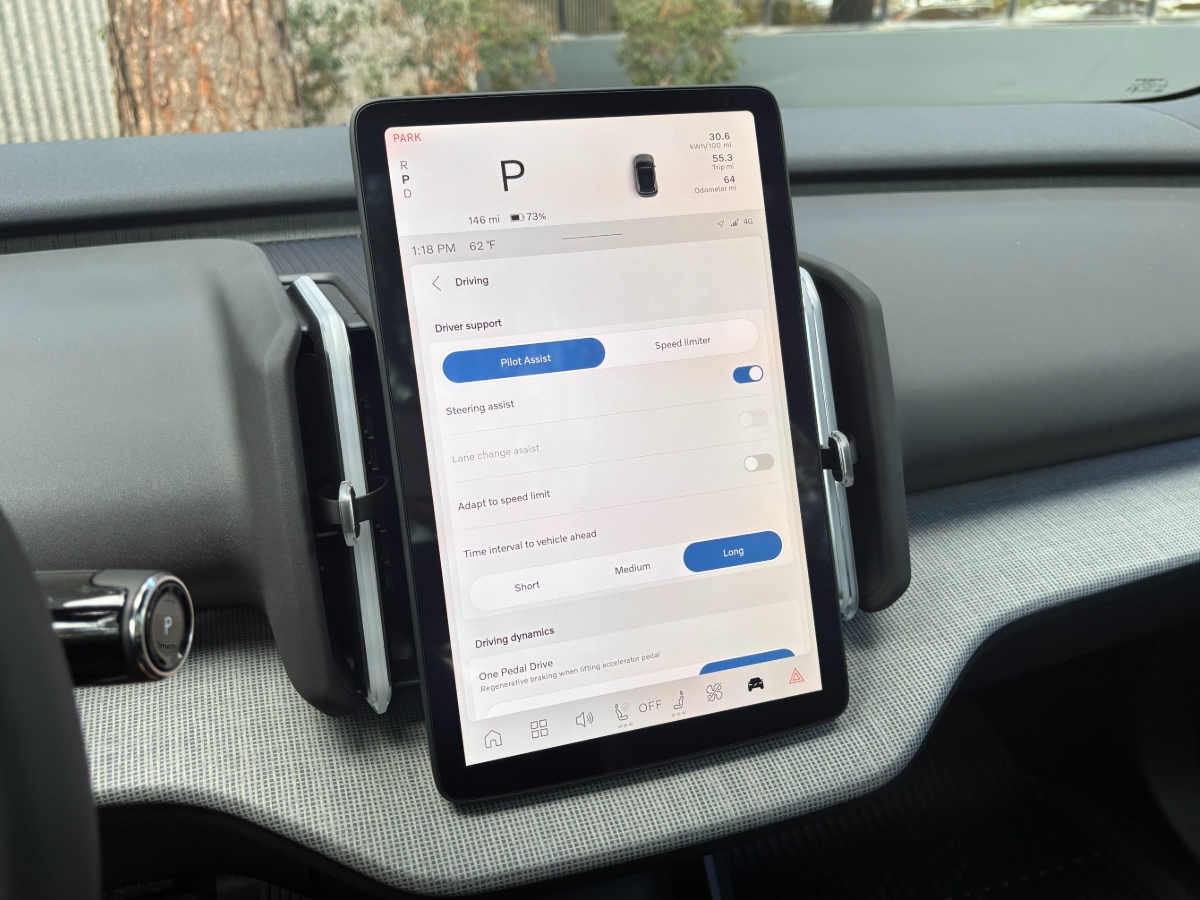
Photo: James Riswick
The EX30 Cross Country goes far beyond the usual safety technologies. Everything below is standard:
This is a lot of features, and although I could not test them all, I can say they did not annoy me with false alarms or hyperactive warnings, with one exception. The adaptive cruise control system is also very well executed, including its lane centering system that basically did the steering for me on the highway as long as I kept a token hand on the wheel.
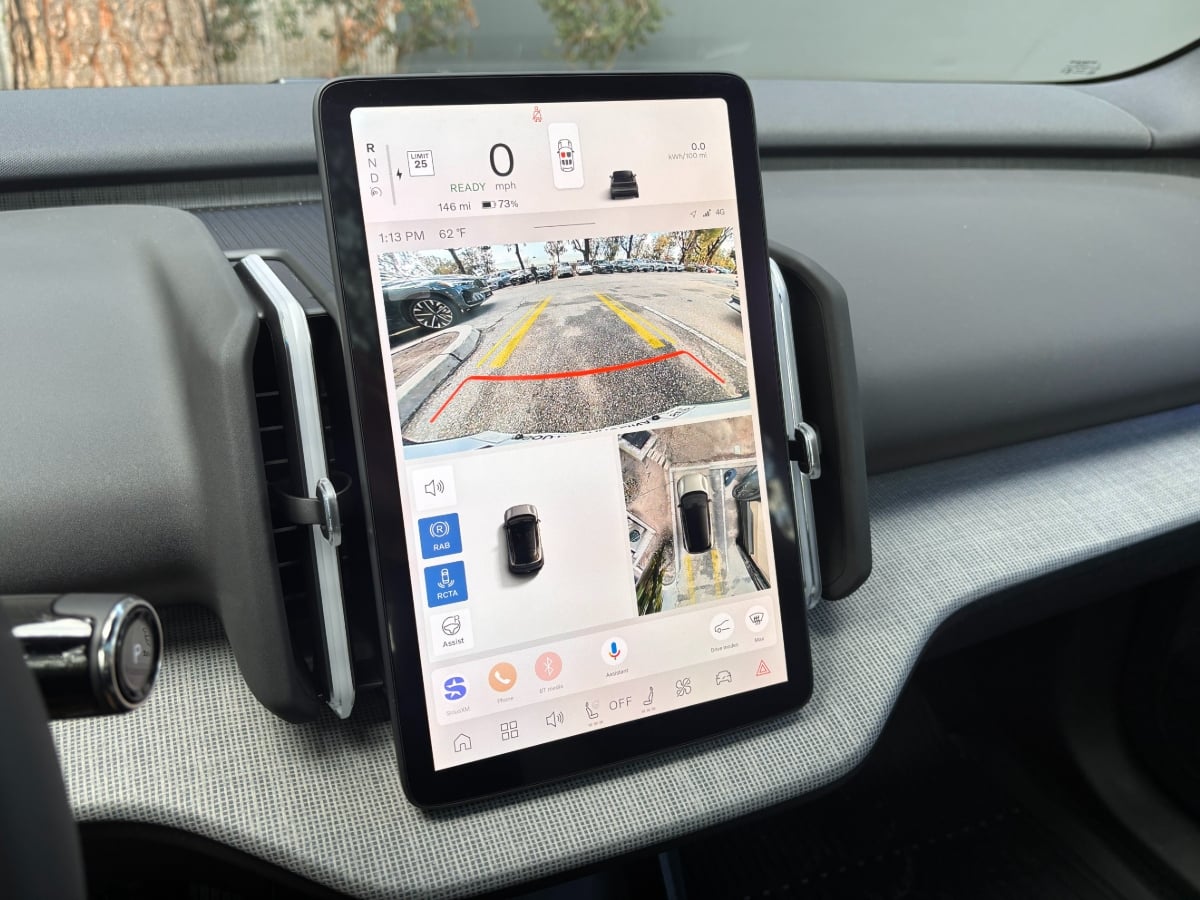
Photo: James Riswick
The above-mentioned exception was the driver monitoring system, which consistently nagged me to pay attention to the road. Twice it did so while I was looking ahead and to the right through a corner, so it was a false alarm. Every other time, it was because I was forced to look at the touchscreen. Hmm, even the car itself thinks its interior controls are unwise.
According to the JD Power 2025 Initial Quality Study (IQS), the Audi Q3 ranks highest in the Small Premium SUV segment. The Lexus UX and the Mercedes-Benz GLA are the next highest-ranked models.
According to the JD Power 2025 Automotive Performance, Execution and Layout (APEAL) Study, the BMW X1 ranks highest in the Small Premium SUV segment. The Genesis GV60 is the next highest-ranked model.
According to the JD Power 2025 U.S. Electric Vehicle Experience (EVX) Ownership Study, the BMW iX ranks highest in the Premium Battery Electric Vehicles segment. The BMW i4 and the Rivian R1S are the next highest-ranked models.
Other 2026 EX30 Cross Country competitors include the Acura ADX, BMW X2, and Volvo XC40.
Talk about high peaks and low valleys. The EX30 Cross Country looks great, has a beautifully crafted interior, and is a joy to drive, with almost absurd acceleration. Yet its range is below average, and its interior is infuriating to use. This ultimately makes its value questionable, despite a seemingly reasonable price.
James Riswick has been testing and reviewing cars since 2007, serving as an editor at Edmunds.com and Autoblog. In addition to JDPower.com, he has also contributed to Autoguide Magazine, Autotrader, Capital One Auto Navigator, Car and Driver, and Hagerty. He resides in Southern California and owns a 1998 BMW Z3, a 2013 Mercedes-Benz E350 Wagon, and a 2025 Cadillac Optiq.


The Ford Transit is the automaker’s full-size cargo and passenger van offering, designed to serve a wide range of commercial and lifestyle applications. With 37 available configurations, the platform ...See More
Read the Full Article
The Chevrolet Tahoe is a full-size, three-row SUV with a standard V8 engine and available diesel power. Built on the same platform as the Chevrolet Silverado 1500 pickup, the Tahoe benefits from its ...See More
Read the Full Article
It is the end of the line for the Ford Escape. After 25 years as a fixture of Ford’s lineup, 2026 will be the compact SUV’s last model year.
Read the Full Article
The Colorado is Chevrolet’s midsize pickup. It ranks among the segment’s most capable trucks for payload and towing, and can be configured for both work and off-road adventures. For 2026, the ...See More
Read the Full Article