
Historically, the Volkswagen Tiguan has been a bit bland, both in appearance and driving dynamics. It didn’t exactly stand out from the crowd of compact SUVs unless you count its distinctive third-row seat, which wasn’t particularly useful. With the redesigned 2025 Volkswagen Tiguan, the German automaker addresses those issues and, in the process, kicks to the curb the crossover SUV’s plain-Jane vibe.

Photo: James Riswick
The 2025 Tiguan’s new design comes with a reduction in cargo functionality that dulls its family hauler credentials. For many, however, the 2025 Tiguan’s bolder style, higher-quality cabin, and significantly improved driving experience should add up to a much better package. The SUV also gets a new infotainment system, improved storage, new features (especially on the top trim level), and an uptick in horsepower and fuel economy.
The 2025 VW Tiguan is available in a single body style: a two-row, five-passenger crossover. Only one engine is available for 2025, but VW says a more powerful upgrade will arrive for 2026. There are four trim levels: S, SE, SE R-Line Black, and SEL R-Line. Only the latter comes standard with all-wheel drive (AWD); the others offer it as an option with front-wheel drive (FWD) standard. Prices range from $30,920 to $41,180, including the $1,425 destination charge.
Read our full 2025 Volkswagen Tiguan preview for more background and details.
For this 2025 Tiguan review, Volkswagen provided a test vehicle equipped with SE R-Line Black trim. Monterey Blue paint with a Deep Black contrast roof was the only option. The test vehicle’s manufacturer's suggested retail price (MSRP) was $39,230, including the $1,425 destination charge to ship the SUV to your local dealership from the Puebla, Mexico, assembly plant.

Photo: James Riswick
The 2025 Tiguan gets an updated version of the infotainment system previously introduced in other Volkswagens, and then some. Fortunately, it does not inherit all of the accompanying interior controls that have been incredibly irksome to use.
The standard touchscreen measures 12.9 inches, with the SEL R-Line getting a gargantuan 15-inch unit. I tried out both versions and found they work identically—one’s just bigger. Volkswagen says the new system is quicker than earlier iterations, and I experienced no glitches. I also found it easy to view and operate while driving, including toggling between menus, and entering/exiting wireless Apple CarPlay/Android Auto smartphone mirroring.
The satellite radio controls remain nonsensical, though, and most climate controls are annoyingly stuffed into the touchscreen. The air recirculation, in particular, requires delving into a separate menu. You can adjust the temperature on the screen or with touch-sensitive slider controls. They’re illuminated, but glare can make them hard to see during the day. Real buttons are better.
Perhaps someone at Volkswagen agrees with that assessment because the Tiguan’s steering wheel has reverted to having real buttons instead of horrid touch-sensitive ones. The volume touch slider is also supplanted by a redundant knob on the center console that weirdly doubles as the drive-mode selector (plus another thing I’ll get to later). Volkswagen also didn’t delete the rear window switches on the driver door as it did for the ID.4.
Volkswagen relocated the shifter in the 2025 Tiguan to the steering column (it’s a similar design as the ID.4’s), which frees up space on the center console for that volume/mode knob, and a very deep bin that contains the standard wireless charger. The latter item not only did a good job of keeping my phone in place, but it’s cooled to prevent device overheating.
Besides looking better, the cabin also gets improved materials. There’s still cheap-looking hard plastic on the center console of most trims and the rear doors, but the SE trims get a sort of simulated suede on the dashboard and doors (pictured above), metal-look accents, and a dashboard-spanning patterned trim panel. The SEL R-Line goes even further with real wood and simulated leather trim on the dashboard, doors, and center console.
All but the base S trim also get “Atmospheres.” Selected with the aforementioned volume combo knob, these are preset combinations of ambient lighting and sound system settings (bass, treble, etc.). For example, red pairs with a more energetic sound mix. I don’t get it. It seems like something that’ll be relegated to the “oh yeah, I remember that!” oddity realm of automotive history.
You can also separately select one of 10 (SE trims) or 30 (SEL) ambient lighting colors that appear all over the cabin, including accent hues for the instrument and infotainment displays.
Regarding space, at the time of writing, Volkswagen has not provided an official cargo volume figure. However, I believe the new Tiguan’s cargo area is unquestionably smaller and less functional than the old model. It’s just not as boxy anywhere, and worse, it lacks the dual-level cargo floor found on many competitors that expands cargo capacity. I think a lot of families will need more than this.
Rear-seat space is better, though, with legroom expanding by 1.5 inches, to 40.2. On paper, that’s mid-pack for the segment. In practice, I’m 6-foot-3 and comfortably fit without my legs touching the driver seat adjusted for my driving position.
Headroom is also ample, even under a panoramic sunroof. Also, the doors are enormous, which should make for easy ingress/egress, car seat installation, and putting a child into said car seat. I also noted that VW moved the rear LATCH anchors up on the back seat for easier access.

Photo: James Riswick
I touched on the new infotainment system’s functionality above, so let’s talk about what you get. Standard features include wireless Apple CarPlay and Android Auto, satellite radio, in-car Wi-Fi, and natural voice controls. You gain no other features until the SEL R-Line with its Harman Kardon audio system (which I thought sounded very impressive for this segment) and 15-inch display.
Also standard on every 2025 Tiguan is a 10.25-inch instrument panel display with the same look and functionality regardless of the trim level. It offers multiple layouts, each with choices of information displayed, and color scheme by way of ambient light choice or Atmosphere (not applicable on the base S). It looks great, and I appreciate that you can control it with the steering wheel buttons instead of the touchscreen.
There are no new advanced driver assistance systems (ADAS) introduced for 2025 besides parking sensors, but that’s OK because the Tiguan already has a full ADAS menu. Standard technologies include forward-collision warning with pedestrian and newly added cyclist detection, blind-spot warning, and lane-keeping assistance. During my evaluation, the latter proved a little overeager on a winding road, but otherwise, I experienced no false alarms or issues with these systems.
There are also three levels of cruise control aboard, easily selected with a steering wheel button: basic cruise, adaptive cruise (maintains your speed and distance to the cars ahead), and “Travel Assist,” which adds lane-centering steering assistance to adaptive cruise. The latter did an excellent job of steering the vehicle with only a token hand on the wheel, even in rain and with faded lane markings. Kudos to Volkswagen for making this well-executed system standard.
It's also worth noting that there are four new airbags for 2025: driver knee, rear sides, and front center.

Photo: James Riswick
The 2025 Volkswagen Tiguan comes standard with a turbocharged 2.0-liter four-cylinder engine that produces 201 horsepower (up from 184), and either 207 pound-feet of torque (FWD) or 221 pound-feet (AWD).
Besides the Nissan Rogue, this exceeds the standard overall outputs of its competitors. However, Volkswagen’s eight-speed automatic transmission trumps Nissan’s continuously variable automatic transmission (CVT) that slurs between ratios and hangs onto revs instead of smartly changing gears (ditto the CVTs in other competitors).
Importantly, though, the Tiguan’s engine feels just as muscular when behind the wheel as it seems on the spec sheet. There’s a disappointing amount of throttle delay should you plant your foot from a stop, but that’s probably to prevent all that immediate torque from overwhelming the tires, especially with FWD. Once underway, passing power is abundant, even at high elevations around Bozeman, Montana, where I test-drove the new Tiguan.
The new 2025 model isn’t that different from the last Tiguan. Still, the driving experience has dramatically changed for the better. The redesigned Tiguan rides on a new underlying platform with suspension and body structure improvements. Whatever was done, however, resulted in a more buttoned-down and responsive small SUV that’s far more engaging to drive. The steering, in particular, is a massive improvement, eliciting greater confidence and driver involvement.
In short, the old Tiguan was just as blah to drive as it was to look at. The new one flips the script. Maybe it’s not quite to the level of a Mazda CX-50, but the Tiguan now joins it in the segment clique labeled “fun to drive.”
The trade-off for that fun is fuel economy. While better for 2025, the FWD Tiguan S returns 29 mpg combined (the SE and SE R-Line Black come in at 28 mpg combined). All-wheel drive lowers that estimate to 25 mpg combined regardless of trim. That’s lower than the base engines of all competitors except the Hyundai Tucson and Kia Sportage. The Rogue, in particular, smokes it at 31 mpg combined with AWD.
I averaged 23.4 mpg during a short drive in the mountains outside Bozeman, but based on the driving conditions, I wouldn’t draw any conclusions from it.
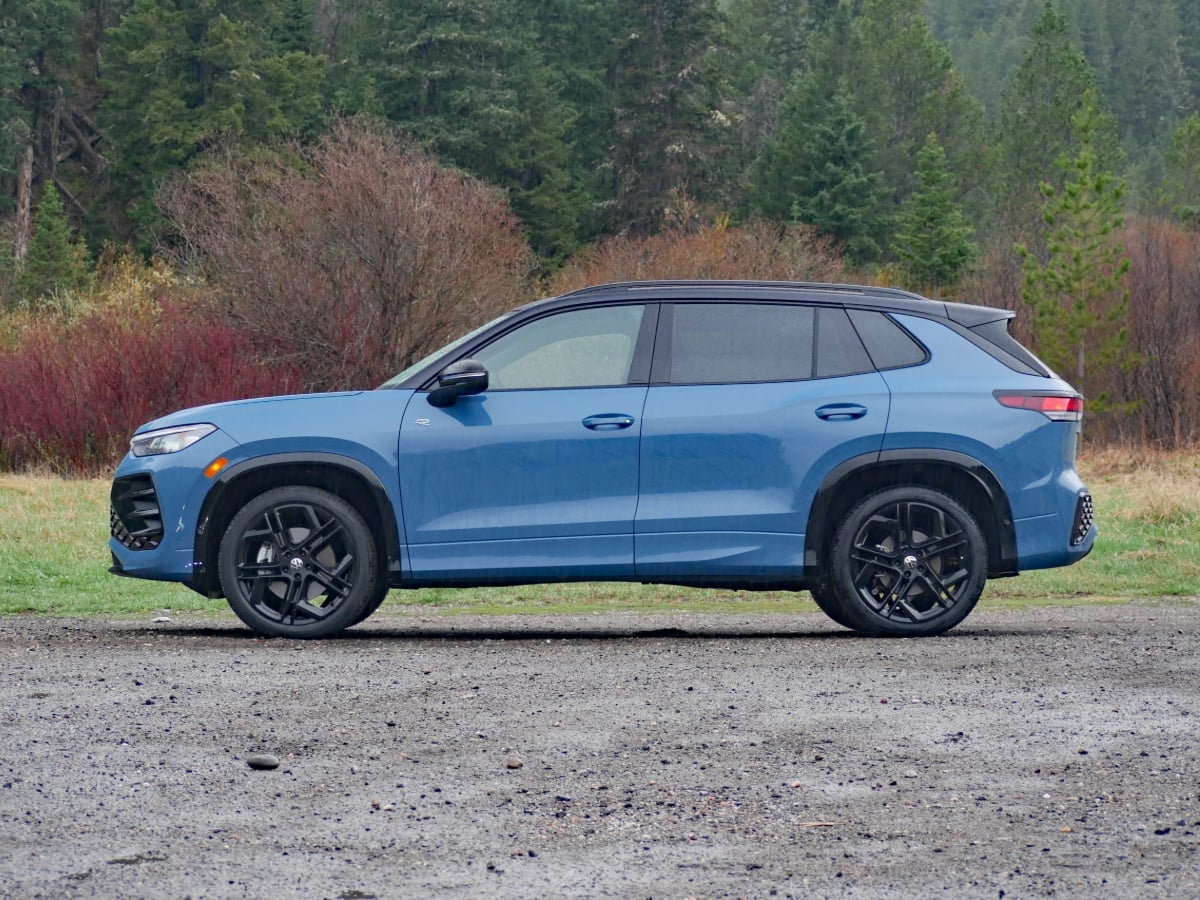
Photo: James Riswick
The 2025 Volkswagen Tiguan greatly exceeded my expectations. Its new infotainment system and interior controls were not the pull-my-hair-out experience I’ve had with the ID.4 and ID. Buzz. The driving experience was also far more engaging than other Volkswagen SUVs, including the Taos, Atlas, and previous-generation Tiguan. I also liked the design, including the new, on-trend color options.
Essentially, the Tiguan has gone from “Sure, I guess you can check it out” to “Definitely check it out.” Just make sure to see if there’s enough cargo space for your needs.
James Riswick has been testing and reviewing cars since 2007, serving as an editor at Edmunds.com and Autoblog. He has also contributed to Autoguide Magazine, Autotrader, Capital One Auto Navigator, Car and Driver, and Hagerty. He resides in Southern California and owns a 1998 BMW Z3, a 2013 Mercedes-Benz E350 Wagon, and a 2023 Kia Niro EV.


The Ford Transit is the automaker’s full-size cargo and passenger van offering, designed to serve a wide range of commercial and lifestyle applications. With 37 available configurations, the platform ...See More
Read the Full Article
The Chevrolet Tahoe is a full-size, three-row SUV with a standard V8 engine and available diesel power. Built on the same platform as the Chevrolet Silverado 1500 pickup, the Tahoe benefits from its ...See More
Read the Full Article
It is the end of the line for the Ford Escape. After 25 years as a fixture of Ford’s lineup, 2026 will be the compact SUV’s last model year.
Read the Full Article
The Colorado is Chevrolet’s midsize pickup. It ranks among the segment’s most capable trucks for payload and towing, and can be configured for both work and off-road adventures. For 2026, the ...See More
Read the Full Article