See answers to common EV questions, tax incentives, charging maps & more.
Explore EV
26 - 30
36 - 40
147 - 190
1 speed, CVT w/OD, 8 speed, Automatic w/OD
Intercooled Turbo Regular Unleaded I-4, Regular Unleaded I-4
Front Wheel Drive
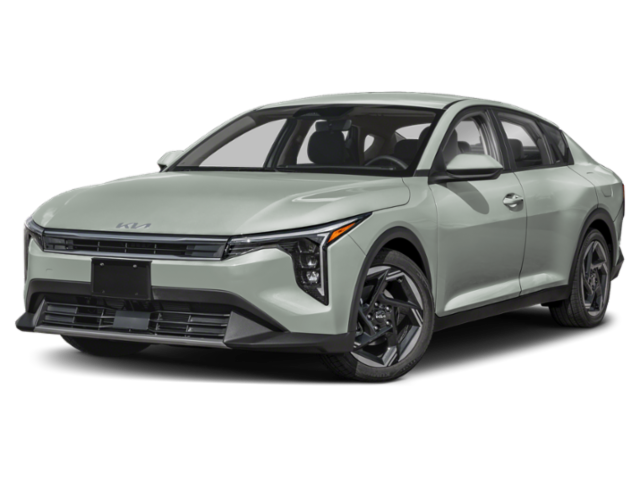
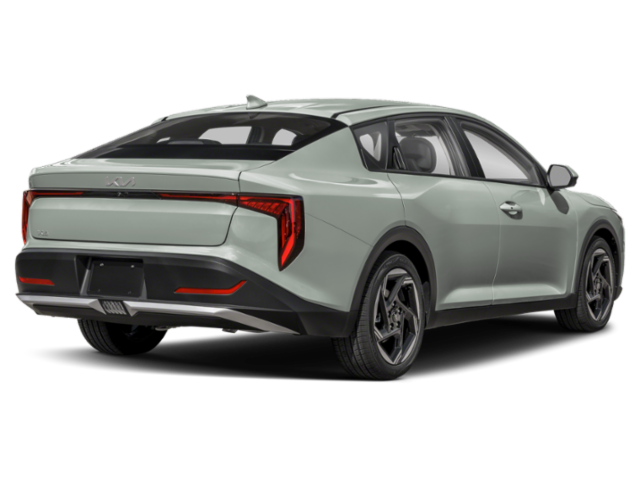
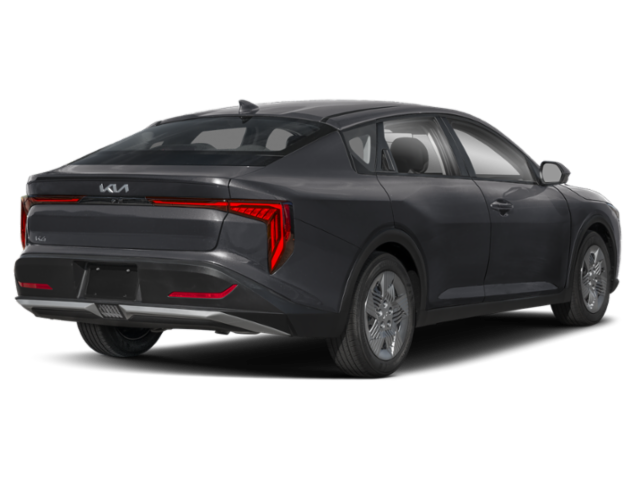
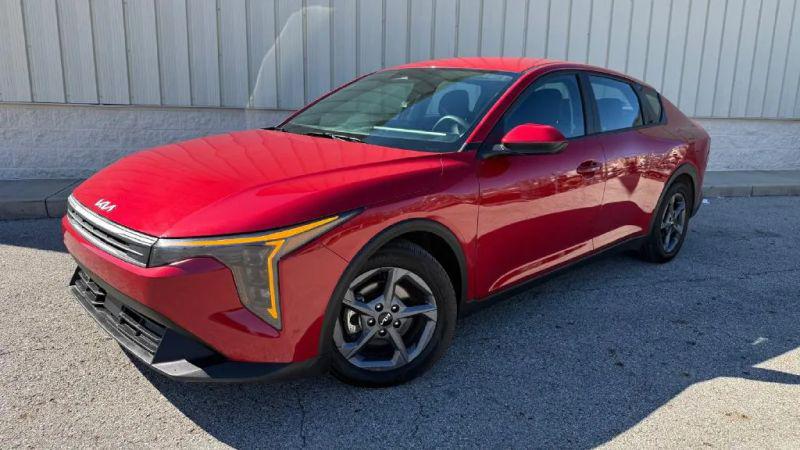
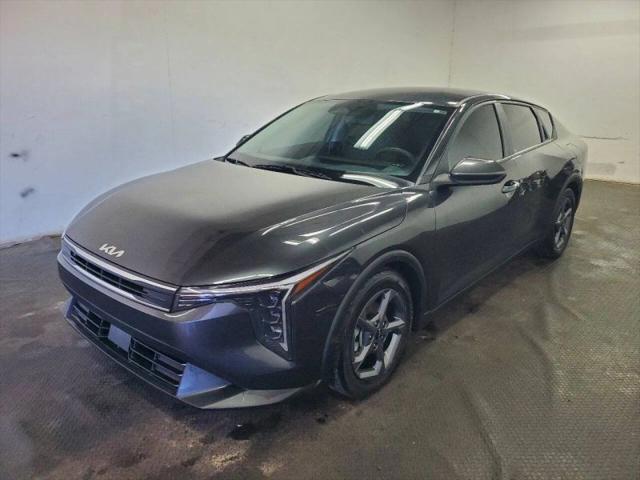
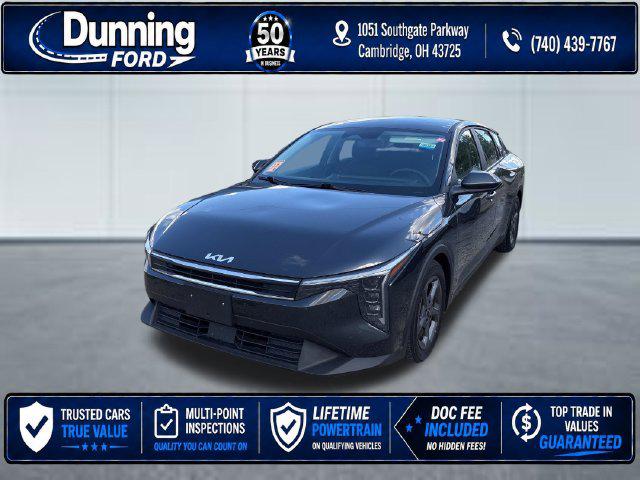
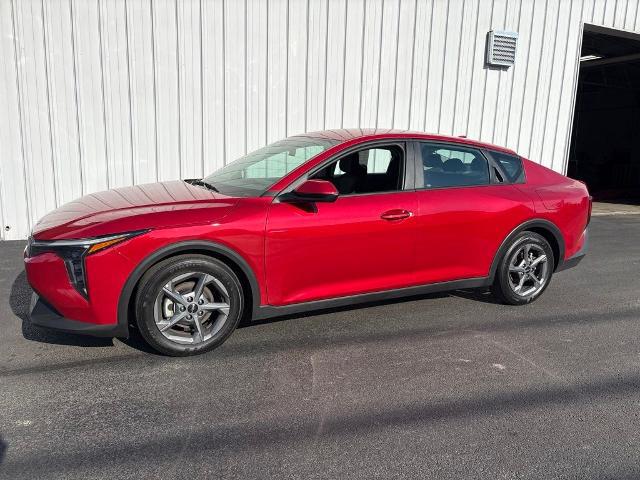
The 2025 Kia K4 does exactly what a good compact sedan should: offer stronger fuel economy and a lower price than many small SUVs while surprising with its spaciousness and feature content. That’s nice, but its predecessor, the Forte, also did that. Where the K4 moves the ball forward is with its unique design and state-of-the-art technology, which stands out from the $20,000-plus crowd of sedans and small SUVs.

Photo: James Riswick
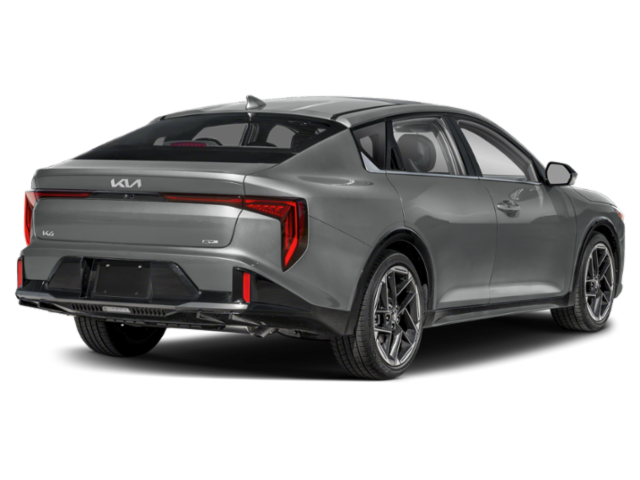
The K4’s overall length, wheelbase, and back-seat legroom are up by a couple of inches over the Forte. The standard engine remains unchanged, and the rear suspension design continues to vary by trim level, with the GT-Line featuring a more sophisticated multi-link setup. The radically new design and Kia’s latest infotainment and driver-assistance technologies are the most significant additions.
Most of those features come standard too, although the EX, GT-Line, and GT-Line Turbo trim levels add features such as wireless phone charging and a third touchscreen dedicated to the climate controls. Those trims mainly differ in terms of style, rear suspension, and engine. Prices range from $23,165 for the base LX to $29,265 for the top GT-Line Turbo, including the $1,175 destination charge.
For this review of the 2025 K4, Kia provided a test vehicle equipped with GT-Line trim. It featured an optional sunroof and the GT-Line Premium package, which included synthetic leather upholstery, ventilated front seats, driver's memory settings, and a Harman/Kardon sound system. These options amounted to $2,000.
The test vehicle’s manufacturer's suggested retail price (MSRP) was $28,365, including the $1,175 destination charge to ship the car to your local dealership from the Pesqueria, NL, Mexico, assembly plant.

Photo: James Riswick
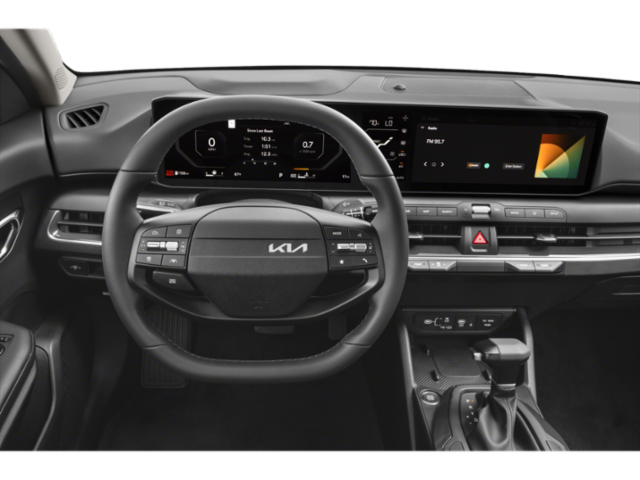
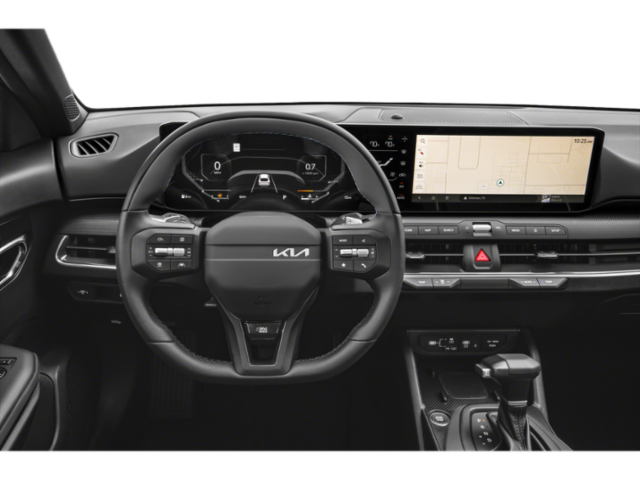
Two things immediately stand out when sliding inside the K4 GT-Line. First is the sporty steering wheel, featuring crème-colored accents. Second is the wide display module featuring a crisp and configurable instrument panel, Kia’s latest infotainment touchscreen, and a unique climate control touch panel in between. A Honda Civic may have higher-quality materials, but it can’t match the K4’s high-tech wow factor. Neither can any other compact sedan.
Despite all that digital real estate, Kia didn’t turn the K4’s controls over to a touchscreen overlord. The little climate control screen displays temperature and buttons for defrosting and air recirculation, but temperature, fan, and direction adjustments are all done with physical toggles on the dashboard. Heated and ventilated seat buttons are on the doors. Even the infotainment system retains its physical shortcut buttons.
One unheralded but greatly appreciated improvement is the cupholders. Those in the doors and center console are quite clearly larger than what I’ve found in Kia’s Niro, Sportage, Sorento, and Telluride. All those struggled to fit reusable metal water bottles of various sizes, especially in the doors. The K4’s, on the other hand, were suitable for even my wine-bottle-sized water bottle.
The center console cupholders can also disappear to reveal an open space for storing non-cup items, while a large bin in front of the mercifully normal gear shifter houses the wireless phone charger. That, by the way, didn’t overheat my iPhone and has a rubberized surface with bumpers that kept it in place.
Passenger space in the K4 is very generous. The GT-Line’s power driver's seat provided a wealth of adjustability for this 6-foot-3 driver, and my 6-foot-tall father could sit comfortably behind me with only a slight adjustment of the front seat. Similarly, the front passenger seat provided ample legroom after I moved it forward sufficiently to accommodate my son in his forward-facing child seat. It may be harder to put him in that seat than in compact SUVs, but space in the K4 is as good or better.
Overall, cargo space is not as good as what you’ll find in a small SUV, but if you’re talking about storing luggage behind the back seat (and not loading to the roof), the difference may surprise you. I could fit five suitcases and three duffle bags in the K4’s 14.6-cubic-foot trunk. That’s more than the Honda Civic Sedan managed, as well as many subcompact SUVs that cost as much or more than the K4.
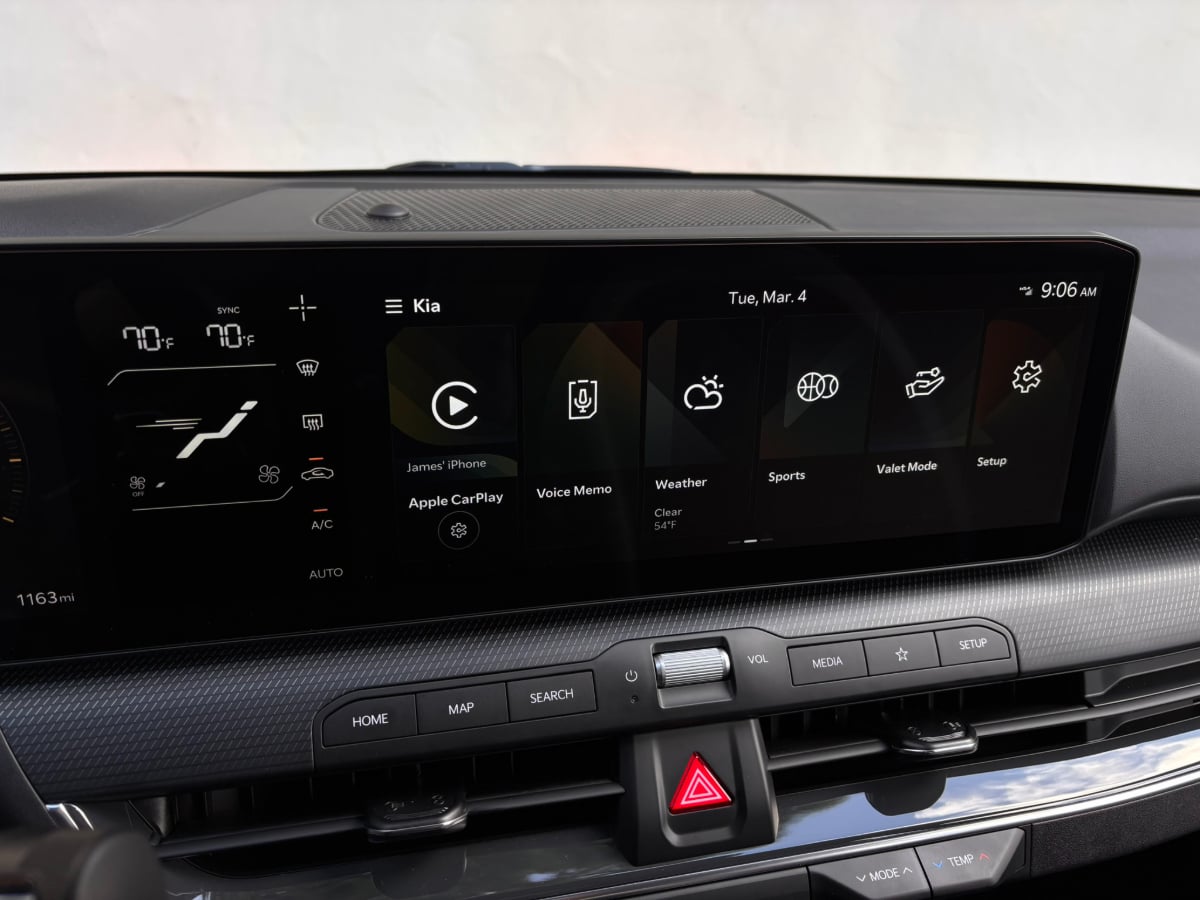
Photo: James Riswick
Base compact sedans often have a small infotainment screen with minimal functionality and content. Not the K4; all versions come with the big-dog 12.3-inch touchscreen. Its graphics are fresh, and you can easily decipher Home screen icons at a glance. You can also easily press physical shortcut buttons without a glance. Unfortunately, Kia replaced the old radio shortcut button with a Search button of questionable use. Going between Apple CarPlay and radio controls is now a pain.
That said, Apple CarPlay and Android Auto are now wirelessly connected. That’s great if that’s all you’ll ever use. If you also listen to satellite radio, you may be annoyed by the system’s inability to show song information and your favorites list on the same screen. Seeing song information in general is difficult; it’s also no longer an option for split-screen display content.
The GT-Line includes Kia’s navigation system, which I found adjusts its routes based on traffic conditions like Google Maps does. Programming it is easy, be it by screen or voice, and using the native system (versus Google Maps via CarPlay) provides superior graphics and map functionality. You can also choose to display directions in the instrument panel.
Speaking of which, the EX and GT-Line trims feature a configurable panel with multiple design layouts and information presentation options. My favorite was the crisp analog gauge reproduction, accompanied by a supplementary digital speedometer and speed limit readout.
Finally, my GT-Line test vehicle came equipped with the optional Harman/Kardon premium sound system. It was just OK, but without a car with the standard system on hand, it’s impossible to comment on any improvement. At the very least, its inclusion alongside a handful of other desirable features makes its Premium package add-on an easy choice.
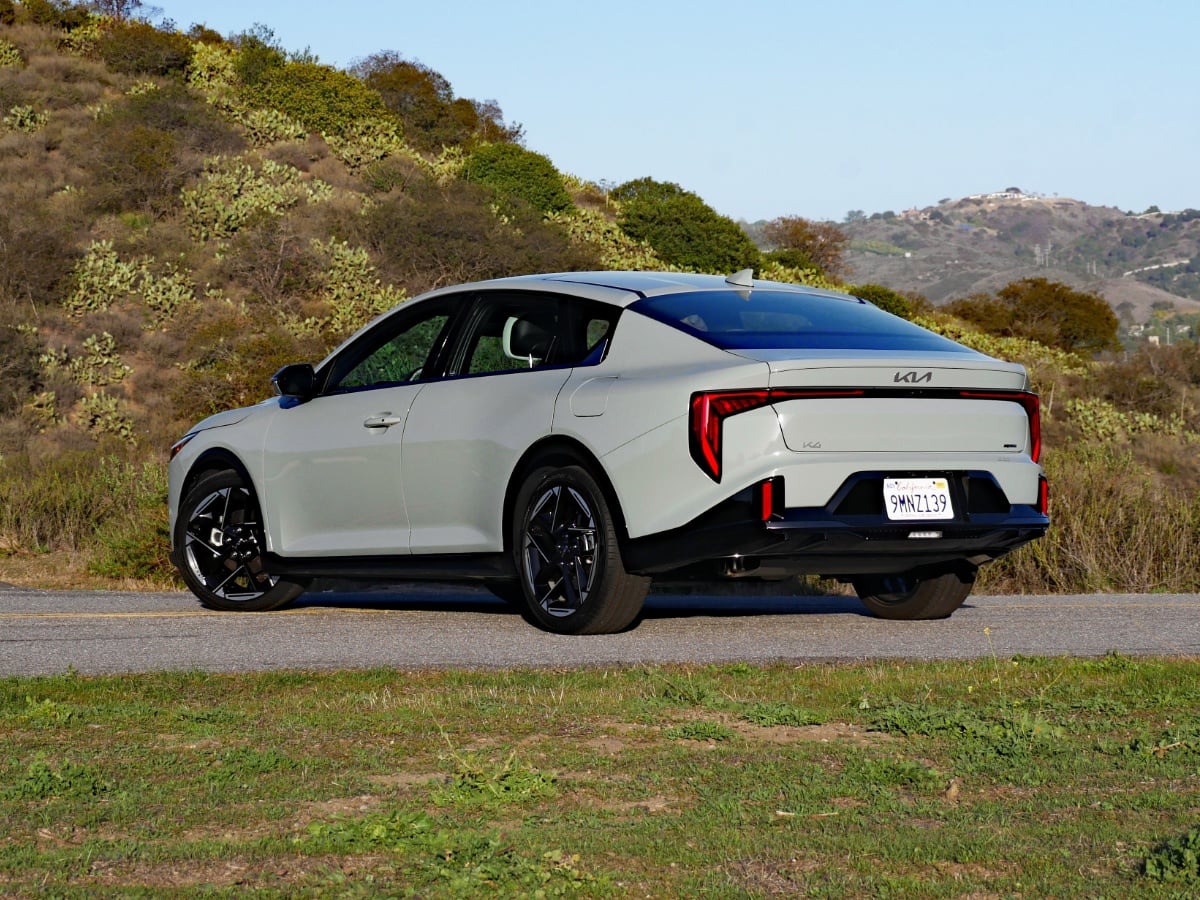
Photo: James Riswick
The GT-Line is the only trim level available with a turbocharged 1.6-liter four-cylinder engine, producing a robust 190 horsepower and 195 pound-feet of torque. My GT-Line, however, had the base, naturally aspirated 2.0-liter four-cylinder found in every other K4 trim. It produces 147 hp and 132 pound-feet of torque.
The Environmental Protection Agency (EPA) estimates the 2025 K4’s base engine fuel economy at 33 mpg combined. I managed only 27.3 mpg on my evaluation route, but a 45-mile highway journey returned a far more palatable 34.5 mpg. Unlike most competitors, there is no hybrid available.
Acceleration in the K4 was hardly inspiring. The bar is low for cars in this price range, so it wasn’t surprising that I needed to plant my right foot firmly on the floor to quickly reach highway speeds or think twice about making a highway pass. Instead, it was the engine’s hollow whir, accompanied by a weird, supercharger-like whine above 4,500 rpm, that stood out negatively compared to the pleasing, mechanical thrum of the Honda Civic’s similarly powerful four-cylinder.
The K4’s transmission is a better effort. Like most vehicles in the segment, it features a continuously variable automatic transmission (CVT) that lacks traditional gears. This allows it to maintain consistently low revs and the engine to be more efficient in sedate driving. It also simulates gear changes when accelerating more aggressively, providing a more “normal” feel, as Honda and Subaru’s CVTs do; however, Kia’s programming is superior.
I still found the CVT too quick to drop revs, even in Sport mode, when driving quickly on my mountain road evaluation route. This produces a yo-yo effect of revs constantly rising and falling that gets old (remember what I said about the engine noise). Thankfully, paddle shifters can impressively snap off up- and downshifts as needed and then keep the car in your desired gear. Well done.
The aforementioned mountain road demonstrated that the GT-Line, with its more sophisticated rear suspension (compared to the LX, LXS, and EX), has sufficient grip and body control. It’s not totally out of its depth should you enjoy a quick drive on a winding country road. Just don’t expect any steering feel, nor the overall composure and human-machine interaction you get from the Honda Civic. The Honda can be fun to drive; the K4 really isn’t.
It is, however, impressively comfortable despite the GT-Line’s relatively low-profile tires. Choppy highway pavement wasn’t an issue, and big bumps didn’t make me wish for the smaller wheels found on the EX.
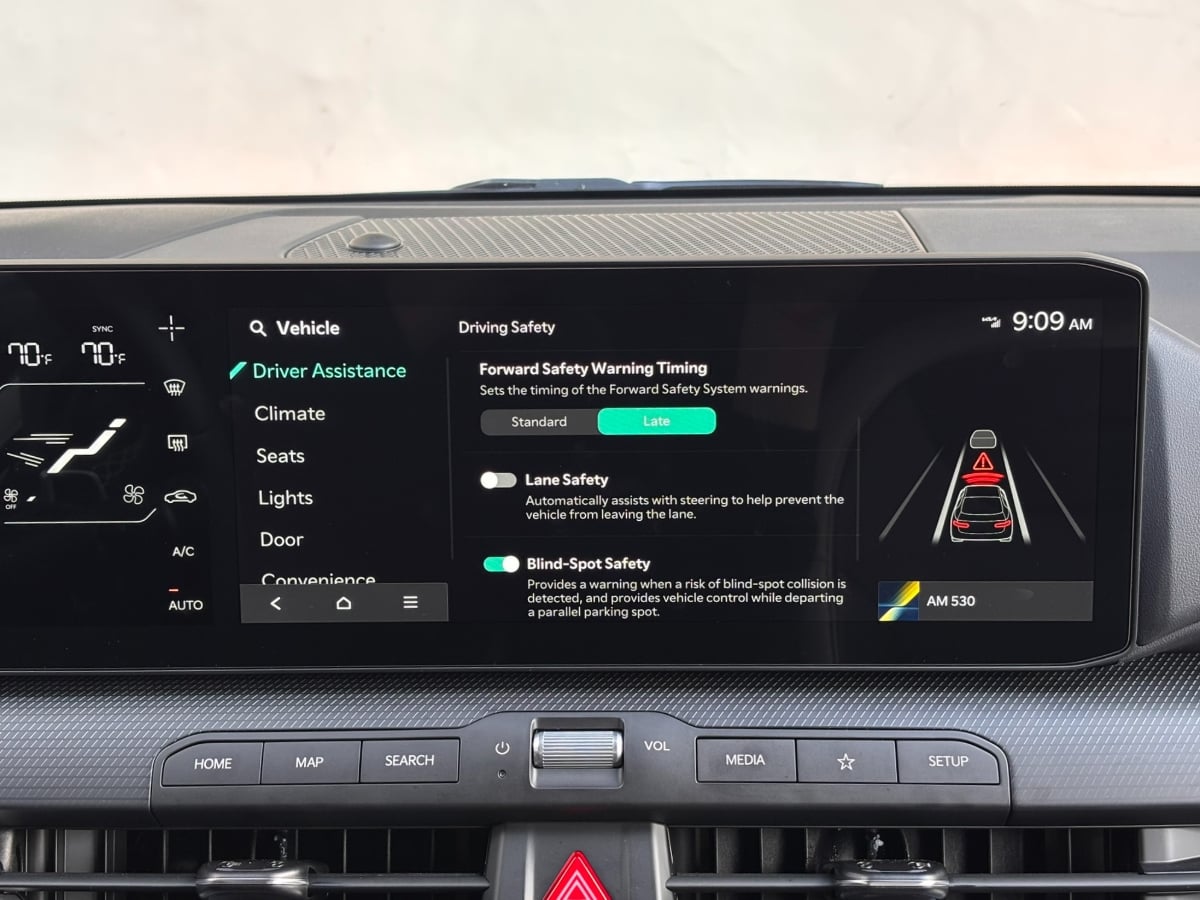
Photo: James Riswick
The K4 doesn’t short-change base trim levels on driver-assistance equipment. Blind-spot warning is the only notable omission from the base LX; it’s included on all other trims. At the same time, Kia restricts upgrades to a more advanced adaptive cruise control system in the GT-Line and a package exclusive to the GT-Line Turbo that includes enhanced forward-collision warning parameters and parking assistance features. Base feature content includes:
I find Kia’s systems are better than most, with fewer false alarms and no hyperactive, nanny-like beeping. Driver-assistance systems are pointless if they annoy a driver to the point of turning them off. Kia’s don’t. The forward-collision warning system even offers a choice of system sensitivity.
The adaptive cruise control is also better than most. Besides maintaining a set speed and distance to vehicles ahead (as the standard system does), the GT-Line’s Highway Driving Assist adds lane-centering steering assistance. The car does the lion’s share of driving for you on the highway as long as you keep a token hand on the wheel. This upgrade system can also adjust speed based on navigation-sourced speed and road curve data; however, I found its adjustments to be overly aggressive.
The National Highway Traffic Safety Administration (NHTSA) gave the K4 a maximum of five stars for overall crash protection. The Insurance Institute for Highway Safety (IIHS) also named it a Top Safety Pick for the 2024 calendar year, recognizing its satisfactory performance in crash protection and prevention tests, as well as its effective headlights.
According to the JD Power 2024 Initial Quality Study (IQS), the Kia Forte—the predecessor to the K4—ranks highest in the Compact Car segment. The Nissan Sentra and the Hyundai Elantra are the next highest-ranked models.
According to the JD Power 2024 Automotive Performance, Execution and Layout (APEAL) Study, the Kia Forte ranks highest in the Compact Car segment. The Hyundai Elantra and the Mini Clubman are the next highest-ranked models.
Other 2025 K4 competitors include the Honda Civic, Mazda Mazda3, and Toyota Corolla.