
- Concerns about gas prices are declining, while worries over housing costs are close to becoming the second-largest source of financial stress
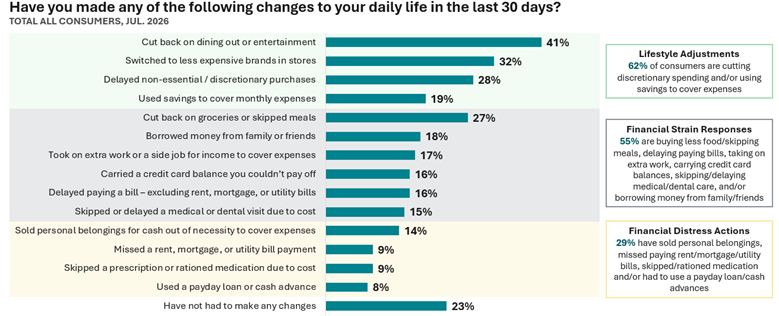
- In the past 30 days, 29% of consumers have taken actions indicative of financial distress such as missing rent, mortgage or utility payments
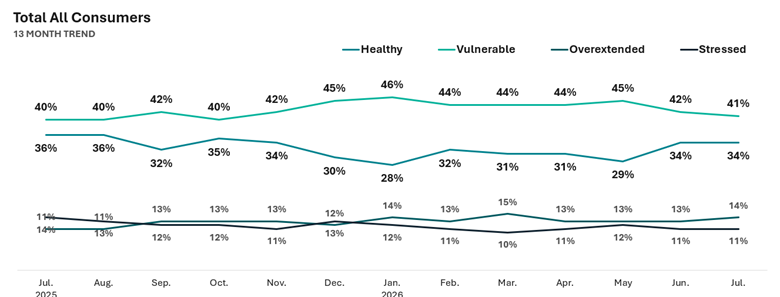
- The total share of financially healthy consumers in the U.S. holds steady at 34% in July
The share of U.S. consumers classified as financially healthy[1] held at 34% in July — its second consecutive month at that level and the highest reading since November 2025. While overall consumer confidence is improving, housing-related affordability pressures are also on the rise, and many consumers are still showing real signs of financial distress. It’s an example of 2026’s K-shaped economy at work, as the landscape shows that there is clearly uneven resilience among the different consumer segments.
More than three-fourths (77%) of consumers say they’ve made changes to their day-to-day spending to address mounting costs, and 29% of those changes are actions indicating more dire financial distress. That includes selling personal possessions to cover bills, missing rent, mortgage or utility payments or skipping a prescription or rationing a medication due to cost.
This Banking and Payments Intelligence Report dives into key data points gathered from
JD Power studies and proprietary market data to offer a by-the-numbers perspective on the financial health of U.S. consumers.
Percentage of Financially Unhealthy Consumers Holds Steady
In July, the total share of financially unhealthy consumers, defined as those who are financially vulnerable, overextended or stressed, was unchanged at 66%.
Affordability Concerns Impact Spending
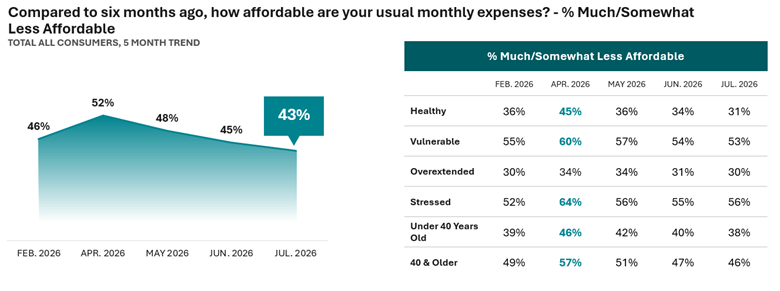
The total number of consumers who say monthly expenses feel less affordable than they did six months ago declined to 43%, down from 45% last month. While affordability concerns have been trending down since their peak in April, the cost of everyday items remains a prevalent issue. Stressed (56%) and vulnerable (53%) consumers are most likely to say their expenses are less affordable.
Most consumers continue to modify their spending habits, with 77% once again reporting changes to their day-to-day expenses in July, a rate that was unchanged from June. The most common areas where people are cutting back include lifestyle changes like dining out and entertainment (41%), switching to less expensive brands or stores (32%) and delaying non-essential or discretionary purchases (28%). More concerning, 27% of consumers have cut back on groceries or skipped meals and 18% have borrowed money from family or friends to cover expenses. Additionally, 14% of consumers have sold personal belongings to cover expenses, 9% have missed rent, mortgage or utility payments and 9% have skipped a prescription or rationed medication due to cost.
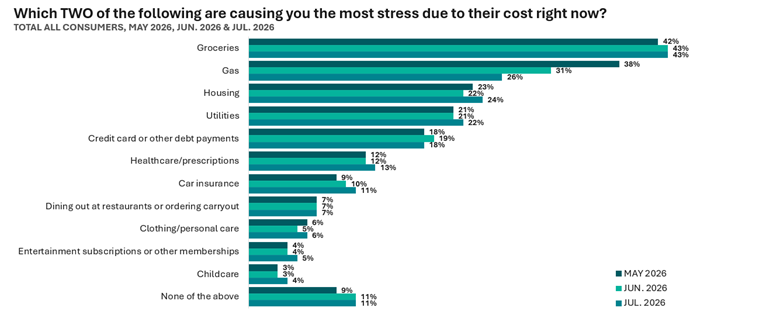
While groceries continue to place the greatest strain on consumers, housing costs are starting to become a focal point. Overall, 43% of consumers say the high cost of groceries is causing the most stress, which is flat from June. Gas continues to fall to just 26% (down 5 percentage points), while housing is close to overtaking gas as the second biggest source of financial stress among U.S. consumers (24%).
Consumers Look for Tangible Wins
As consumers continue to feel persistent financial stress, they are looking to build some positive momentum. To do that, they want tangible wins, and while big financial moves like consolidating credit card debt or paying off a home equity loan may be out of reach, they can take small steps to improving their financial standing. As an example; showing customers which debt to prioritize to make the biggest impact on their credit, banks can be valuable partners in this pursuit. In fact, banks and card issuers receive their strongest customer satisfaction and brand advocacy ratings when they help customers meet credit and borrowing needs and improve their credit scores. These are the areas where retail financial institutions need to focus. For customers that find themselves stuck in financial malaise, banks can help strengthen everyday financial habits with guidance and engagement. Those that do that stand to build the most meaningful relationships with their customers through all economic cycles.
Find out More
This Banking and Payments Intelligence Report is based on responses from 4,000 consumers nationwide and was fielded in July 2026. It was authored by Jennifer White, managing director of financial services intelligence at JD Power. Please contact us at the numbers below to connect with Ms. White or to learn more about the underlying research.
Media Contacts
[1]JD Power measures the financial health of any consumer as a metric combining their spending/savings ratio, creditworthiness, and safety net items like insurance coverage. Consumers are placed on a continuum from healthy to vulnerable.