
The Subaru Forester recipe is simple. Take a box, put it on wheels, add rugged design details, give it all-wheel drive (AWD) with plenty of ground clearance, and price it affordably. The redesigned 2025 Subaru Forester adheres to that ingredient list and previously established measures, right down to its adequately powered boxer-type 4-cylinder engine and standard symmetrical AWD system.
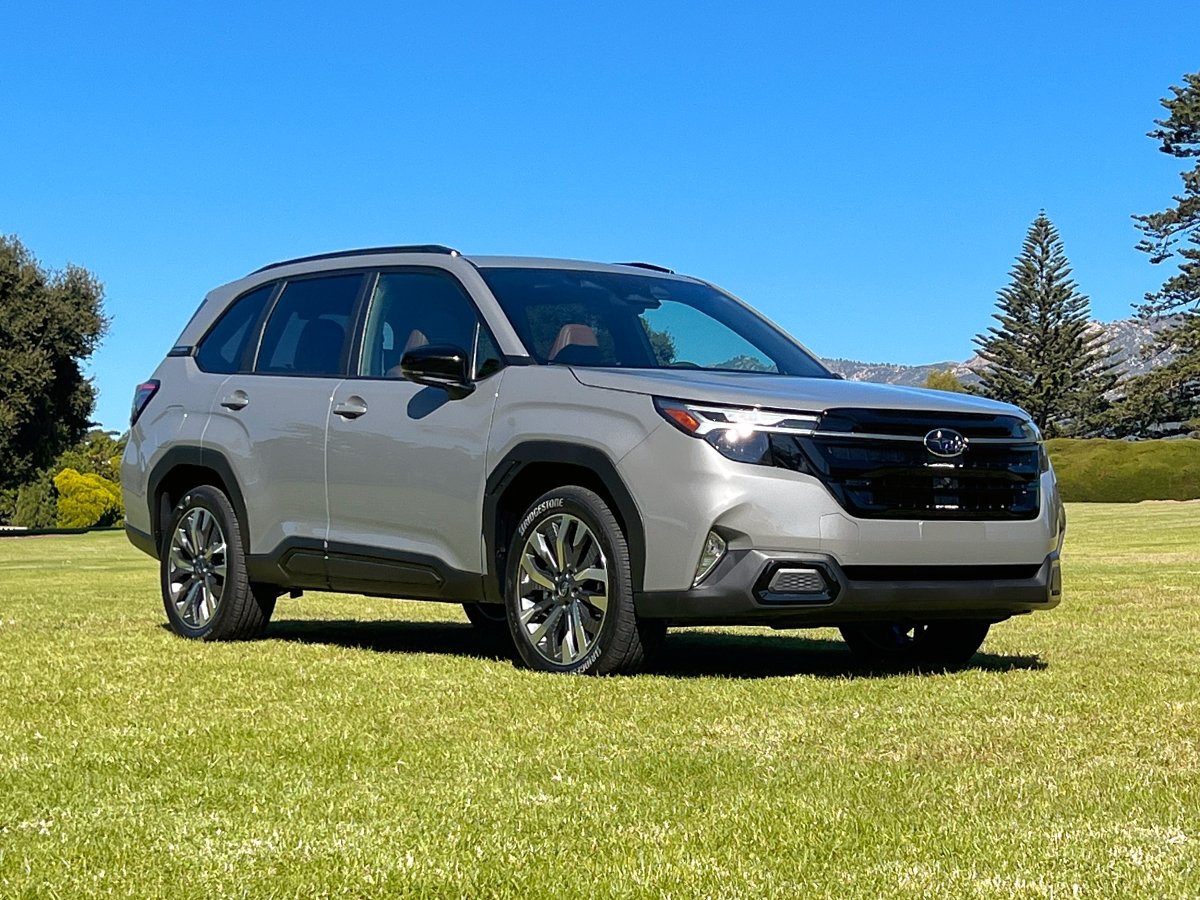
Photo: Christian Wardlaw
Subaru’s popular compact crossover SUV also continues with a familiar trim-level lineup. It includes Base, Premium, Sport, Limited, and Touring variants, and it’s almost certain that Subaru will reveal a Wilderness version. The 2025 Forester Wilderness will likely provide extra ground clearance, more protective body cladding, and enhanced off-roading capability.
A new Subaru Forester Hybrid is also on the way. It remains unknown what the 2025 Forester Hybrid will use for a powertrain, but don’t be surprised if Subaru leans on its electrification partner, Toyota, for the technology, as it did when building the previous-generation Crosstrek plug-in hybrid electric vehicle (PHEV). A Forester equipped with similar technology would be compelling now that Toyota is crafting PHEVs with significant range (RAV4 Prime, Prius Prime).
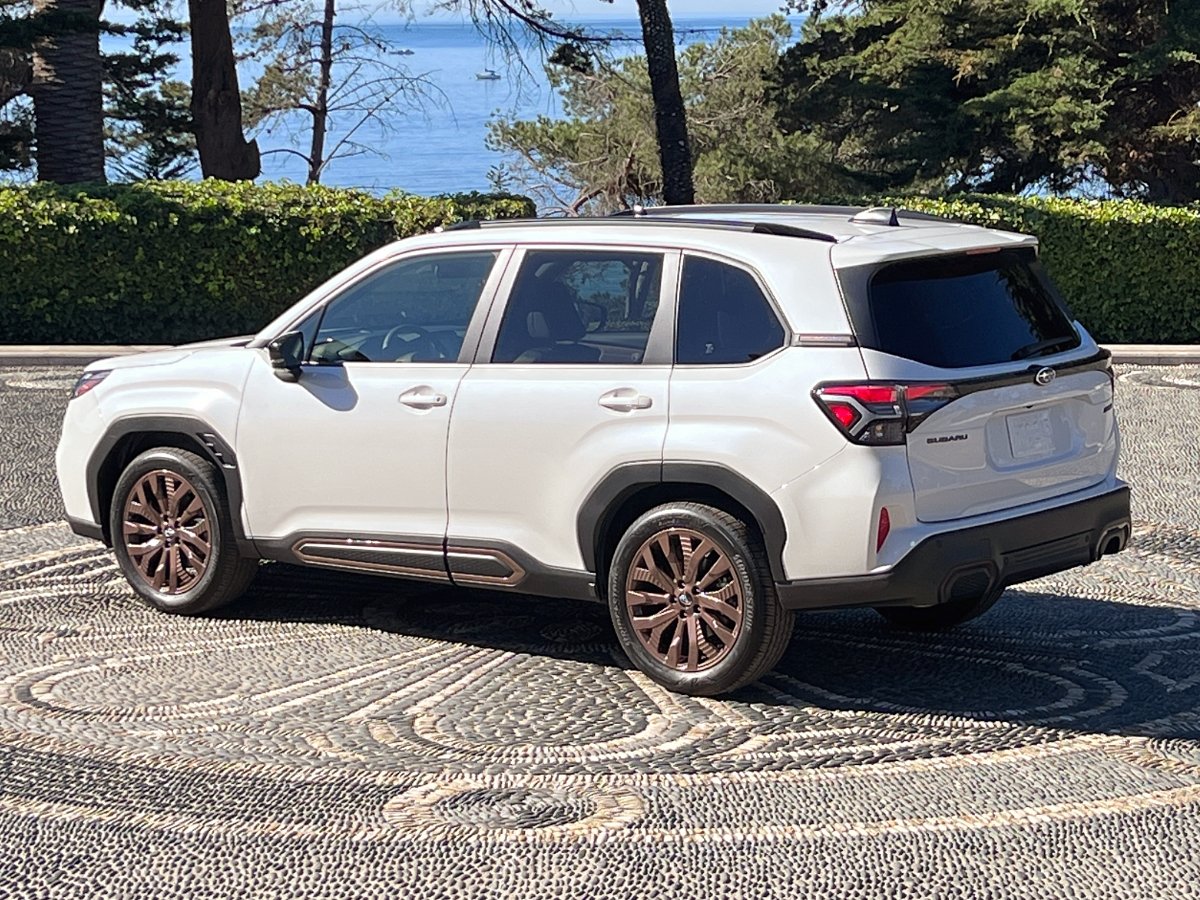
Photo: Christian Wardlaw
While the 2025 Forester adheres to established design parameters, it is arguably derivative of other SUVs. The front styling is similar to what you see on the Honda Passport. The trapezoidal wheel arches remind me of Jeeps and the all-new 2024 Hyundai Santa Fe. The rear end is reminiscent of a Kia Seltos.
Is that good? Bad? Neither, in my opinion. It might not ooze originality, but it looks inoffensively appealing while sticking to the core styling tenets that make a Subaru Forester a Subaru Forester.

Photo: Christian Wardlaw
Standard remote keyless entry grants access to the Forester’s new interior, where you’ll find a cleaner, more modern dashboard with fewer knobs and buttons. All but the Forester Base get an 11.6-inch touchscreen infotainment system incorporating the climate controls.
Is that good? Bad? It all depends on your perspective. The previous Forester’s cabin was a busy-looking, yet practical and functional space. The new 2025 Forester’s interior is cleaner and more sophisticated but could cause frustration.
Fortunately, Subaru knows that excellent outward visibility is a Forester hallmark, and the automaker promises it remains so. Based on a brief sit inside, that appears to be true.
In addition, Subaru redesigned the front seats to improve support and comfort while minimizing fatigue on longer trips. A minute or two spent behind the thick-rimmed steering wheel showed them to be comfortable on first impressions. To know whether they remain so after hours on the road requires an extended test drive.
A dual-zone automatic climate control system is standard on all 2025 Foresters and automatically focuses on the occupied seats instead of the entire cabin. Upgrades include heated front seats, heated side mirrors, and heated wipers. The Forester Touring adds ventilated front seats as standard equipment.
One reason for the Forester’s squared-off design is cargo capacity. Subaru says the maximum volume for 2025 is 74.4 cubic feet with the rear seats folded down, but that’s likely applicable only to variants without the panoramic glass sunroof. In any case, that measurement is 0.2 cubic feet larger than in 2024, so don’t expect the cargo space dimensions to change dramatically from the outgoing model.
Utility is baked right into the 2025 Subaru Forester. Roof rails are now standard on all trims, the cargo opening is wider, and the cargo area contains eight heavy-duty utility hooks. A hands-free power-operated liftgate is available for the first time, and you activate it by placing your foot under the back bumper.
Subaru equips the 2025 Forester with a 2.5-liter 4-cylinder engine. It makes 180 horsepower and 178 pound-feet of torque and powers all four wheels through a continuously variable automatic transmission (CVT). The automaker says the standard AWD system offers quicker response time to changing surface conditions, and it has refined the CVT for smoother operation.
Starting with Premium trim, the Forester provides transmission paddle shifters to control the CVT’s eight programmed ratios manually. In addition, the Forester Premium includes a hill descent control system and Subaru X-Mode, which enhances grip in different driving conditions. Starting with Sport trim, Subaru equips the Forester with dual-function X-Mode offering added traction programs useful in a wider array of driving situations.
The 2025 Subaru Forester provides 8.7 inches of ground clearance, surpassing nearly all its rivals. That’s useful when traveling through standing water on roads, when blizzards strike, and when heading far off-road to a remote campsite.
Driving dynamics get an upgrade thanks to a 10-percent increase in torsional rigidity and a version of the WRX sport sedan’s dual-pinion electronic power steering rack. In addition, Subaru says the new Forester boasts a smoother ride and a quieter interior than before.
Alloy wheels are standard on every 2025 Forester, ranging in size from 17 to 19 inches. The Sport trim offers trendy bronze-colored wheels for a distinctive look.
Subaru equips the 2025 Forester with a next-generation version of its EyeSight collection of advanced driver assistance systems (ADAS). It benefits from a wider field of view than before, updated software, and an electronic brake booster to deliver improved effectiveness.
In addition, the new Forester is the first Subaru to offer a new standard safety feature called Emergency Stop Assist. This automatic emergency stop assistance system works when using the adaptive cruise control system and responds to an inattentive driver by bringing the Forester to a stop, turning on the hazard lights, and calling emergency services to summon help.
Every 2025 Forester also has standard steering-responsive LED headlights with automatic high-beam operation. Additionally, the compact crossover SUV offers these available ADAS:
Automatic emergency steering is an evasive steering-assistance system that works at speeds under 50 mph. It gives the Forester added stability when the driver suddenly swerves to avoid an obstacle in the road.
In addition, the Forester Touring includes a DriverFocus Distraction Mitigation System. This driver monitoring system employs facial recognition software and a camera that monitors the driver’s face and can warn when the driver is distracted from driving. It also supports gesture control adjustment of the climate control system temperature.
In addition to the latest EyeSight technology, the all-new 2025 Forester upgrades to the latest STARLINK infotainment systems. For the Base trim, this means dual 7-inch touchscreens, with the upper screen offering Bluetooth connectivity, Apple CarPlay, Android Auto, and SiriusXM satellite radio access, while the bottom screen controls the climate system and other vehicle settings.
Most 2025 Foresters will have the all-in-one 11.6-inch infotainment touchscreen with wireless Apple CarPlay, wireless Android Auto, wireless smartphone charging, and embedded climate controls. This system provides volume and tuning knobs and temperature control buttons, so it’s easy to adjust common functions. A navigation system with voice recognition and what3words technology is available with the single-display infotainment system.
STARLINK Safety and Security connected services are available, equipping the Forester with features such as SOS emergency assistance, automatic collision notification, a remote vehicle locator, remote access to vehicle locking, and more.
Every car company makes a compact crossover SUV, so the new Subaru Forester faces plenty of competition. The list of the most appealing alternatives includes the Ford Bronco Sport, Honda CR-V, Hyundai Tucson, Kia Sportage, Mazda CX-50, Nissan Rogue, Toyota RAV4, and Volkswagen Tiguan.
Still, the Forester’s traditional focus on roominess, practicality, utility, safety, and genuine capability on and off the road in any weather should continue to serve it well.
Subaru is the source of information in this article. It was accurate as of November 16, 2023, but it may have changed since that date. Always confirm product details and availability with the automaker’s website or your local dealership.
Christian Wardlaw is a veteran digital automotive journalist with nearly 30 years of experience in test-driving vehicles. In addition to JDPower.com, his work has appeared in numerous new- and used-car buying guides, newspapers, and automotive industry trade journals. Google him to learn more.


Although both the 2026 Toyota Corolla and Toyota Camry share Toyota engineering and many standard features, they target different buyers. To see how they compare in value, reliability, performance, ...See More
Read the Full Article
Both the 2026 Toyota Corolla and the 2026 Mazda Mazda3 come with comprehensive safety features and connected services, along with large infotainment screens and premium audio. To see how their ...See More
Read the Full Article
Touchscreens are almost universal in modern cars. However, not all display types are the same. An increasing number of the latest cars use something called an OLED display. But what exactly is OLED, ...See More
Read the Full Article
Although the 2026 Toyota Corolla and the 2026 Nissan Sentra target buyers with similar goals, they take different routes. To see how those approaches translate into real world value, reliability, ...See More
Read the Full Article