2/8/2017
By Dave Sargent
I have a confession to make: When Apple first unveiled the iPhone 10 years ago, I thought it was one of the most unnecessary things I had ever heard of. While the tech industry was telling me it would change the world, all I could see was that it was shockingly expensive and didn’t do much new compared with my very cool Motorola Razr, my laptop, and all of the other technology in my life. “Uh, no thanks.” Fast-forward to today where my iPhone is one of the first things I would grab if my house was on fire.
While technology continues to advance like a bullet train, consumers aren’t always willing to jump on board right away. JD Power recently asked regular consumers how they feel about the idea of fully autonomous vehicles being on the road. More than half basically said, “Uh, no thanks.”
In the meantime, automakers, automotive suppliers, universities, software companies, telecommunications companies, and even video gaming companies are moving full speed ahead to shape the future of autonomous vehicles. They’re spending billions of dollars to develop and sell autonomous vehicles that will function properly on city streets and highways. Frequent announcements are made by one automaker or another about the millions of miles their autonomous-vehicle fleets have driven to date. Predictions from industry experts about when fully autonomous vehicles will be available can range from three to 30 years, depending on the degree of automation, where they will be deployed and more.
Why are so many consumers worried about autonomous vehicles? It’s the technology.
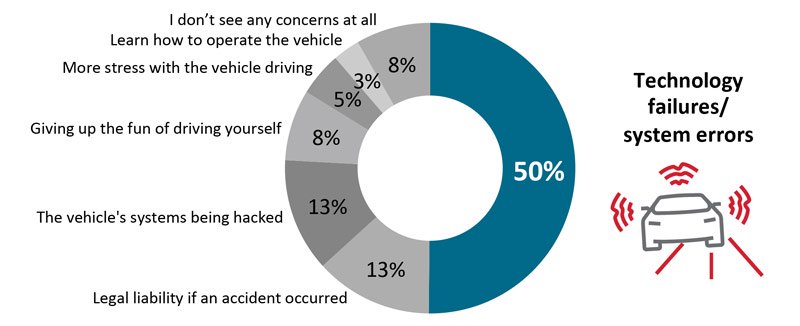
The most frequently mentioned concern about autonomous vehicles is the possibility of the technology failing. Half of all consumers surveyed cited this as their greatest concern, four times that of any other reason. Add to this another 13% saying their greatest concern involved the vehicle’s systems being hacked and almost two-thirds wondering whether the technology was safe. If my computer or phone crashes unexpectedly, it’s annoying, but not much more than that. If my autonomous vehicle’s technology fails, then “crash” takes on a whole new meaning.
Main Concerns with Fully Autonomous Vehicles
The good news for the automotive industry is that younger consumers—those who will likely comprise the bulk of vehicle buyers by the time autonomous vehicles are ready for mass consumption—have a much more positive outlook. Sixty-two percent of 18- to 24-year-old consumers and 56% of 25- to 34-year-olds say they have a “very positive” or “somewhat positive” feeling about autonomous vehicles.
Positive Feeling About Fully Autonomous Vehicles on the Road

Notwithstanding the concerns about autonomous technology, consumers consider safety (“fewer accidents”) as the primary benefit of autonomous vehicles. That said, the most popular answer to the question was, “I don’t see any benefits at all.”
Largest potential benefit of fully autonomous vehicles

An autonomous vehicle future is coming. Few industry observers doubt this and certainly JD Power is preparing for this. But while the engineers develop the technology and the infrastructure, the same level of effort will need to be made to gaining consumer acceptance. Manufacturers need to look at their marketing and communications strategies now and invest in nurturing and educating their potential customers.
As for me? Apple promises autonomous vehicles will rock my world, and this time I believe them.
# # #
Dave Sargent is vice president, global automotive at JD Power. He is rarely more than 10 feet from his iPhone, although he still thinks the Motorola Razr V3 looks better.
The information contained herein has been obtained by JD Power from sources believed to be reliable. However, because of the possibility of human or mechanical error by our sources, JD Power does not guarantee the accuracy, adequacy, or completeness of any information and is not responsible for any errors or omissions or for the results obtained from use of such information.
This material is the property of JD Power or is licensed to JD Power. This material may only be reproduced, transmitted, excerpted, distributed or commingled with other information, with the express written permission of JD Power. The user of this material shall not edit, modify, or alter any portion. Requests for use may be submitted to [email protected]. Any material quoted from this publication must be attributed to “JD Power Mobility Disruptors, © 2017 JD Power and Associates. All Rights Reserved.” Advertising claims cannot be based on information published in this report.