KEY TAKEAWAYS
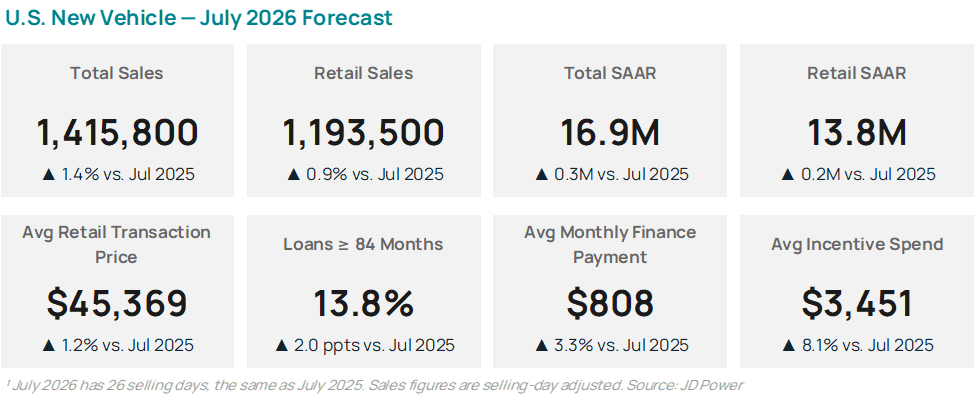
- Seasonally adjusted annualized sales rate (SAAR) forecast to rise 1.7% year over year to 16.9 million
- Hybrid market share rises 2.5 percentage points to 15.9%, while EV share falls 3.3 percentage points to 7.0% year over year
- Non-EV incentives tracking up 22.2% while EV incentives fall 7.0% to $10,092 per vehicle
The Total Sales Forecast
Total new-vehicle sales for July 2026, including retail and non-retail transactions, are projected to reach 1,415,800, a 1.4% increase year-over-year, according to a joint forecast from JD Power and GlobalData. The SAAR for total new-vehicle sales is expected to be 16.9 million units, up 0.3 million units from July 2025.
The Retail Sales Forecast
New-vehicle retail sales for July 2026 are projected to reach 1,193,500, a 0.9% increase from July 2025. The SAAR for retail new-vehicle sales is expected to be 13.8 million units, up 0.2 million units from July 2025.
Thomas King, president of OEM solutions at JD Power:
“Demand for new vehicles continues to be strong, with July delivering the highest annualized sales pace so far this year at 16.9 million units, with unit sales projected to rise 1.4% compared to a year ago.
“July’s headline sales results are unquestionably impressive, but evaluating the year-over-year results requires consideration of what happened a year ago. Last year, sales were boosted by the announcement that federal credits of up to $7,500 on electric vehicles would expire on Sept. 30. In response, many consumers who were thinking about buying an EV accelerated their purchases that otherwise would have occurred later in the year. On the other hand, sales last year were negatively impacted by lower-than-normal incentive escalation by manufacturers. Instead of discounts rising as they normally would at this time of year, incentive spending edged down reflecting the cost pressure that manufacturers were anticipating from tariffs.
“As with last year, macroeconomic uncertainty and affordability challenges persist, while higher fuel prices are an additional headwind this year. Despite all these complex dynamics, new vehicle demand remains robust. In fact, retail consumers are expected to spend $51.8 billion buying new vehicles this month, up $1.2 billion from a year ago and the highest ever for the month of July.
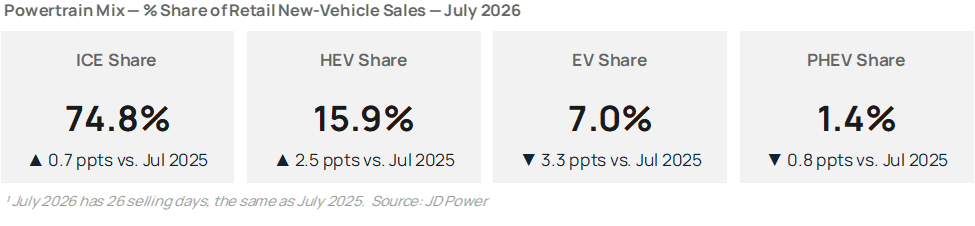
“While EV share has softened to 7.0% following the elimination of federal EV credits, the combination of elevated fuel prices and increased availability of vehicles with hybrid powertrains is driving a shift in the sales mix with hybrid share of retail sales expected to reach 15.9%, up 2.5 percentage points from last year.
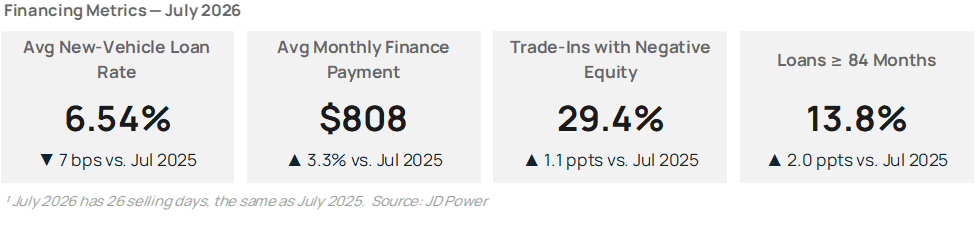
“Regarding affordability, the cost of financing a new vehicle keeps easing, though not by enough to neutralize the structural affordability pressures weighing on buyers. The average interest rate on new-vehicle loans is expected to fall 7 basis points to 6.54%, the lowest July reading since 2022. However, the average transaction price of a new vehicle has increased to $45,369, an increase of 1.2% from a year ago, while average monthly finance payments have climbed 3.3% to $808, the highest ever for the month of July. A key driver of the higher monthly payment, despite longer loan terms, is lower trade-in equity. Many of the buyers returning to showrooms today purchased when prices were at their peak several years ago when inventory was scarce. This is resulting in more buyers carrying negative equity on their trade-in; 29.4% of trade-ins had negative equity in July, up 1.1 percentage points from a year ago.
“Manufacturers are leaning harder on discounts to keep buyers in the market. Average incentive spending per vehicle is trending towards $3,451, an 8.1% increase from a year ago. Part of that jump reflects tariff dynamics last year, since several OEMs made unseasonal pullbacks in incentive spending last July as they cut discounts precautionarily to offset tariff costs. Incentives as a percentage of MSRP are expected to hit 6.7% in July, up 0.4 percentage points from July 2025.
“The divergence in manufacturer incentive strategies by powertrain continues to be evident in July. Incentive spending on traditional ICE and hybrid vehicles is expected to increase $578 per unit year-over-year, up 22.2%, to $3,181 in July 2026. Meanwhile, EV incentives moved in the opposite direction with a forecasted decline of $759 per unit or 7.0% to $10,092, contributing to the 3.3 percentage point decline in EV share of new vehicle sales compared to last year.
“Subprime penetration remains elevated from last year, with the mix rising 1.8 percentage points from July 2025 to 10.3% this month, a shift toward low-credit buyers as affordability pressures persist and many high credit buyers with the ability to accelerate their purchases did so last year. To manage monthly payments, consumers are using longer loan terms, with 13.8% of loans now carrying terms of 84 months or longer, up 2.0 percentage points year over year.”
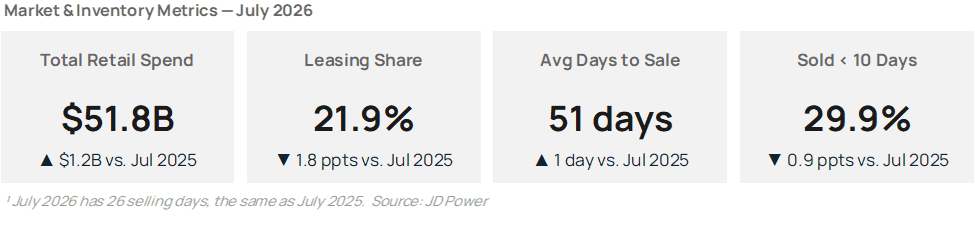
Retail sales volume growth with higher transaction prices means that total retail consumer expenditure is projected to rise to $51.8 billion, an increase of $1.2 billion from July 2025.
Global Sales Outlook
Kimberly Krafft, analyst, Americas vehicle sales forecasts at GlobalData:
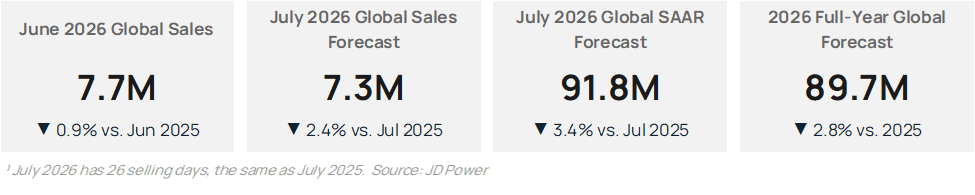
“June global light-vehicle sales are estimated to have declined 0.9% year over year to 7.7 million units. Although overall sales declined slightly, this was again mostly driven by a sharp decline in China, with other markets showing comparatively resilient sales. The selling rate for June was estimated at 90.0 million units, up only slightly from 89.3 million units in May.
“The Chinese market declined once again in June, with sales falling by 26.3% year over year, contributing to a further 22.7% decline of the year-to-date performance. China has been hurt by soaring fuel costs, on top of the ongoing ineffectiveness of auto market policy, regional financial difficulties and underlying macroeconomic divergence. Sales in the U.S. were supported by an additional selling day and remained steady despite weak consumer confidence. Western Europe also remained robust as consumers benefited from a widening range of BEV offerings.
“July sales are expected to decline 2.4% from July 2025, to reach 7.3 million units. This would translate to a selling rate of 91.8 million units, down by 3.4% year over year. China is expected to see another month of year over year declines, as sales in other markets are expected to remain relatively flat.
“Our forecast for total global sales in 2026 has been revised down to 89.7 million units, compared to an outlook of 90.5 million units a month ago. This forecast would represent a 2.8% year over year decline, as relative weakness in China, along with headwinds from economic and trade factors, drag down the global industry. Middle East tensions appear to be re-escalating, which could risk higher oil prices and other associated side effects including fuel costs, inflation and consumer demand. Therefore, we are maintaining a cautious stance on our global light-vehicle outlook for the second half of the year.”
Media Contacts
About JD Power
JD Power is a proven leader in business-critical data and intelligence to drive auto-related decisions with confidence and clarity. By leveraging unmatched proprietary data, advanced analytics and deep industry expertise, JD Power fuels original equipment manufacturers, retailers, lenders, insurers and partners to enhance their performance.
Since 1968, JD Power has delivered incisive guidance and intelligence about customer interactions with brands and products. To learn more about the company’s business offerings, visit JDPower.com.
About GlobalData: https://www.globaldata.com/