News & Insights

Tagged:
Clear filters
Content Type
Topic
Industry
Segment

Event Webinar

Residual Value Outlook 2026: What’s Next for Europe’s Used Vehicle Markets?

For the last few years, used-car markets across Europe have been under pressure, and the second half of 2026 is shaping up to be just as unpredictable. However, in this webinar, you’ll get a clear, data-backed view of where residual values are heading, and why. What’s Driving Europe’s Residual Value Movements in the Second Half of the Year? Behind every shift in used-car pricing is a web of macroeconomic pressures, supply-demand imbalances, and powertrain-level dynamics that are constantly evolving. In 2026, that complexity has only deepened.  Meanwhile, the UK used-car market, one of Europe’s largest and most distinctive, is following its own trajectory.  In this session, our valuations experts walk through the latest residual value forecasts, the macro forces behind the numbers, and what it all means for vehicle value retention across the markets you operate in.  VIEW THE ON DEMAND WEBINAR Meet our experts Hear directly from our specialists with hands-on experience across European used-car markets, residual value modelling, and automotive pricing forecasts Who This Webinar Is For This session is designed for automotive industry professionals whose work is directly shaped by used-car values, vehicle depreciation, and market pricing dynamics: Finance, insurance, and risk analysts   Fleet, leasing, and residual value managers   OEMs  Pricing and product managers   Portfolio and remarketing managers   Industry executives and business analysts   Key Takeaways A clear view of the European used-car market conditions: Understand depreciation pressures, supply dynamics, and demand signals determining vehicle value retention across key European markets.  The latest residual value forecasts, straight from the source: Get the most up-to-date RV projections and used-car pricing outlook, explained by the experts.  A focused look at the UK used-car market: Dig into one of Europe’s largest and most unique automotive markets, its depreciation trends, pricing dynamics, and what they signal for the broader region.  The market will remain uncertain for some. Yet, by watching this webinar, you can gain a sharper understanding of the forces shaping residual values and used-car price movements in the second half of 2026, and what they mean for the decisions you’re making right now.  Webinar Recap: What you missed The full webinar recap is now available. Watch the recording below. https://www.youtube.com/watch?v=uTFCTM9QVnk
Electric car charging

Insights

Is China’s appetite for new EVs starting to wane?

This content previously appeared on the Autovista24 website. Both battery-electric vehicle (BEV) and plug-in hybrid (PHEV) markets saw volumes plummet in China during February. But what is driving these declines, and which models came out on top? Autovista24 special content editor Phil Curry explores the figures. Following a difficult January, BEV and PHEV markets in China plummeted for a second month, according to EV Volumes’ data. BEV deliveries declined by 39.2%, with 262,698 sales in the month. Meanwhile, PHEV registrations fell 40.5%, with just 169,699 units leaving showrooms. As a result, BEV sales were down by 29.7%, with 609,513 deliveries after two months of 2026. PHEV volumes suffered more, as the 390,576 tally was 37.9% down compared with the same period last year. Increased model diversity has impacted the popularity of 2025’s best-selling options so far this year. This also suggests the appetite for new EVs in China is starting to wane. Tesla leads the way in China The Tesla Model Y led China’s BEV market in February, with 25,136 sales in the month. The crossover SUV struggled in the second month of 2025, but bounced back this year, increasing 214% year on year. Tesla often prospers in the end-of-quarter months due to its reporting patterns. This result in February highlights the turbulence of the Chinese market. The Model Y accounted for 9.6% of all local BEV sales in the month, up by 7.7 percentage points (pp). Second was the Xiaomi YU7, which only began recording domestic sales in June 2025. The model was the most popular in China during January. However, its 20,086-unit tally in February was markedly down on this performance. It accounted for 7.6% of total BEV deliveries. The Li Auto I6 rounded out the top three. Another relative newcomer, it saw sales begin in September 2025. A total of 15,997 units made their way onto Chinese roads in February. China’s top three BEVs were split by an even amount of almost 5,000 units between each position. This contrasted with the dominance of the Xiaomi YU7 in January. The result suggests buyers may be looking around in a more diverse market. Last year’s leading models appear to be struggling, as the country’s market faces headwinds. Popular models struggle Tesla saw its Model 3 place in the Chinese top 10, taking fourth in the month. With 12,758 units sold, this was a 32% year-on-year slide. The US BEV was responsible for 4.9% of deliveries, and due to competitor declines, this was an increase of 0.6pp. Last year’s best-seller, the Geely Geome Xingyuan, only managed fifth in February, with its 11,906-unit total down by 58.4%. The model has seen a slower start to 2026, suggesting it may not be able to live up to its performance last year. Sixth was the Nio ES8, which saw volumes increase dramatically since September last year. Its 11,779 units marked a 2,359.1% increase compared to February 2025, while a 4.5% market share was up 4.4pp. A pair of BYDs followed, with the Dolphin seeing stable results in seventh. A total of 6,006 units represented a decline of 0.1%. In eighth was the BYD Seagull, which saw numbers plummet by 78.6%, as just 5,779 units were sold. Next came another pair of models, with the Wuling Bingo Plus seeing 5,263 sales, a 45.3% rise compared to the same point last year. Rounding out the top 10 was the Wuling Mini, the second-best-selling BEV in China last year. With 5,230 deliveries, volumes were down 76.3%. This was only good enough for a 2% market share, a drop of 3.1pp. Xiaomi proves popular February’s top three all featured in the top cumulative positions spanning the first two months of 2026. Thanks to its strong result in January, the Xiaomi YU7 led the way. With 58,010 sales, it held 9.5% of the market, a sizeable 14,802 units ahead of its nearest challenger. This was the Tesla Model Y, which started 2026 much stronger than last year. With 43,208 units, it represented 7.1% of BEV sales and ended the two-month period 10,335 deliveries ahead of third place. This position was taken by the Li Auto I6, recording 32,873 sales. It took a 5.4% share of the country’s BEV market between January and February. While these BEVs soared, both the Geely Geome Xingyuan and the Wuling Mini struggled. The Geely model took fifth after two months with 26,793 sales. Meanwhile, the Wuling Mini did not feature in the top 10, sitting 13th after two months of 2026. Fang Cheng Bao up top in China China’s PHEV market has been struggling for some time. However, while volumes were down year-on-year, there was some stability in model choice. For the second successive month, the Fang Cheng Bao Tai 7 led the way. The BYD subsidiary brand saw 11,078 units sold in February. It represented 6.5% of China’s PHEV volumes in the month. The BYD Song Pro took second, although its 9,307-unit total was 37.9% down year on year. While the domestic brand placed five models in the top 10 during the month, none of them managed to see volume increases. As a popular PHEV brand in recent years, this decline is likely contributing to the market’s struggles. Third went to the Aito M7, with the PHEV variant responsible for 3.8% of all deliveries, a 2pp rise. Its 6,479 sales were an increase of 24.5% compared to February 2025. BYD volumes plummet Both of last year’s top two models struggled in February. The BYD Qin Plus saw sales plummet 66.9% as just 5,252 units left forecourts. This was enough for a 3.1% market share, down 2.5pp. It was followed by the BYD Seal 6 with 5,159 deliveries, down 59.1%. A 3% hold of the PHEV total was down 1.4pp compared to 12 months prior. Sixth was the Zeekr 9X with 5,082 units sold, having only entered the market in September 2025. It also held a 3% market share. The Li Auto L6 was next. The medium SUV struggled in February, with its 4,746 sales down by 63.9% year on year. It claimed 2.8% of the market, a 1.8pp drop. Following it in eighth was the Wey Gaoshan. First recording sales in September 2023, its numbers started ramping up in the middle of 2025. Its 4,133-unit total was a jump of 1,105% compared to February 2025. Rounding out the table was another pair of BYD vehicles. The Song L suffered a 59.5% fall as 3,724 units were sold in the month. The BYD Qin L took 10th, with 3,603 units, a 77.8% fall in volumes. This was the biggest decline in the top 10. Close battle for PHEV models After leading the sales in both January and February, the Fang Chen Bao Tai 7 led the cumulative table. With 28,631 units delivered, it held 7.3% of the market, 10,251 units ahead of its nearest competitor. In second, after two months of 2026, was the Aito M7. It saw 18,380 units delivered in the period, taking a 4.7% market share. After a strong result in January, it slipped back towards the BYD Song Pro, which held third, but was only 423 units behind. The BYD model accounted for 17,957 units between January and February. This resulted in a 4.6% share of the market.
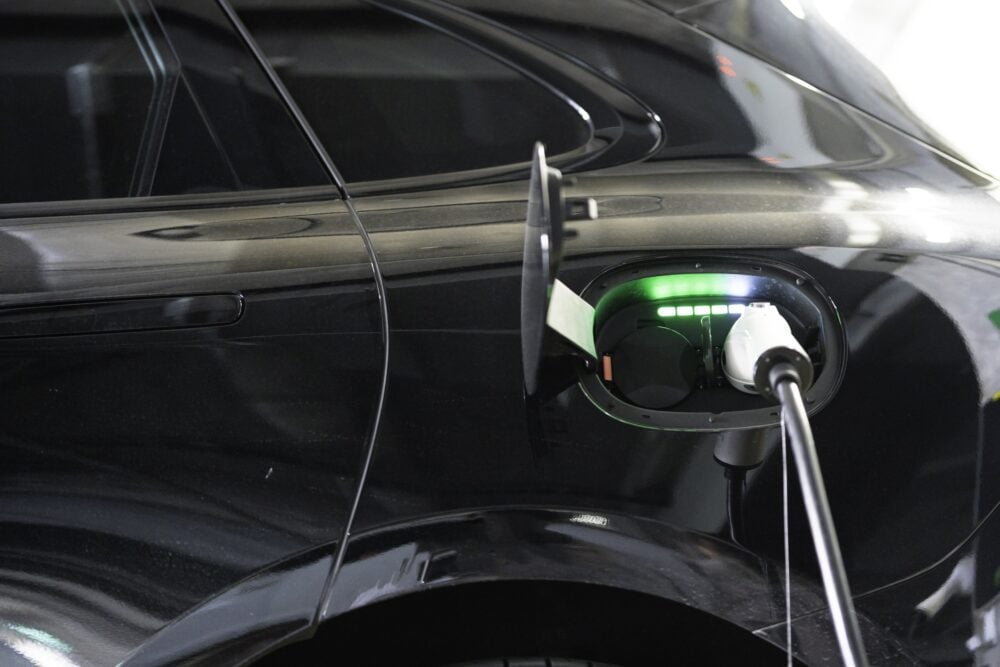
An electric car that is currently charging.|

Insights

What drove unusual Chinese EV results in January?

This content previously appeared on the Autovista24 website. Electric vehicle (EV) sales in China dropped dramatically in January, as the market started 2026 with a struggle. But how did different brands influence this result? Autovista24 special content editor Phil Curry examines the numbers. China’s EV market started 2026 in disarray. Battery-electric vehicle (BEV) and plug-in hybrid (PHEV) sales were down compared to January 2025, according to EV Volumes’ latest data. Additionally, the top 10 best-selling models for both markets were mixed, with newcomers spread throughout. BEV deliveries fell by 20.4% in January, with 346,798 units reaching customers. This was the lowest total for the technology since February 2024. Meanwhile, PHEVs suffered an even steeper drop of 35.6% to 220,867 sales. The country’s PHEV decline was a recurring theme throughout the last half of 2025. However, the drop in BEV volumes is new. This comes after sales growth slowed towards the end of 2025. The country’s market will be hoping January’s drop is not the start of an ongoing trend. Mixed BEV results The top 10 best-selling BEVs in China included five models that were not on sale in January 2025. To highlight the diverse mix, only one model from Tesla and BYD featured, respectively. Both brands appeared to struggle at the start of the year. Even last year’s best-selling BEV in China, the Geely Geome Xingyuan, dropped deliveries compared to 12 months prior. Instead, a slew of newer models took advantage of the BEV market’s slowdown, entering the top 10. The Xiaomi YU7 headed the Chinese BEV table in January. This model began recording sales volumes in June 2025. It achieved 37,924 deliveries in the month and gained a 10.9% market share. The YU7’s delivery figure was a record for a single BEV in January. Although the model itself achieved higher sales in December 2025. The Nio ES8 achieved second with 18,513 units sold. The carmaker has ramped up deliveries, and January represented its third consecutive month of five-digit figures. Its market share jumped to 5.3%, up from just 0.1% a year prior. Rounding out the top three was the Tesla Model Y. With 18,072 units, its sales declined by 29.7% compared to January 2025. This was also reflected in its market share, which dropped 0.7 percentage points (pp) to 5.2%. Newcomers storm BEV chart Since first recording sales in September 2025, the Li Auto I6 ended January in fourth with 16,876 sales. This equated to a 4.9% market share, a positive performance for a newcomer. Last year’s best-selling Chinese BEV, the Geely Geome Xingyuan, ended January in fifth, with 14,887 deliveries. This was a 47.1% year-on-year decline, and the model’s lowest monthly sales since it started recording sales in September 2024. Sixth went to the Aito M7, with 13,129 sales. This was a record amount and the model’s first foray into five digits since its launch in September last year. With 6,772 deliveries, the combined total of the MG4 and MG4 Urban took seventh. These models were relaunched in the second half of 205 in China and achieved a 2% market share in January. The only BYD model in the top 10 was the Dolphin, which saw sales increase by 25.9% to 5,859 units. Its 1.7% market share was up 0.6pp. Eighth went to the Wuling Bingo Plus with 5,632 deliveries, a 103.5% rise compared to January 2025. It achieved a 1.6% hold of the market, a full percentage point increase. Rounding out the top 10 was the Toyota bZ3X. The Japanese model made its top 10 debut, just nine units behind the Wuling BEV. With 5,623 deliveries, it achieved an equal 1.6% market share. Struggles for BYD and Tesla Both Tesla and BYD have been staples of China’s BEV market, but January’s figures could suggest a difficult year ahead. Although the Tesla Model Y placed well, its sales decline was the second successive January drop. Meanwhile, the US brand’s Model 3 ended the first month of 2026 in 43rd place, with just 2,030 units making their way to customers. For BYD, its Seagull model, a constant BEV top 10 finisher last year, ended January 2026 in 11th. With just 5,525 sales, this was its worst monthly total since its first appearance in the Chinese market in April 2023. Meanwhile, the Yuan Up was 14th with 5,495 units. This also marked its worst volume since debuting in March 2024. Looking at both brands’ EV sales, January was a poor month. BYD saw a 61.6% decline to 77,209 plug-in units, compared to 201,017 deliveries a year prior. Tesla saw 20,116 deliveries, all of which took place in the BEV market. This was a drop of 40.4% compared to the same period in 2025. Fang Cheng Bao leads the way BYD’s woes continued in the PHEV market, a sector it dominated in 2025. Last year, seven of the best-selling top 10 came from the Chinese carmaker. In January, however, just three made it to the chart, and none saw sales growth. Instead, it was the carmaker’s sub-brand, Fang Cheng Bao, that took the top spot with the Tai 7. The SUV, which began mass deliveries in September 2025, has been slowly climbing the PHEV table. It dominated January’s chart with 17,553 units and a 7.9% market share. Second went to the Aito M7, with 11,901 deliveries, a 41% rise year on year. This meant a 5.4% share of PHEV sales in China, up by 2.9pp. The BYD Song Pro led PHEV sales for the brand in January. Its share sank by 0.7pp to 3.9% as it took third with 8,650 units. This was the model’s worst monthly total since July 2021. The BYD Qin Plus was next, with 7,527 deliveries putting it fourth, with volumes down 49.8% year on year. This too was a new low, with deliveries not hitting these depths since January 2023. Another new model, the Zeekr 9X, took fifth with 6,594 units and a 3% market share. The model started deliveries in September 2025. Mixed results for PHEVs The Aito M8 was the sixth-best-selling PHEV in China during January, with 5,316 units delivered. The model first recorded sales in April 2025. Coming in behind was the Li Auto L6, with 5,030 sales. This was a year-on-year drop of 64%. The figure was the model’s lowest since it hit the market in April 2024. It was good enough for a 2.3% market share, down by 1.8pp compared to the same point last year. The Aito M9 took eighth, the brand’s second appearance in the January top 10. However, its 4,821-unit tally was 47.5% down compared to January 2025. This meant its market share slipped by 0.5pp, to end the month at 2.2%. The Wey Gaoshan came ninth. Having previously moved lower numbers, the model had a stronger end to 2025. It appears to have continued this run into 2026. With 4,813 sales, it managed a market share of 2.2%, up by 2.1pp. Rounding out the top 10 was the BYD Seal 6 with 4,666 sales. This was a drop of 67.8% and was the model’s second consecutive month of four-digit deliveries. It was also its lowest volume since it first recorded sales in May 2024. Compared to 12 months prior, its share of the market was cut in half to 2.1%.
Curve of the highway to the destination. Concept of enjoying the trip and the beauty of the landscape|

Insights

Spain’s new-car market remains strong as new incentives take shape

This content previously appeared on the Autovista24 website. February provided plenty of positives for Spain’s new-car market. But as the nation’s market continues to grow, is electrification progressing as planned? Autovista24 web editor James Roberts examines the latest numbers.  February saw a second consecutive month of growth for the buoyant Spanish new-car market. In total, 97,082 new vehicles took to the country’s roads, 6,755 more than 12 months prior. This ensured a 7.5% year-on-year increase, according to the latest ANFAC data. With only December 2025 blotting an unbroken streak of year-on-year gains for Spain’s new-car market, February resumed a familiar trend. Industry body ANFAC highlighted that all channels achieved growth in the month, particularly the rental sector, which saw a 22.6% uptick. ‘After a hesitant start in January, February is once again a positive month for vehicle sales,’ stated Félix García, director of communication and marketing at ANFAC.‘Last month, the rental car channel was the one that grew the most, accounting for almost one in five sales of passenger cars. It is a logical increase to renew the fleet for the Easter period. Without these sales, the growth of individuals and companies is flatter compared to February 2025.’ This ‘good pace,’ as highlighted by ANFAC, prevailed when assessing the first two months of 2026. Combined January and February totals amounted to 170,185 passenger cars. This ensured a unit upswing of 7,542 compared with the same period in 2025, a healthy 4.6% boost. Hybrids remain top new-car choice Hybrids, made up of both full and mild hybrid powertrains, remained the top seller in February. In total, 46,592 new hybrids joined Spain’s car parc in the month, according to ANFAC. This robust total returned a 17.1% year-on-year increase and a 48% market share. This was just 0.6 percentage points (pp) down on January’s record, suggesting hybrid popularity is not ebbing. It was even up by 3.9pp year on year. Spanning the opening two months of 2026, hybrid cars held a dominant 48.3% market share, up 3.7pp year on year. Across January and February, 82,189 new hybrids made their way to customers in Spain. Spain’s BEV market share issue Amid this preference for hybrids, ANFAC highlighted that EVs, including battery-electric vehicles (BEVs) and plug-in hybrid vehicles (PHEVs), continue to be a ‘key segment.’ However, is this consistently strong sector in danger of stagnating, especially when it comes to BEV uptake?   February saw 8,889 new BEVs take to Spain’s roads. This equated to a 45.4% volume increase, carving out a 9.2% market share, up 2.4pp. After two months of the year, the BEV market share stood at 9%, 2.2pp up year on year. This comes as volumes reached 15,361 units, establishing a 38.1% year-on-year upswing. One reason for new-BEV buying reticence could be uncertainty. Spain’s relatively successful trend of EV adoption had been enabled by a long-standing incentive framework, the MOVES plan. This was introduced in 2019, funded by the EU’s NextGenerationEU recovery funds, and managed in conjunction with Spain’s regional governments.  The issue with incentives The last iteration, MOVES III, came to an end on 31 December 2025. Its replacement, the Auto 2030 Plan (Auto+), announced at the beginning of December, aims to centralise and simplify EV incentives. It will mobilise up to €400 million in public and private investment between 2026 and 2030 to increase electrification in Spain. It will offer varying discounts on BEVs and PHEVs, spanning direct purchases, leasing and renting arrangements. The subsidies will be applied retroactively to vehicles purchased since 1 January in Spain. However, the government website has not yet confirmed publication. According to Carwow, Full implementation of the Auto 2030 Plan is not expected until at least May this year.  In late January, the Ministry of Economy, Trade and Business proposed amendments to the Auto 2030 Plan, according to La Tribuna. Addressing industry concerns, the change reportedly re-centres the scheme around cars manufactured within the EU. This would make the plan more closely aligned with the system used in France, as reported by electrive. One result of the amendments could be the discouragement of some models made in China from eligibility. This could bring additional uncertainty into the market. An added complication relates to Chinese carmakers investing in Spanish manufacturing, such as Chery and BYD. Spain’s need for clarity ‘Although the Auto+ plan has already been announced, and there are brands that have committed to bringing forward the discounts, there is no doubt that the official publication of clear and agile regulatory bases is essential to increase confidence,’ stated Tania Puche, GANVAM’s director of communication. Raúl Morales, communications director of FACONAUTO, added: ‘For another month, electrification has driven the market, once again exceeding 20% ​​market share in new registrations. This is partly due to the announcement of the retroactive application of the Auto+ Plan, which provides aid to electric vehicles. ‘What we need now is for the regulatory framework for this plan to be published as soon as possible, so that buyers continue to have certainty and electrification can continue to increase its registration numbers,’ he continued. Whatever the outcome, industry bodies are urging further clarity around electrification uptake measures to boost sales in the country. ‘It is urgent to reactivate the tax deduction in personal income tax for the purchase of electric vehicles and the bonus for the installation of charging points, measures that have been overturned in congress for the second time in two months,’ Puche stated. PHEVs still proving popular As BEV uptake looks to push through to new heights, PHEV popularity has helped lift Spain’s overall plug-in sector. Since a notable triple-digit percentage volume surge in May 2025, the powertrain has continued to sell well. In February, 12,092 new PHEVs left forecourts in Spain, equating to a 75.2% year-on-year increase. Across the first two months of this year, PHEVs have seen 20,832 registrations and a 71.6% volume lift. This has ensured a 12.2% market share, up 4.7pp year on year. This strong start to 2026 and the enduring appeal of the powertrain have boosted overall plug-in deliveries. Spanning January and February, combined BEV and PHEV registrations reached 36,193 units. This marked a significant year-on-year climb of 55.6%. This also brought some meaningful market share capture, with the powertrains accounting for 21.3% of overall registrations, up 7.2pp. The combination of electrified registrations, including hybrids, BEVs and PHEVs, took the dominant slice of the Spanish new-car market. Across the opening two months of 2026, a total of 118,382 new electrified vehicles were registered in the country. This 23.7% upswing ensured a market share of 69.6%, a new high, and a 10.7pp increase. Petrol remains a key player With many headlines surrounding EV volume growth, it is easy to ignore the prevailing appeal of petrol within Spain. At first glance, sales have taken a year-on-year nosedive. Fewer new petrol-powered options are available as the industry moves towards net-zero. However, when it comes to market share, the fuel type is clinging on in Spain. In February, 22,534 new petrol vehicles reached customers, a 19.5% year-on-year dip. Although this continued the trend of double-digit monthly declines, the reality is more nuanced. Combining January and February’s new-car registration totals, petrol accounted for 23% of the market, with 39,067 registrations. Although volumes were down 20.8% year on year, the fuel type commanded the second-highest market share after hybrids. Petrol was 14pp higher than BEVs, and 10.8pp above PHEVs. While petrol retained influence in Spain’s new-car market, diesel continued its descent. The fuel type saw just 7,226 new vehicles registered across January and February. This underlined a significant 28.6% year-on-year drop and a meagre 4.2% market share, down 2pp. Total internal-combustion engine (ICE) new-vehicle registrations, including petrol and diesel, totalled 46,293 in January and February. This provided a 27.2% market share, down 9.3pp year on year, but still 5.9pp above EVs. One of the big questions now is whether plug-in sales will overtake ICE volumes in Spain this year.

|

Insights

The Automotive Update: What does China’s slowing EV market mean for global sales?

This content previously appeared on the Autovista24 website. What is happening in China’s electric vehicle (EV) market? How much is Uber investing in autonomous vehicle charging hubs? Can Europe build its own EV batteries? Tom Geggus, Autovista24 editor, discusses these points in The Automotive Update podcast. In this episode, Autovista24 analyses China’s slowing EV market and reveals the best-selling models in the country. Plus, how has Tesla avoided suspension of its dealer and manufacturer licence in the US? Subscribe to the Autovista24 podcast and listen to previous episodes on Spotify, Apple and Amazon Music. China’s slowing EV market Globally, China accounts for 59.1% of battery-electric vehicle (BEV) sales and 70.3% of plug-in hybrid (PHEV) deliveries. But despite dominating the figures, the country saw its total EV numbers struggle in December. Figures rose by just 0.5%, according to the latest data from EV Volumes. Despite total plug-in sales increasing between January and December last year, this was not helped by the country’s PHEV market. It experienced a run of monthly declines from July onwards. One reason for this poor performance was the decline of BYD. The brand accounted for 33.3% of total EV sales in China during 2025 and dominated the PHEV market. Yet its sales were down 9.9% across the year. However, with new players entering the PHEV market, 2026 will see more brand diversification. This could help boost figures, while new BYD models will also help impress buyers. BEV sales rose by just 4% in December 2025 following a run of double-digit improvements. China’s carmakers will be hoping this is not the start of a new trend, especially if the PHEV market continues to struggle. Tesla avoids suspension Tesla has avoided a 30-day suspension of its dealer and manufacturer license in California. This follows the brand halting its use of the term ‘Autopilot’ in its vehicle marketing in the state. The Department of Motor Vehicles adopted a decision that the use of the term is ‘misleading and violates state law’. This is linked to Tesla’s use of Autopilot to describe its advanced driver-assistance systems. Uber invests in autonomous charging Uber Technologies will invest more than $100 million (€84.9 million) into autonomous vehicle charging hubs, according to Reuters. The company will deploy DC fast charging stations at its fleet depots and other locations throughout priority cities. This is expected to begin in the Los Angeles Bay Area as well as Dallas, before hitting other hubs. Uber will also work with charge point operators to establish ‘utilisation guarantee agreements’. This will support the rollout of hundreds of new chargers in cities across the world. EV charging offer in the Netherlands Leasing provider, Ayvens, has launched a new EV charging offering. Ayvens Power promises customers in the Netherlands access to over one million charging points across Europe, spanning different operators. Drivers will get real-time availability and pricing details before arrival. Meanwhile, a fleet portal will provide charging insights, cost visibility and reporting tools. The solution is due to roll out in France, Germany, Italy, Belgium, and the UK later in 2026. Can Europe build EV batteries? Yann Vincent, CEO of the Automotive Cells Company (ACC), has questioned who will make batteries for Europe’s domestic carmakers. ‘One crucial question remains: who will manufacture the batteries for European cars?’ Vincent asked. ‘Asian players, particularly Chinese giants, as is already the case for 99% of them? At the risk of putting the strategic independence of European car manufacturers solely in the hands of BYD, CATL, LG, etc?’. The CEO also confirmed that the ramp-up of ACC’s gigafactory in Hauts-de-France is taking longer and costing more than expected. This is weakening the company’s financial position. He also stated the goal of building the factory was ‘too close to give up on.’

Displaying 12 of 32 insights