
Hyundai's electric-vehicle (EV) catalog is expanding, this time with a polished, alluring sedan. The Ioniq 6 is an incredibly sleek, sexy car with curves for days. Hyundai recently held a press conference to debut the car, the second Ioniq-branded EV in the United States. Following the Ioniq 6, Hyundai will further expand the line in 2024 with the Ioniq 7, a midsize electric crossover SUV.

The new Ioniq 6 shares a platform and much of its underpinnings with the Hyundai Ioniq 5, Kia EV6, and Genesis GV60. While the other vehicles are crossovers, the Ioniq 6 is a sedan, demonstrating the flexibility of Hyundai's global EV architecture. Though it's a dramatically different shape than the related crossovers, the "6" carries the same battery configurations as the Ioniq 5.
Hyundai says production will start in late 2022, and the car will first hit South Korea and European markets. The North American release is scheduled for early 2023.
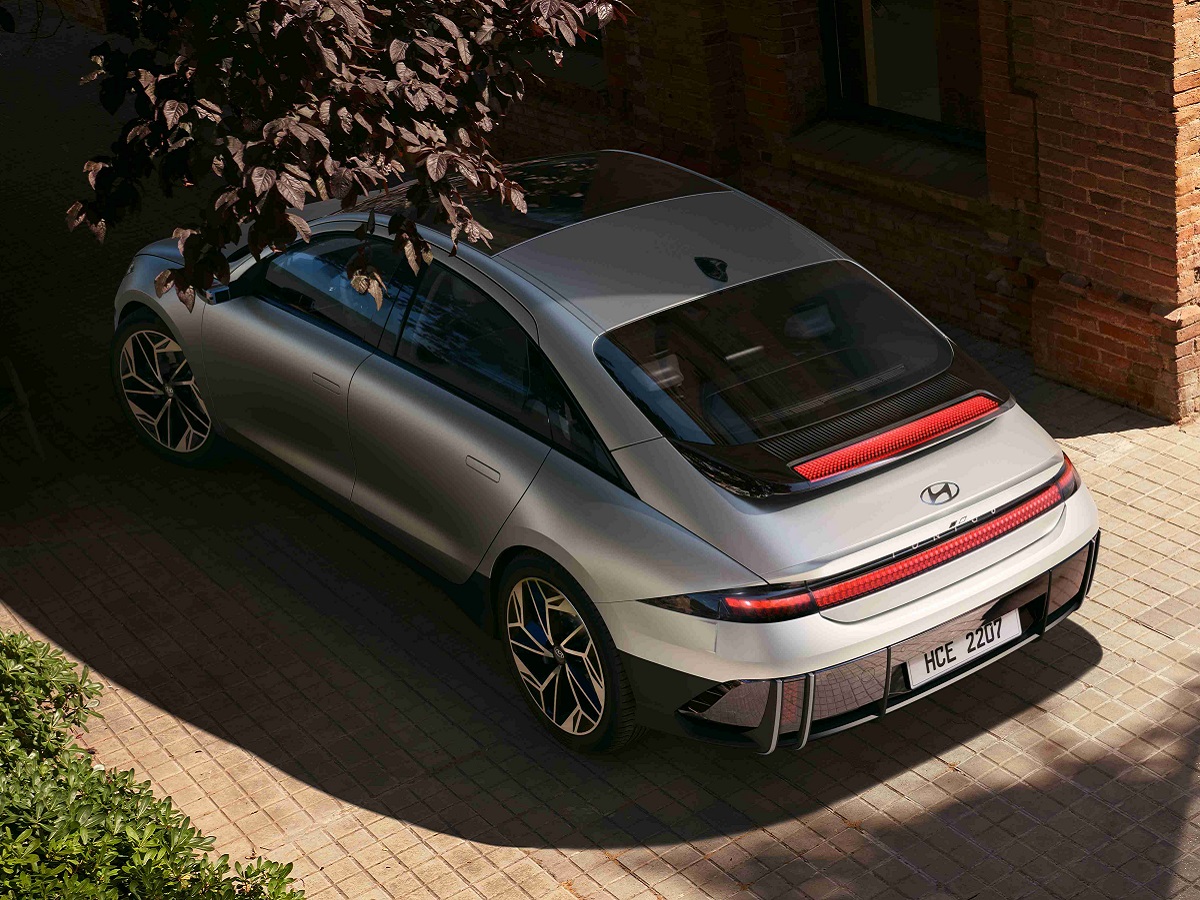
Where the Ioniq 5 is a somewhat boxy crossover, the Ioniq 6 is a sleek, slippery sports sedan. Hyundai says the car features a drag coefficient of just 0.21, putting it on par with the Lucid Air Dream Edition Range, Tesla Model S Long Range, and the Model S Plaid. The Ioniq 6 has a stretched wheelbase that Hyundai says provides better ride quality and stability, and it features the pixelated taillight design that debuted on the Ioniq 5.

Inside, Hyundai uses sustainable materials and unique processes to reduce the car's environmental impact. The automaker derived some of the paints from vegetable oils, and the carpeting is partially made from recycled fishing nets. Hyundai upholsters the seats and other interior components with recycled fabric or eco-process leathers.
Hyundai emphasizes the car's lounge-like interior and notes that the 64-color ambient interior lighting system shifts colors and intensity depending on the drive mode and situation. The dash features two large displays, with a fully digital gauge cluster and a prominent infotainment touchscreen. Hyundai also incorporated a unique state-of-charge gauge on the steering wheel, so the driver can quickly determine the car's remaining range.
Hyundai offers two battery configurations in the Ioniq 6. The standard-range setup incorporates a 53-kWh battery, and the extended-range configuration uses a 77.4-kWh battery. Extended-range models are available with either rear- or all-wheel drive. In its top configuration, the Ioniq 6 delivers 320 horsepower and 446 pound-feet of torque, good enough to propel it to 62 mph (100 km/h) from a standstill in a claimed 5.1 seconds. The WLTP standard typically yields much different range estimates than the EPA, but Hyundai says the Ioniq 6 returns up to 380 miles on a charge using WLTP.
Hyundai's E-GMP platform underpins the Ioniq 6 and enables 400- and 800-volt charging technologies. Using a 350-kW charger, Hyundai says the car can charge from 10 to 80 percent in 18 minutes. Like its predecessor, the Ioniq 5, the sedan carries vehicle-to-load (V2L) technology as standard. The feature lets Ioniq 6 owners run power equipment, charge devices, and even charge another EV using the car's battery.
The Ioniq 6 comes with all of Hyundai's advanced driver aids and safety goodies, but the automaker updates them for use in the new car. Standard features include:
The Ioniq 6 comes standard with a 12-inch digital gauge cluster and a 12-inch touchscreen. Apple CarPlay and Android Auto come standard, along with an updated Bluetooth function that supports pairing two devices at the same time. Hyundai connected services offer app functionality, vehicle controls for climate and other functions, and charging information.
Hyundai has built an online "Digital Studio" preview experience to build excitement for the vehicle, where prospective buyers can "walk" through the interior in 3D and view details on various components. Not one to miss out on a fad, Hyundai's also releasing an NFT collection for the car on July 14.
Over-the-air (OTA) updates have been a thing for a while now, but Hyundai says the Ioniq 6 is its first model to offer the function for updating vehicle controllers. That means the automaker can remotely update software for the car's electric system, autonomous driving functions, and battery control components. The OTAs will also continue for functions like maps and infotainment software.
The 2023 Hyundai Ioniq 6 has serious competition from high-end and mainstream EVs. It most directly competes with the Tesla Model 3 in range and size. Buyers may also consider crossovers like the Kia EV6 and even the Hyundai Ioniq 5. At the high end of the market, cars like the BMW i4 and Polestar 2 are compelling options.
Hyundai is the source of information in this article. It was accurate as of July 14, 2022, but it may have changed since that date. Always confirm product details and availability with the automaker's website or your local dealership.


Although both the 2026 Toyota Corolla and Toyota Camry share Toyota engineering and many standard features, they target different buyers. To see how they compare in value, reliability, performance, ...See More
Read the Full Article
Both the 2026 Toyota Corolla and the 2026 Mazda Mazda3 come with comprehensive safety features and connected services, along with large infotainment screens and premium audio. To see how their ...See More
Read the Full Article
Touchscreens are almost universal in modern cars. However, not all display types are the same. An increasing number of the latest cars use something called an OLED display. But what exactly is OLED, ...See More
Read the Full Article
Although the 2026 Toyota Corolla and the 2026 Nissan Sentra target buyers with similar goals, they take different routes. To see how those approaches translate into real world value, reliability, ...See More
Read the Full Article