
The latest chapter in Hyundai’s smart mobility transformation is the unexpected 2023 Ioniq 6. The streamlined, electric-powered midsize 4-door sedan sits low and wide, juxtaposed to taller-riding SUVs. It coddles passengers with exceptional roominess and uncommon design features. Single-motor rear-wheel-drive (RWD) and dual-motor all-wheel-drive (AWD) versions are available.
The driving range is exceptional for the class, estimated at 240 miles with the standard-range battery and between 270 and 361 miles with the long-range battery, depending on drive configuration and wheel size.
Owners can recharge their all-new Hyundai Ioniq 6 at both 400-volt fast-charge and 800-volt ultra-fast-charge DC stations, the latter with the capability to bring the Ioniq 6’s propulsion battery up to an 80-percent charge in as little as 18 minutes, according to Hyundai. The Korean automaker builds the Ioniq 6 on its first dedicated electric-vehicle (EV) platform, one that also underpins the Hyundai Ioniq 5, Kia EV6, and Genesis GV60.
Under sunny skies at a recent media event in Scottsdale, Arizona, I drove an Ioniq 6 AWD over more than 75 miles of busy suburban streets, limited-access highways, and curvy two-lane rural roads.

Image: Ron Sessions
The 2023 Hyundai Ioniq 6 model lineup consists of the following (prices include the $1,115 destination charge):
Built in Hyundai’s Asan plant in South Korea, Ioniq 6 production began in January 2023. The 2023 Hyundai Ioniq 6 is currently on sale and available in 43 U.S. states. Hyundai expects a sales mix of 45 percent AWD and 55 percent RWD.
Hyundai includes the Ioniq 6 EV in a new Evolve+ subscription program that also offers the Ioniq 5 and Kona EVs. The company says it is cheaper than renting; Evolve+ customers can subscribe at $799 for 28 days.
For this review, I drove the top-of-the-line Ioniq 6 Limited AWD long-range model with 20-inch wheels. Including the optional Gravity Gold matte-finish premium paint and carpeted floor mats, the test vehicle had a retail price of $58,425, including the $1,115 destination charge.
Hyundai lists the Tesla Model 3 and Polestar 2 among the Ioniq 6’s significant competitors.

Image: Ron Sessions
To say Hyundai’s new all-electric 4-door sedan has a unique shape is an understatement. The 2023 Ioniq 6 looks like nothing else in new car showrooms today. It’s not akin to anything in the brand’s existing product quiver wearing a Hyundai badge, either. Instead, there’s a hint of Porsche 911 or Oldsmobile Aurora in the nose, a bit of Infiniti J30 at the rear, and the organic, tail-dragger signature of a 1950s Hudson Hornet or 1960s Citroen DS21 in profile.
The Ioniq 6 California Design Manager Seung Wook Ryu was previously responsible for the Genesis G90 and G80 sedans as well as the GV60 electric crossover SUV. Mr. Ryu says his favorite angle is the rear but notes that Hyundai spent the most studio time on the Ioniq 6’s low and wide front appearance.
More than just a design that incorporates whimsical and eye-catching design elements, the Ioniq 6’s shape is a slippery one with a top-rated 0.22 coefficient of drag. The streamlined bodywork and several other aerodynamic enhancements not visible to the casual observer are vital to achieving the Ioniq 6’s impressive estimated maximum 361-mile all-electric range.
A cab-forward design with the low and wide dash moved to the front, and a long wheelbase help create a roomy interior. The Ioniq 6’s full-size-sedan-like 116.1-inch wheelbase is nearly 2 inches greater than Hyundai’s biggest SUV, the Palisade, and 5.6 inches longer than the Sonata midsize sedan.
Long doors ease access to the Ioniq 6’s roomy and airy interior. Rear-seat legroom is 4 inches greater than in the Tesla Model 3 and nearly a half-foot roomier than offered in the Polestar 2.
Not only is passenger space generous for both front and rear passengers, but there is also a feeling of spaciousness, from the low hood line and slender roof pillars to the large glass area all around. In addition, the cabin design is an exercise in architectural simplicity and ease of use.
Not making it to production for U.S.-bound cars are digital side mirrors, which replace the physical side mirrors with cameras outside and display screens at the upswept outboard edges of the instrument panel in other markets. The Ioniq 6 uses traditional side mirrors for the U.S. but keeps the upswept, aircraft-inspired winglets on the dash as a design element.
The generously proportioned front bucket seats, heated, ventilated, and power-operated in the Limited test car, were covered in premium faux-leather H-Tex material and had ample lateral torso bolstering for good support.
As with other contemporary Hyundai vehicles, in the Ioniq 6, the driver faces a pair of bright and crisp 12.3-inch high-resolution screens, a configurable digital driver instrument cluster with an EV technology display, and a central touchscreen for the infotainment system, navigation, and vehicle settings.
The Ioniq 6 features nicely sculpted inside door trim panels with simple pull-type door release handles free of decoration save for artfully scalloped forward sections that are perfect for comfortably resting a knee. The Ioniq 6’s switchgear is high quality yet straightforward in function. Mirror control moves from the door to the lower dash, and power window switches and door lock controls transfer to the center console.
Interior storage is generous. There’s a roomy glovebox that’s deep enough to swallow half of my forearm. A bridge-type console with a concealed cubby under the center armrest, dual cupholders, and an open forward bin with an available wireless device charger provides a flat workspace above and a large, open storage area below.
However, the Ioniq 6’s drooping tail crimps the trunk’s luggage capacity, which is a subcompact sedan-like 11.2 cubic feet—2.1 cubic feet less than a Ford Mustang fastback. There is also a tiny (0.5 cubic feet) front trunk or “frunk” big enough for a small laptop computer. Mitigating the small trunk, however, the car’s 60/40 split rear bench seat folds down, allowing longer items such as skis and ladders (or more luggage) to fit inside the sedan.
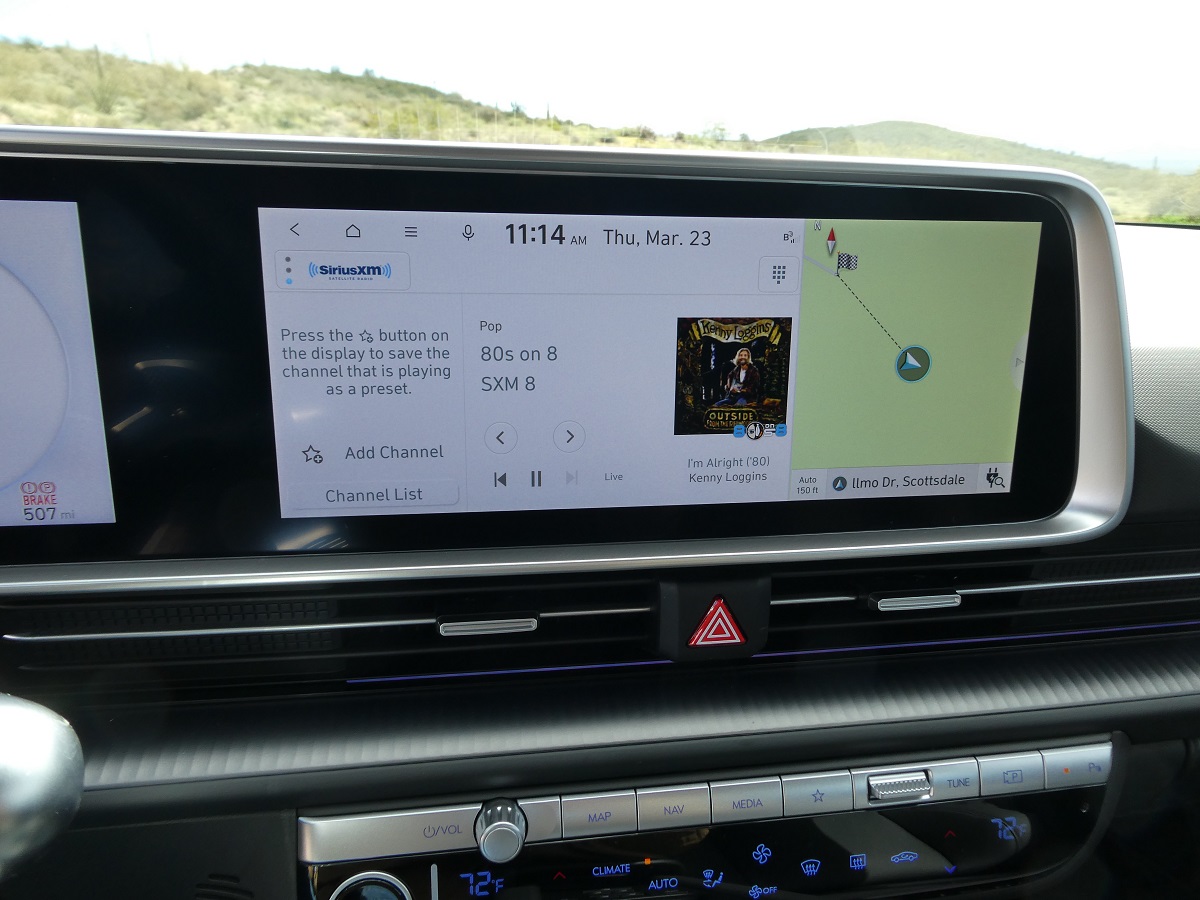
Image: Ron Sessions
The Hyundai Ioniq 6’s infotainment system combines the best aspects of a large, modern 12.3-inch landscape-oriented touchscreen with proven legacy controls such as a rotary analog volume knob and physical tuning toggle on the dash beneath the screen, along with a bank of hard shortcut buttons for accessing navigation, a map, media, and favorites. There is also a dedicated Home tab in the upper left corner of the touchscreen. As with other vehicles, redundant volume and tuning controls are on the steering wheel spokes. As a result, it’s an easy system to learn and use.
Hyundai’s voice control using native commands and activated with a steering wheel button works very well, responding to point-of-interest and other queries promptly and accurately.
One thing the Ioniq 6 is behind the curve with, however, is offering wireless access to Apple CarPlay and Android Auto. Unfortunately, you’ll need a USB cable to use smartphone mirroring in this otherwise very modern EV—something Hyundai promises to remedy once the company works out what they see as data security kinks with the wireless system.
At the front of the console is a single USB-A port for data and charging. A pair of smaller USB-C ports for charging only resides mid-console, with another pair of USB-C ports at the rear of the console for keeping the devices of back-seat passengers charged. A console-mounted wireless phone charger is standard with SEL and Limited trim.
Hyundai equipped the Limited test car with a rich-sounding, 8-speaker Bose premium audio system, replacing the 6-speaker AM/FM stereo standard in lower trims. In addition, both come with embedded navigation, HD Radio with traffic flow data, and a trial of SiriusXM satellite radio.
The Ioniq 6 is the first Hyundai to roll out with the advanced connectivity of a new Bluelink+ system that’s free to new buyers. Bluelink+ enables access to dozens of functions, including remote vehicle access, maintenance reminders, safety alerts, digital key access, remote charging control, intelligent route guidance for finding charge stations, cloud-connected point-of-interest searches, smart voice recognition, and much more. It also enables services such as a Verizon Wi-Fi hotspot, free during a three-month trial and $20 monthly afterward.
Hyundai equipped the Ioniq 6 Limited test car with a newly expanded array of SmartSense safety and parking-assist features. Luckily, aside from some warning beeps and an instrument panel alert to brake when another vehicle cut sharply in front of the Ioniq 6 ahead of a stoplight, I had no interaction with the systems that were silently watching over me in the background.
However, some of the advancements in these systems are worth noting. For example, forward-collision avoidance assistance—standard on SEL and Limited trims—now includes corner radar sensors for lane changes, junction crossing, and turning detection.
A blind-spot collision-avoidance system on SEL and Limited trims upgrades the standard blind-spot warning system with one that intervenes if the driver ignores the visual and audible warnings.
The Highway Driving Assist 2 (HDA2) system on SEL and Limited trims upgrades the adaptive cruise control and lane-centering assistance of the first-generation Highway Driving Assist system to help give more space to a vehicle in an adjacent lane and make smoother transitions if a car cuts in front abruptly. The HDA2 system can also make automatic lane changes when the driver has engaged adaptive cruise control, uses the turn signal, and keeps a light grip on the steering wheel if the adjacent lane is clear of traffic.

Image: Ron Sessions
Although not in the nosebleed territory of some performance and luxury EVs, acceleration with the Ioniq 6 Limited AWD’s 320-horsepower, 446 pound-feet of torque, dual-motor configuration is pleasantly brisk with a claimed zero-to-100-kph (0-62 mph) time of 5.1 seconds. That’s the best among the Ioniq 6’s three available powertrain combinations, including 7.4 seconds for the 225-hp, 258 pound-feet RWD single-motor, long-range battery model and 9 seconds for the base SE model’s 149-hp, 258 pound-feet RWD single-motor, standard-range battery combination.
As with other EVs, full torque is available when accelerating from a stop and for a satisfying dollop of thrust at any speed. In addition, the AWD apportions drive torque where needed and, according to Hyundai, can launch from rest at up to 0.75g.
Unlike other EVs that use the driver’s seat cushion as a start switch, the Ioniq 6 has a simple pushbutton on the dash. The only unusual control is a column-mounted twist shifter for selecting Drive and Reverse with a pushbutton at the shifter’s tip to select Park. Hyundai nicely weighted the shifter with tactile movement. Unfortunately, it is also partially obscured by the Limited’s heated and leather-wrapped steering wheel rim. But once you operate it a couple of times, it becomes second nature.
On the road, the Ioniq 6’s wide stance and grippy, low-profile 245/40R20 tires available on all but the base SE model result in drama-free, flat cornering. The ride is firm but not harsh. Body movement is well-damped with the standard gas-charged shocks. Hyundai doesn’t offer an adaptive damping system on the Ioniq 6, and you don’t need it. As with other EVs, the heavy lithium-ion propulsion battery (the long-range one in the Limited test car weighing 1,057 pounds) mounted under the floor results in a low-center-of-gravity feeling and a stabilizing effect on the highway.
The Ioniq 6’s standard 4-wheel disc brakes offer a crisp top-of-pedal response and nicely linear stopping power. However, once I sampled the four levels of regenerative braking controlled by paddles behind the steering wheel spokes, I rarely had to use the foot brakes. The regen levels range from simple coasting to true one-pedal driving, which initiates up to 0.25g of deceleration and brings the Ioniq 6 to a complete stop without lifting a foot off the accelerator. There is even a selectable Smart Regenerative coasting setting that adjusts the regenerative level as needed when using the car’s adaptive cruise control.
Models with AWD offer five driving modes: Eco, Normal, Sport, Snow, and Custom. Selecting Eco mode keeps the Ioniq 6 in RWD most of the time and lowers the max output to 225 hp. Normal mode gives access to the full 320 hp. Sport mode slightly reduces steering boost, and the vehicle stays in AWD, apportioning front/rear drive torque as needed to maintain traction. Snow mode splits drive torque 50/50. And Custom allows the driver to adjust electric motor output, steering boost, and the AWD front/rear drive torque split as desired.
Two lithium-ion propulsion batteries are available on the new Ioniq 6, with a 53-kWh standard-range unit used solely in the base SE RWD model and a 77.4-kWh long-range one installed in all other Ioniq 6 RWD and AWD models.
According to Hyundai, the Ioniq 6 can travel anywhere from 240 to 361 miles on a single charge, depending on the drivetrain setup and wheel size. On the low end, the RWD SE model’s base standard-range battery and 18-inch wheels give the Ioniq 6 a driving range of 240 miles. You’ll want the RWD SE model’s long-range battery and 18-inch wheels for maximum range, good for 361 miles.
Inside the Ioniq 6, it’s whisper quiet. The EV Active Sound Design, included only with Limited trim, brings spacy propulsion sounds that change with speed and acceleration. Drivers can select their preferred sound from the extensive vehicle settings menu. However, the default setting is glorious silence with no powertrain sound.
The 2023 Hyundai Ioniq 6 is a roomy, streamlined electric 4-door sedan with excellent driving range, easy-to-use infotainment technology, an extensive roster of safety and driver-assistive systems, and class-leading 800-volt fast-charge capability.
It’s a bold design that celebrates the low and wide stance and maximized interior space that Hyundai thinks differentiates sedan buyers from fans of SUVs. In addition, the Ioniq 6 comes packed with thoughtful features and interesting whimsical details, such as ambient cabin lighting, customizable in more than 4,000 combinations, and more than 700 parametric pixels, rows of little squares that dot various locations on and in the Ioniq 6.
And the Ioniq 6 leads the charge in connectivity technology as the first Hyundai with free Bluelink+ 4G broadband that enables dozens of ways for young millennial professionals to manage their EV lifestyle.
Ron Sessions is a seasoned vehicle evaluator with more than three decades of experience. He has penned hundreds of road tests for automotive and consumer websites, enthusiast magazines, newsletters, technical journals, and newspapers.


The Ford Transit is the automaker’s full-size cargo and passenger van offering, designed to serve a wide range of commercial and lifestyle applications. With 37 available configurations, the platform ...See More
Read the Full Article
The Chevrolet Tahoe is a full-size, three-row SUV with a standard V8 engine and available diesel power. Built on the same platform as the Chevrolet Silverado 1500 pickup, the Tahoe benefits from its ...See More
Read the Full Article
It is the end of the line for the Ford Escape. After 25 years as a fixture of Ford’s lineup, 2026 will be the compact SUV’s last model year.
Read the Full Article
The Colorado is Chevrolet’s midsize pickup. It ranks among the segment’s most capable trucks for payload and towing, and can be configured for both work and off-road adventures. For 2026, the ...See More
Read the Full Article