
Because a car company apparently cannot have too many SUV models to sell, Mercedes-Benz offers six of them. On the small and more affordable end of the lineup, you’ll find the Mercedes GLA and the Mercedes GLB, separated in price by a mere $2,200. They sit on the same platform and use the same powertrains, but they’re distinctly different in terms of design and utility. For example, the GLB is more angular with traditional 2-box SUV styling, and as a result, it offers more passenger room and cargo space than the GLA.
Mercedes introduced the GLB for the 2020 model year. Since then, the SUV has seen a few changes. In 2021, the GLB 250 added standard blind-spot warning with rear cross-traffic alert, but the big news was the arrival of the performance-tuned Mercedes-AMG GLB 35.
Highlights of the AMG GLB 35 version include:
In 2022, the GLB received a few more updates:
Previously, JD Power reviewed the 2020 Mercedes GLB 250. This review focuses on the GLB’s updates since 2020, the performance modifications that accompany the AMG GLB 35, and how they potentially impact its overall appeal to consumers.
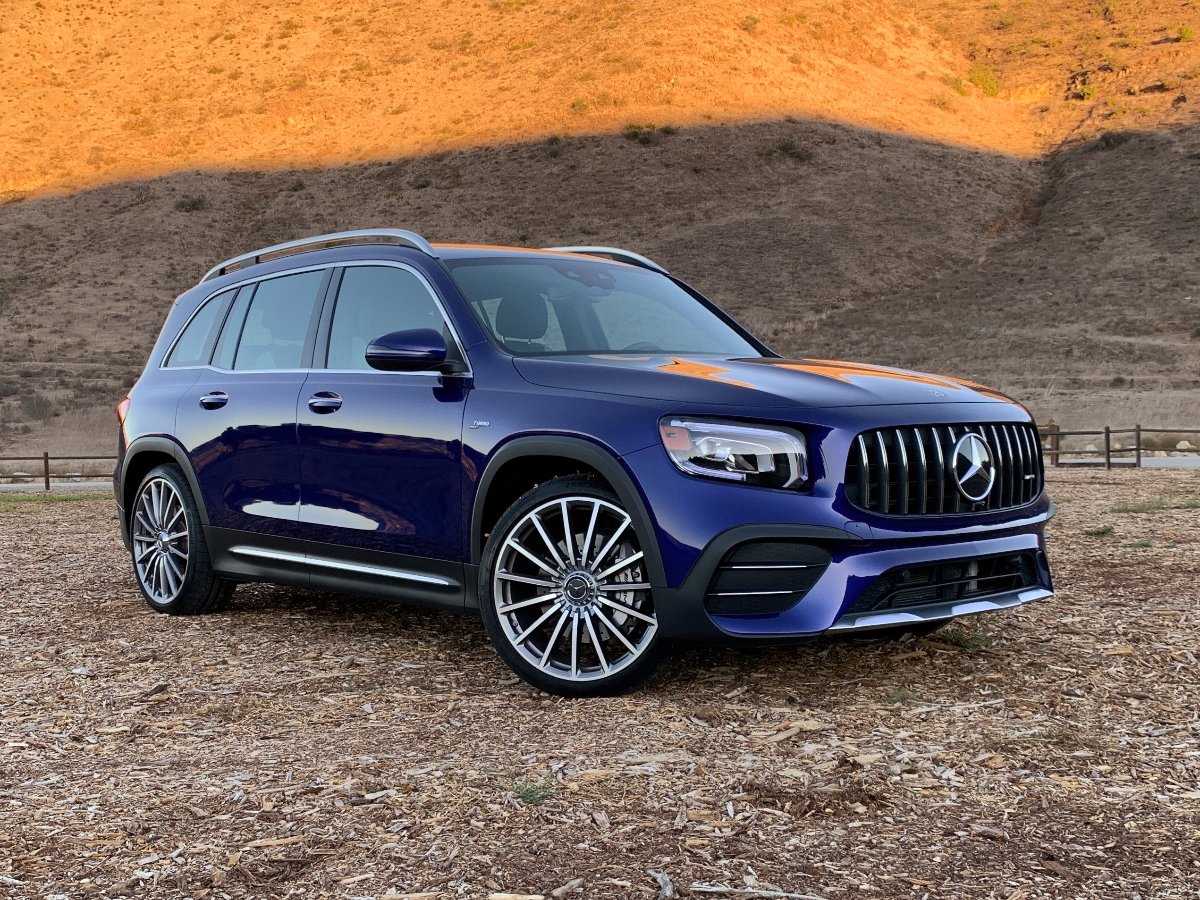
Photo: Christian Wardlaw
The Mercedes-Benz GLB competes in the Compact Premium SUV market segment. According to data collected from verified new-vehicle buyers for the JD Power 2021 Automotive Performance, Execution and Layout (APEAL) Study, 50 percent of new Mercedes GLB buyers are male (vs. 53 percent for the segment), and the median age of a new GLB buyer is 53 years (vs. 60).
As part of the APEAL Study, owners rated the GLB in 10 primary categories. Listed below in descending order, you’ll find their preferences from their most favorite thing about the vehicle to their least favorite:
In the 2021 APEAL Study, the GLB ranks ninth out of 12 Compact Premium SUV models.
In the sections that follow, our independent expert analyzes a Mercedes-AMG GLB 35 equipped with the following options:
The price of the test vehicle came to $57,250, including the $1,050 destination charge.

Photo: Christian Wardlaw
When AMG affixes its name to a Mercedes-Benz, you know you’re getting more than just a look. The company’s in-house tuning team touches every aspect of a model’s mechanical hardware, from the drivetrain to the tire contact patches.
With the 2022 Mercedes-AMG GLB 35, the upgrades start under the hood, where you’ll find a turbocharged 2.0-liter 4-cylinder engine good for 302 hp and 295 pound-feet of torque. According to Mercedes, that’s enough juice to scoot the AMG GLB 35 to 60 mph in 5.1 seconds.
The SUV’s 8-speed DCT and 4Matic AWD system receive some special attention to ensure drivers can make maximum use of the power. AMG also modifies the suspension, brakes, exhaust system, and driving modes to support performance driving. It also gets a Dynamic Cornering Assist system that selectively brakes the rear wheels to help the GLB feel more natural when rounding curves.
Collectively, these modifications transform the GLB from a mild-mannered crossover into a scrappy backroad missile. But there is a price to pay, and it’s not just related to your bank account.
My vehicle testing route includes some of the most challenging roads in Southern California, and it is in this environment where the AMG GLB 35 feels most at home.
Switch the AMG Dynamic Select system into Sport+ mode, and this boxy little SUV devours blacktop like a sports sedan. It sounds the part, too, with an added snarl to its exhaust note as it rounds corners and rockets down straights. The test vehicle’s 21-inch wheels and tires delivered astounding grip, the adaptive damping suspension kept the GLB firmly planted to the road, and the Dynamic Cornering Assist undoubtedly made the SUV feel more heroic than it otherwise might. The performance braking system suffered no fade, either, even when subjected to a torture test on a mountain road I reserve expressly for testing performance-tuned vehicles.
However, unless you’re planning to drive a Mercedes GLB like you stole it, I recommend that you stick with the GLB 250 and spend your savings on optional equipment. Why? Because in the areas where you spend most of your time, such as the city, suburbs, and the freeways in between, the AMG GLB 35 is a little ornery.
When you drive in Comfort mode—which you’ll want in order to help soften the blows that the low-profile performance tires can’t absorb—the AMG GLB 35’s drivetrain suffers turbo lag. The 295 pound-feet of torque doesn’t arrive until 3,000 rpm, so at the low end, there is some delay in response to what your right foot dictates. Additionally, in this driving mode, the DCT sometimes behaves in a confused manner. Furthermore, the fade-free performance brakes feel grabby in traffic and when coming to a stop at intersections.
The AMG GLB 35 is thirstier, too. According to the EPA, it returns 22 mpg in combined city/highway driving, while the GLB 250 4Matic averages 25 mpg. During testing, the AMG-tuned SUV got 21.8 mpg.
If you’re buying the Mercedes-AMG GLB 35 because you think it’s the “best” because it has the highest price tag, that’s only true if you strongly value the SUV’s performance capabilities. Otherwise, you are better off sticking with the slower but more comfortable and efficient GLB 250.

Photo: Christian Wardlaw
Mercedes equips the AMG GLB 35 with its Mercedes-Benz User Experience (MBUX) digital instrumentation and infotainment technology, and it is terrific. You get two 10.25-inch color displays, one for instrumentation and one for the infotainment system. The infotainment screen is touch-sensing. To adjust the instrumentation panel, you use touch-sensing controls on the AMG GLB 35’s steering wheel.
As you might expect, MBUX offers a broad and deep menu structure that allows a GLB’s owner to customize various vehicle settings to personal preferences. It takes some time to acclimate to how the tech works, but once you get the hang of it and make your selections, MBUX is remarkably easy to reference and use.
One of the best things about the system is its natural-voice-recognition technology. You can wake the digital assistant by saying, “Hey Mercedes,” and then you can ask questions and issue commands to control various features and functions. During testing, the only hiccup with MBUX was that in response to a request to find a hospital, it also listed medical facilities that were not hospitals. Other automakers successfully filter such database “noise” when I use that particular test prompt.
With the optional Multimedia package, MBUX includes navigation with augmented-reality technology. It shows a feed from the forward-facing camera on the infotainment display and overlays directions on top of the imagery so that you know exactly what lane you should be in and where you should turn. This feature is especially helpful after dark when it is harder to see.
Additional upgrades include wireless smartphone charging, a Burmester premium surround-sound audio system, and an MBUX Interior Assistant, which is a fancy way of describing gesture control for some features and functions. A head-up display is also available for the AMG GLB 35. Unfortunately, the test vehicle had none of these extras, so I could not evaluate them.
Naturally, Mercedes takes steps to ensure that you won’t confuse the AMG GLB 35 for a run-of-the-mill GLB 250.
To that end, the SUV gets a standard AMG body kit, 19-inch AMG twin-spoke wheels, and chrome vertical grille bars—a signature design cue of performance-tuned Benz models. The front and rear bumpers feature a bolder design, and the AMG GLB 35 has four round exhaust outlets, a rear diffuser panel, and a functional spoiler on the liftgate. Inside, the AMG treatment includes sport-bolstered front seats, a sport-design steering wheel with aluminum shift paddles, Carbon Structure trim pieces, stainless steel pedal covers, and AMG-branded floor mats.
Now, most of these elements are available as options for the GLB 250. You can’t build a carbon copy of the AMG GLB 35 by throwing money at a GLB 250, but you can nevertheless build yourself a pretty spiffy lookalike. And it might work to convince people you’ve got a genuine AMG—until the traffic light turns green. Then you’re dust.
Either way, thanks to its 2-box profile, overdone details, and quirky design elements, the AMG GLB 35 has a strong visual personality, inside and out. This is especially true when the SUV is wearing the optional multi-spoke 21-inch wheels, which look positively cartoonish on such a small SUV. For these reasons and more, owners tell JD Power they like how this Mercedes looks, rating exterior styling as one of their favorite things about the GLB.

Photo: Christian Wardlaw
When you shop for a Mercedes-Benz SUV priced between $40,000 and $60,000, you have three choices. You can get a tiny GLA and splurge on options, get a small but boxy GLB and exercise your options, or get a bigger and more sophisticated GLC but have less to spend on options.
In this scenario, the Mercedes GLB makes plenty of sense. You can keep it basic or dress it up. You can add a third-row seat for (very) occasional use or conserve cargo space volume that is actually larger than the pricier GLC. You can stick with the standard turbo four or upgrade to the AMG performance model. And no matter what you do, you’ll enjoy an expansive outward view from the driver’s seat.
My advice, however, is to choose the AMG GLB 35 only if you must have its added power and performance—and you plan to use it. Otherwise, the GLB 250 will likely serve you better as a daily driver.
Christian Wardlaw is a veteran digital automotive journalist with nearly 30 years of experience in test-driving vehicles. He has held editorial leadership roles with Edmunds, JD Power, the New York Daily News, and others. In addition to JDPower.com, his work has appeared in numerous new- and used-car buying guides, newspapers, and automotive industry trade journals including Autotrader, Capital One Auto Navigator, CarGurus, Kelley Blue Book, WardsAuto, and more.


The Ford Transit is the automaker’s full-size cargo and passenger van offering, designed to serve a wide range of commercial and lifestyle applications. With 37 available configurations, the platform ...See More
Read the Full Article
The Chevrolet Tahoe is a full-size, three-row SUV with a standard V8 engine and available diesel power. Built on the same platform as the Chevrolet Silverado 1500 pickup, the Tahoe benefits from its ...See More
Read the Full Article
It is the end of the line for the Ford Escape. After 25 years as a fixture of Ford’s lineup, 2026 will be the compact SUV’s last model year.
Read the Full Article
The Colorado is Chevrolet’s midsize pickup. It ranks among the segment’s most capable trucks for payload and towing, and can be configured for both work and off-road adventures. For 2026, the ...See More
Read the Full Article