E-Vision Intelligence Report
January 2023
Luxury Brands Reassert Themselves in EV Marketplace Following Year Dominated by Mass Market Brand Launches
Key Findings
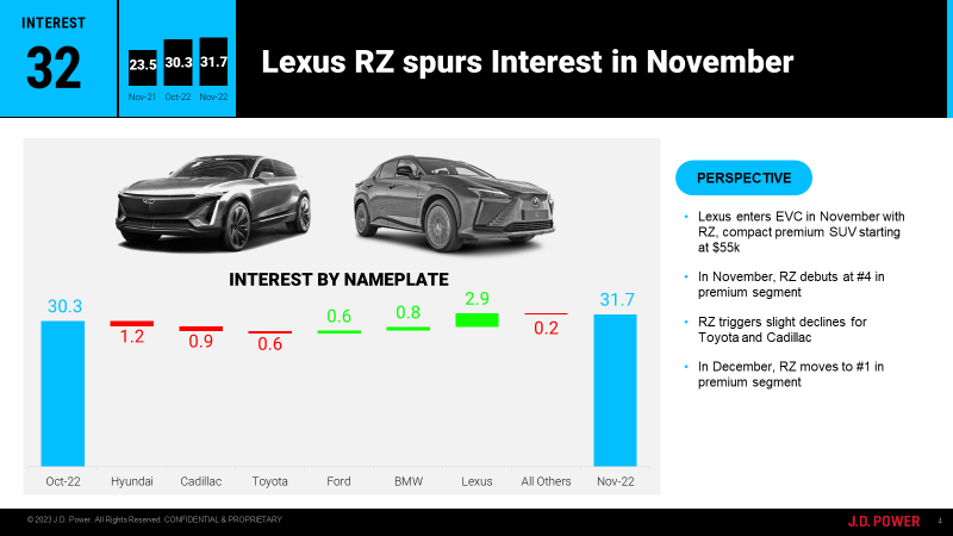
- Lexus On Track to Enter EV Market with a Bang: Lexus RZ debuted as the fourth most considered premium model in the JD Power EV Consideration pulse survey for November 2022 and quickly became the most considered premium model in December 2022.
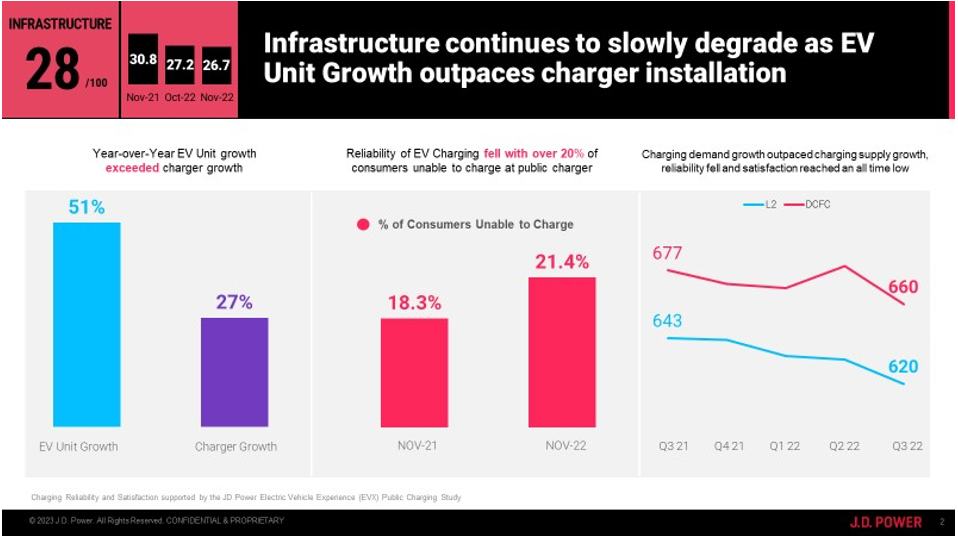
- Mercedes-Benz Charger Network Addresses Key Consumer Pain Point: The year-over-year pace of EV units in operation growth is roughly double that of public charger growth, highlighting a key gap in infrastructure support for EVs.
- Mass Market Brands Drive Overall Brand Consideration in 2022: Chevrolet has emerged as the most-considered brand among EV consumers, with roughly 44% of EV shoppers either very or somewhat likely to consider the brand for their next EV purchase.
Executive Summary
While 2022 will go down in automotive history as the year that mass market manufacturers finally broke into the electric vehicle (EV) marketplace in a meaningful way, two recent moves by legacy luxury brands served as a reminder that all the major OEMs still have some tricks up their sleeves. First, Lexus will make its foray into EVs with the launch of its first fully electric model, the RZ 450e. Then, Mercedes-Benz made headlines with its plans to build its own high-speed public charging network.
According to the JD Power EV Index, a new analytics tool developed by JD Power to track the progress to parity of EVs with internal combustion engine (ICE) vehicles in the United States, both of these moves have tapped into key components of consumer demand. This E-Vision Intelligence Report dives into key data points trending in each monthly EV Index update, along with other data points gathered from JD Power studies and pulse surveys, to spotlight emerging trends and important shifts in EV consumer sentiment.
The Consumer Case for Mercedes-Benz’s New Charger Network
Mercedes-Benz recently revealed its plans to install approximately 10,000 high-power EV chargers worldwide, with about 2,500 charge points at 400 locations across the U.S. and Canada by 2027. According to the company, the Mercedes-Benz-branded network will be open to all brands, but only Mercedes-Benz owners will have the ability to pre-book a charging space for their vehicles.
Currently, the year-over-year pace of EV units in operation growth is roughly double that of public charger growth, highlighting a key gap in infrastructure support for EVs. Mercedes-Benz plan to introduce 10,000 new chargers this year is clearly a strategic step toward addressing that shortfall.
According to the JD Power EV Index, this initiative addresses one of the biggest barriers to EV adoption. At the topline level, EV customer satisfaction with public charging networks has continued to decline steadily since Q3 2021, reaching an all-time low of 620 (on a 1,000-point scale) in Q3 2022. Likewise, we see that the reliability of existing public charger networks has declined during the same period, with 21.4% of consumers saying that they were unable to charge at a public charger in November 2022.
What’s more, by making its network available to all makes—unlike Tesla’s proprietary charging network—Mercedes-Benz will be eligible for federal funding under the National Electric Vehicle Infrastructure Formula Program (NEVI), which could help accelerate expansion.
No Champagne Glasses Needed to Make a Statement
The other major mark that premium brands are making on the EV segment is with new-model introductions that carry their respective reputations for build quality into the EV marketplace. Lexus, for example, a brand that set the standard for a plush ride with its famous champagne glass commercial in 1989, has now announced their first EV. The Lexus RZ is a compact premium SUV that starts at $55,000 and is expected to arrive in showrooms in the first quarter of this year. The new EV debuted as the fourth most considered premium model in the JD Power EV Consideration pulse survey for November 2022, and, by December, it had already risen to the top slot.
2022 Goes Down as Start of Mass Market EV Arms Race
While Lexus and Mercedes-Benz have dominated headlines for the past several weeks, we cannot overlook the fact that the big trend defining the EV marketplace in 2022 was the growth in consumer interest in mass-market EVs. In December, Chevrolet surpassed Tesla in brand-level consideration among consumers, with a full 44% of EV shoppers indicating that they are either “very likely” or “somewhat likely” to consider the brand for their next EV purchase. That’s up from just 31% in June 2022. Ford, Toyota and Hyundai have also continued to make their presence felt in brand consideration.

Buckle-Up: EV Disruption Just Starting
The number of currently available and soon-to-launch EV models has grown from 27 in January of 2021 to 53 today, and that’s still just the beginning. As more established manufacturers plunge deeper into the EV space and barriers to adoption continue to erode, the interplay between customer demand, macroeconomic forces and charging infrastructure will continue to shuffle the deck of leaders and laggards and customer experience will continue to evolve rapidly. JD Power will track those developments across its EV Index, benchmark studies and monthly E-Vision Intelligence Reports such as this.
Methodology
This JD Power E-Vision Intelligence Report is based on data and insights from the JD Power EV Index and the JD Power EV Consideration pulse survey. The JD Power EV Index is an analytics tool to benchmark the growing EV market in the United States. It tracks millions of data points aggregated into six categories—interest, availability, adoption, affordability, infrastructure and experience—to evaluate the progress to parity of EVs with ICE vehicles in the U.S. Each month, JD Power’s electric vehicle practice will analyze these data points, and others to spotlight emerging trends and important shifts in consumer sentiment that are helping to define the fast-moving EV marketplace.

Find out More
This report was authored by Elizabeth Krear, vice president, electric vehicle practice; Brent Gruber, executive director, electric vehicle practice; Stewart Stropp, executive director, electric vehicle practice; and Kristen Richter, senior analyst, electric vehicle practice at JD Power. The JD Power E-Vision initiative is a company-wide program focused on maximizing JD Power industry-leading EV data, analytics, insights and solutions. Please contact us at the numbers below to connect with the authors or to learn more about the underlying research.
Media Contacts
Shane Smith; East Coast; 424-903-3665; [email protected]
Geno Effler, JD Power; West Coast; 714-621-6224; [email protected]