Utilities Intelligence Report
September 2023
Most electric utility customers in the United States acknowledge that climate change is a real phenomenon, but few believe there is much that can be done about it, according to new JD Power research into consumer awareness, support, and engagement with utility sustainability efforts. Beneath the nationwide average, however, variation exists on a state-by-state basis.
As part of its ongoing research into customer sentiment and perceptions of electric utility sustainability initiatives in its annual Sustainability Index, JD Power tracks the key drivers that determine whether a customer believes their utility is a leader in addressing climate change. Among them, the study evaluates consumer perceptions on the severity of climate change and beliefs on what can be done to address the issue. This report takes a deep dive into those issues to identify the states where electric utility customers are most and least concerned about climate change, along with their respective levels of confidence in fixing it.
State-by-State Views on Seriousness of Climate Change
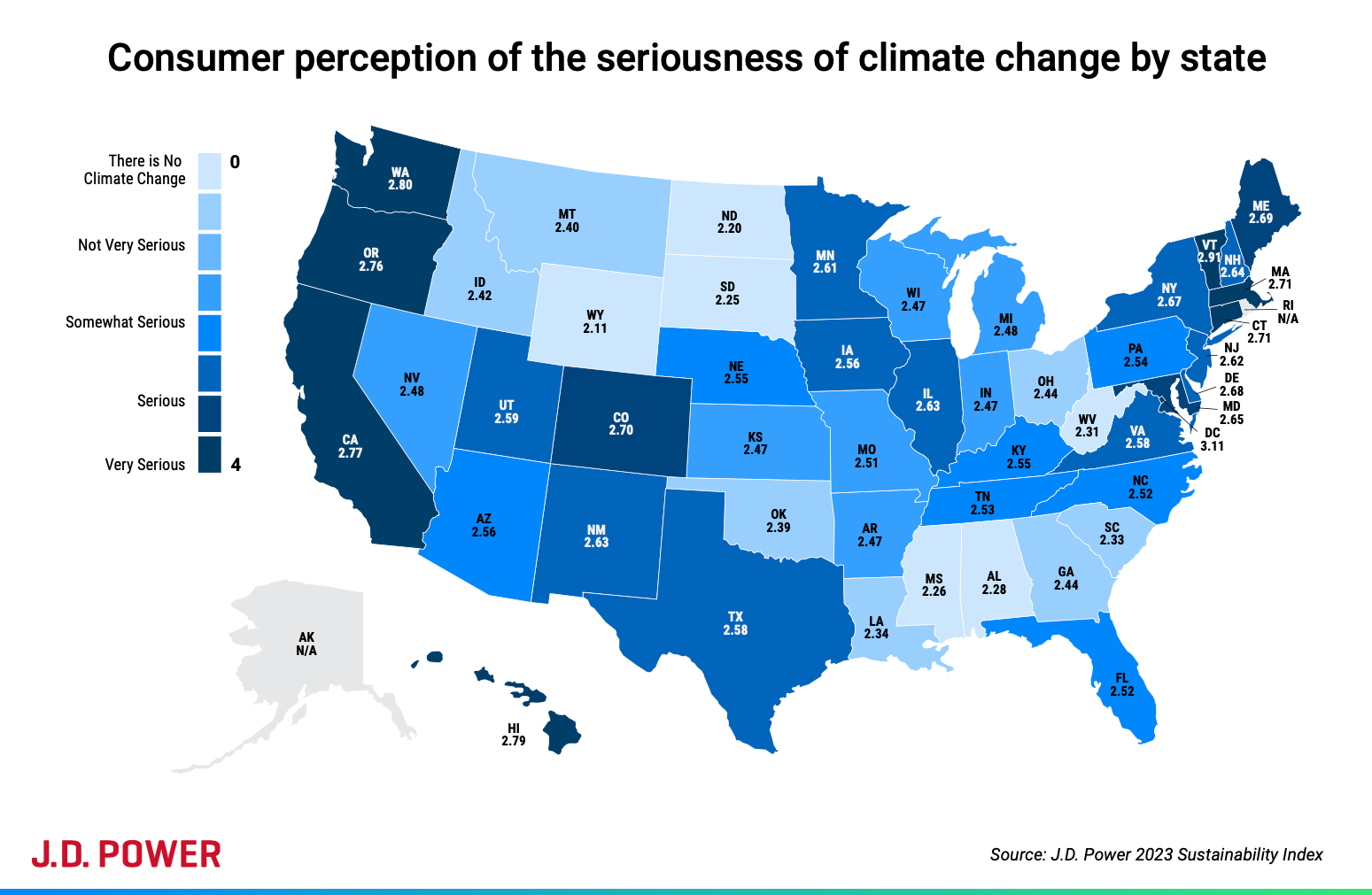
JD Power measures customer views on climate change at the state level by asking them to rank the overall seriousness of the issue on a scale of zero to four, with zero being, “There is no climate change,” and four being, “Climate change is very serious.” The analysis captures data from 48 states and the District of Columbia. Utilities in Alaska and Rhode Island did not qualify for the study.
The national consensus is 2.54, which translates to a 52.7% majority of customers who say they believe climate change a “very serious” or “serious” threat. Utility customers in Washington, D.C., have the greatest sense of urgency about climate change, with an average score of 3.11—the only region evaluated in the study to score higher than 3. It is followed by Vermont (2.91), Washington (2.80), Hawaii (2.79), and California (2.77).
At the other end of the spectrum, electric utility customers are least concerned about climate change in Wyoming, which posted an average score of 2.11. North Dakota (2.20), South Dakota (2.25), Mississippi (2.26) and Alabama (2.28) follow closely.
Is There a Solution?
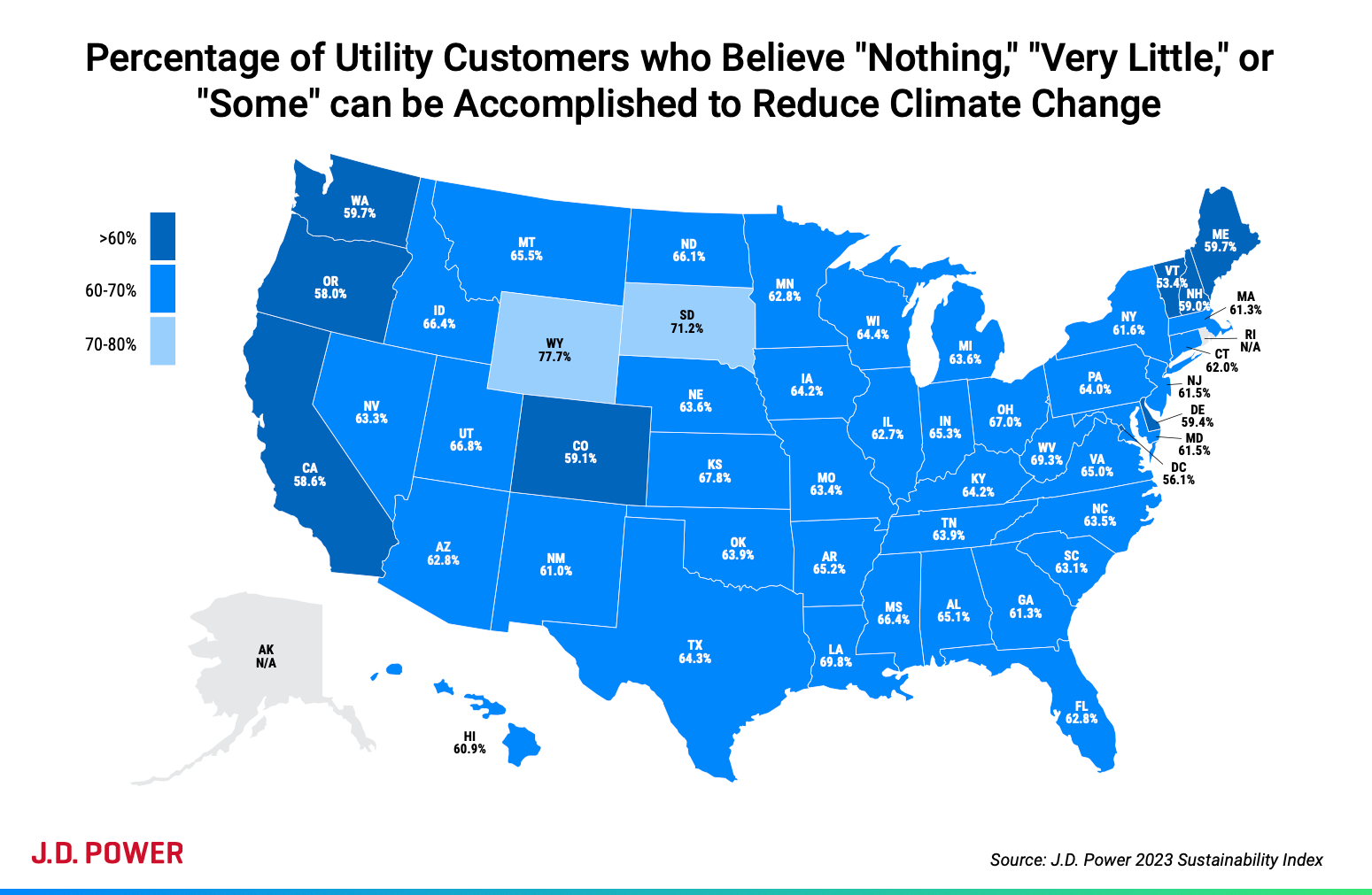
When it comes to finding a solution for climate change, electric utility customers are growing increasingly pessimistic. Nationally, the number of customers who say they believe a lot can be done to reduce climate change has declined steadily to 37.3% this year from 40.3% in 2020. JD Power measures customer sentiment on the prospect of addressing climate change by asking how much can be done. Respondents answer on a scale of “a lot,” “some,” “very little” or “nothing.”
The data paints a particularly skeptical picture. In all areas examined, a majority believes “nothing,” “very little” or “some” can be accomplished to deal with the issue. The overall average for those choosing anything but “a lot” per state is 63.5%. In fact, most states are above 60%.
Vermont is the most optimistic state with only 53.4% of respondents believing little can be done, followed by Washington, D.C. (56.1%), Oregon (58.0%), California (58.6%), and New Hampshire (59.0%).
Wyoming is the most pessimistic state, with 77.7% of respondents saying they feel little can be done, followed by South Dakota (71.2%), Louisiana (69.8%), West Virginia (69.3%) and Kansas (67.8%).
Moving Forward
Regardless of location, most consumers consider climate change a real issue. At the same time, there’s work to be done for increasing awareness of its severity and achieving greater buy-in about utilities ability to do something about it. Today, 82% of electric utility customers are served by a utility with a stated carbon-reduction target[1]. However, utilities, local governments, and non-governmental organizations need to make more of an investment into customer education and customer participation in energy reduction programs and other initiatives designed to reduce carbon emissions and improve utility sustainability. Right now, just 19% of electric utility customers are even aware of those efforts, according to our research.
If they are going to become part of the solution, electric utilities need to improve customer engagement and better incentivize participation in sustainability initiatives.
While there’s a great deal of work to be done, some utilities are providing an excellent roadmap for others. AEP Energy and the Southern Company provide reports on their sustainability efforts. Portland General Electric offers a range of clean energy pricing options for both residential and business customers and has a high adoption rate. Both Southern California Edison and DTE Energy offer consumers a wide range of rebate programs. Sacramento Municipal Utility District (SMUD) and Arizona Public Service (APS) have achieved high adoption rates for their time of day/time of use programs. Charlotte, N.C.-based Duke Energy provides a comprehensive set of energy use and analysis products and services. There are others making strides as well but they are only a starting point.
The issue of climate change is complex and there is no magic communications solution. In some cases, utilities may need to double down on their existing efforts. In other cases, some trial and error may be required to find out what works. Picking up the slack will require more time, determination, and resources than most utilities are currently devoting to their efforts around sustainability and to engaging with their customers about their clean energy goals and plans.
Find Out More
This Utilities Intelligence Report is based on responses from 70,486 utility customers nationwide that were fielded from June 2022 through May 2023. It was authored by Andrew Heath, Ph.D., managing director of utilities intelligence at JD Power. Please contact us at the numbers below to connect with Dr. Heath or to learn more about the underlying research.
Media Contacts
Brian Jaklitsch; East Coast; 631-584-2200; [email protected]
Geno Effler, JD Power; West Coast; 714-621-6224; [email protected]
[1] SEPA Utility Carbon-Reduction Tracker™. Smart Electric Power Alliance (SEPA). Retrieved July 21, 2023, from https://sepapower.org/utility-transformation-challenge/utility-carbon-reduction-tracker/