Banking and Payments Intelligence Report
March 2024

Just as the inflation rate seems stuck at just above 3%, the financial situations of U.S. banking customers have similarly hit a plateau.
According to JD Power, the percentage of U.S. bank customers that are financially healthy[1] remains near the all-time low. While banks would love to use artificial intelligence (AI) to help customers out of this malaise, customers remain unconvinced that AI has a practical benefit to their financial health.
Stuck in Neutral
Customers’ financial health seems to have bottomed out. Nearly one-third (30%) of respondents are financially healthy, while 45% fall into the vulnerable category, virtually identical to levels we have seen during the past five months.
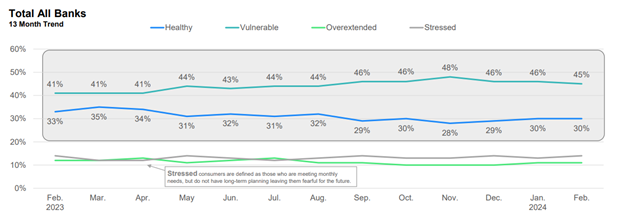
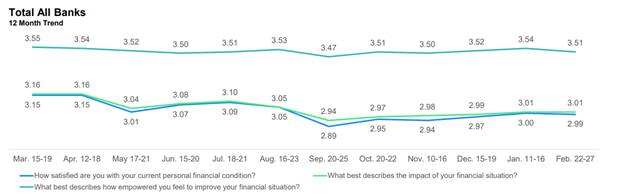
Customer sentiment regarding financial health status, stress levels and empowerment to improve one’s financial situation also remain virtually unchanged month-over-month. The effects of inflation are still being felt, but they are declining slowly. Lower grocery prices are the most recognized way customers are feeling relief from inflation, with prices for dining out, clothing/discretionary items and energy also falling.
Customers Not Sold on AI
While banks are investing time and resources to integrating AI into their offerings, customers are simply not convinced that AI is to be trusted. More than half (56%) say they only somewhat trust the quality of the output generated by their bank’s use of AI, with 32% saying they don’t trust it at all.

Part of that could be how banks’ utilization of AI is perceived by the customer. Bank customers either view their institution’s use of AI as less advanced than other industries’ solutions, or they simply don’t know. If banks are hopeful to incorporate AI into their solutions, they must understand that the measuring stick is not other banks, but how AI is used in other industries as well.

Falling Short of the Hype?
A central theme to AI marketing is often that it helps customers “focus on what matters most,” but banks have yet to prove AI solutions achieve that goal. Just 28% agree that the use of AI lets them focus on what matters most about their financial life. Nearly half (43%) said they do not know.

What’s more, customers do not believe AI is being used to personalize their service or experience. Nearly one-third (32%) said AI is not personalizing their experience at all, while 57% said only somewhat.

Proving the Concept
In a time of financial uncertainty, customers want tangible, personalized solutions from their banks. Broad, sweeping messages from institutions about how AI can help them simply don’t augur the type of trust that customers need.
For banks to truly integrate AI to a point where their customers feel comfortable, they need to go the extra mile by making the individual understand how they’ll personally benefit from it. A promise to keep them focused simply doesn’t win hearts and minds. To bridge this trust chasm, they need to show a true value tailored to each customer’s need. It’s a heavy lift, but if banks want to roll out AI in a way that will make meaningful progress, it’s the only way.
Find out More
This Banking and Payments Intelligence Report is based on responses from 4,000 retail bank customers nationwide and was fielded in February 2024. It was authored by Jennifer White, senior director of banking and payments intelligence at JD Power. Please contact us at the numbers below to connect with Ms. White or to learn more about the underlying research.
Media Contacts
Brian Jaklitsch; East Coast; 631-584-2200; [email protected]
Geno Effler, JD Power; West Coast; 714-621-6224; [email protected]
[1] JD Power measures the financial health of any consumer as a metric combining their spending/savings ratio, creditworthiness, and safety net items like insurance coverage. Consumers are placed on a continuum from healthy to vulnerable.