Banking and Payments Intelligence Report
March 2023
As April 18 Looms, Banks Turn to Tech to Help Customers Ease Their Tax Anxiety
It’s been an arduous year for banking customers in the United States. Between historically high inflation and wading through the fear of a recession, one would assume tax season would seem tame in comparison. Unfortunately, that’s not the case.
According to the latest JD Power data, more than three-fourths (76%) of bank customers in the United States have some sort of worries about their taxes, and 21% say they have more fears about this tax season than normal.
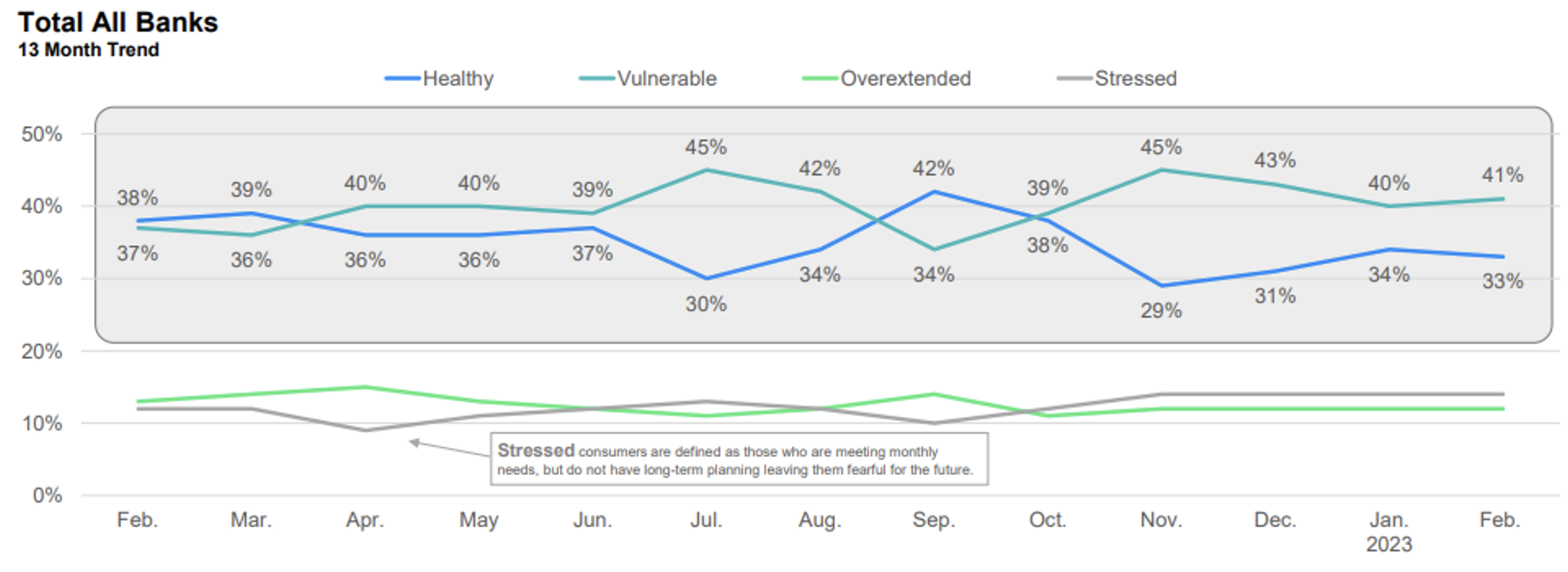
That’s noteworthy, because many customers use their tax returns to inject some much-needed capital into their finances. And with just 33% of respondents financially healthy[1], customers may need some help in navigating this tax season to avoid further financial worries.
A Stagnant Landscape
As the end of Q1 approaches, there has been no noteworthy change in overall financial health. One-third (33%) of respondents are financially healthy, while 41% are vulnerable.
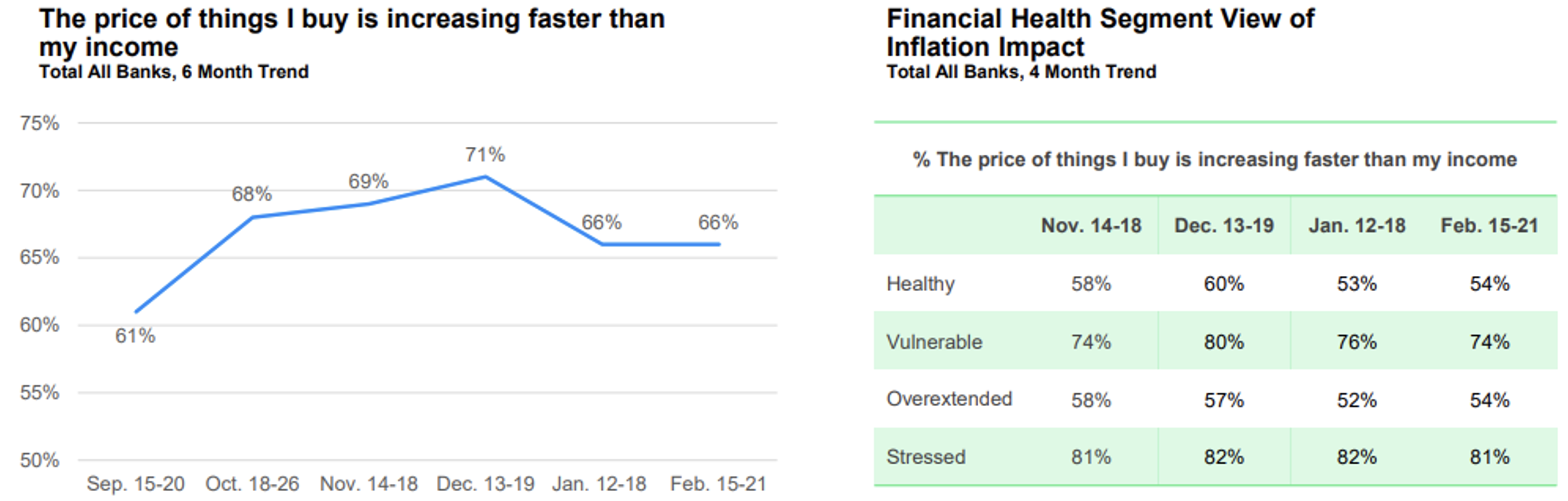
The overall level of inflation recognition also remains unchanged at 66%. The percentage of customers that said the price of goods are increasing faster than their income is virtually identical to the February 2023 report, as well.
Tax Troubles
With the financial landscape relatively unchanged, customers enter a tax season filled with new filing requirements and thresholds with some consternation.
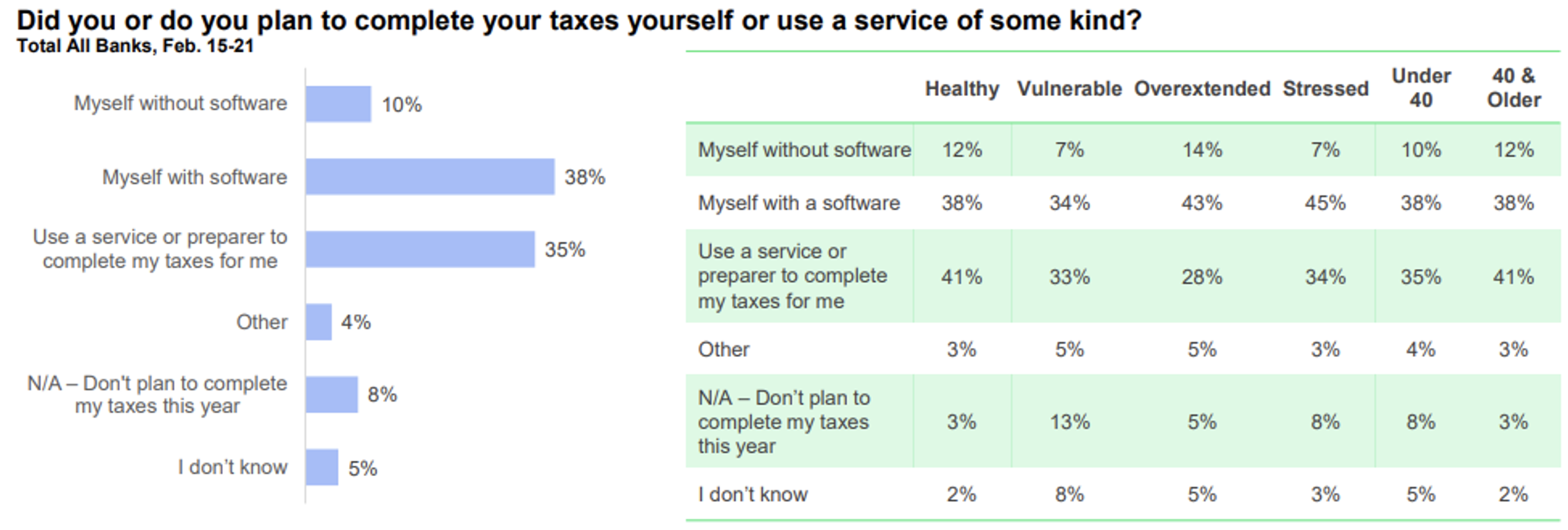
Nearly half (48%) of bank customers say they complete their taxes themselves (38% using software, 10% without software), while 35% say they use a service or a preparer. The stressed (45%) and overextended (43%) are most likely to use a software to complete their taxes themselves, while financially healthy customers (41%) are most likely to use a preparer.
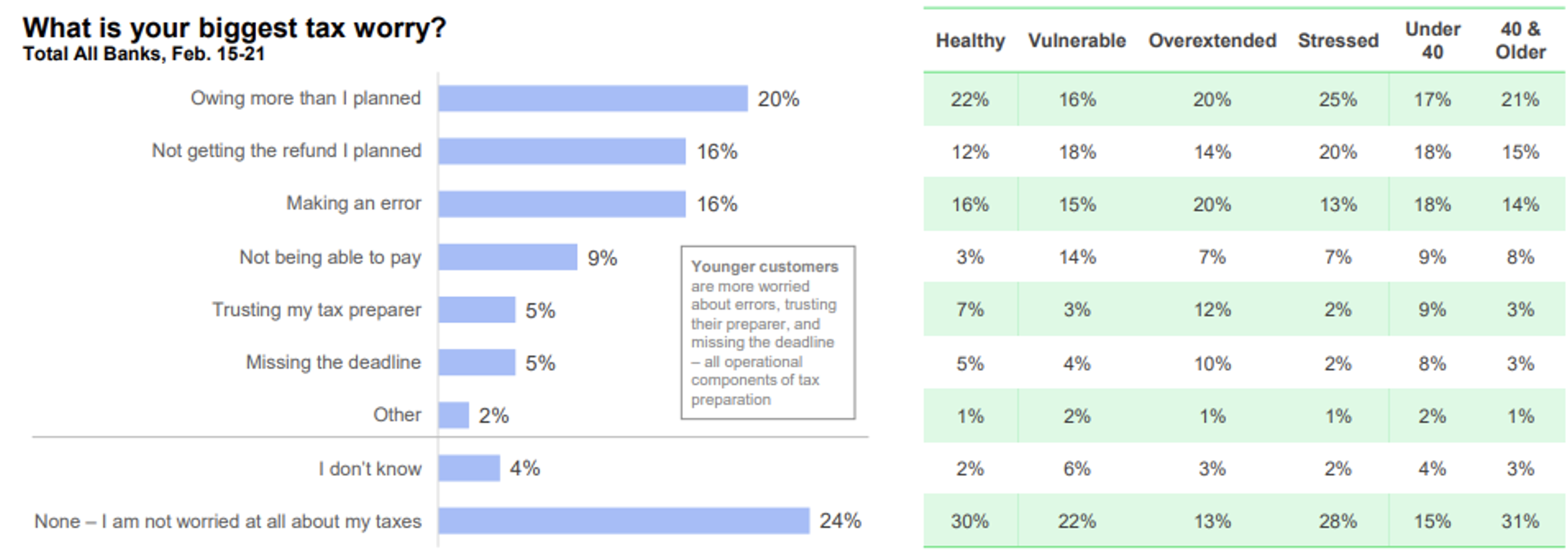
Bank customers’ worries center on the fear of sticker shock, as 20% worry that they’ll end up owing more than planned, and 16% fear they may not get any refund. Both of those scenarios would mean a huge financial setback to customers, many of whom rely on the liquidity to help them pay down debt or keep up with existing expenses.
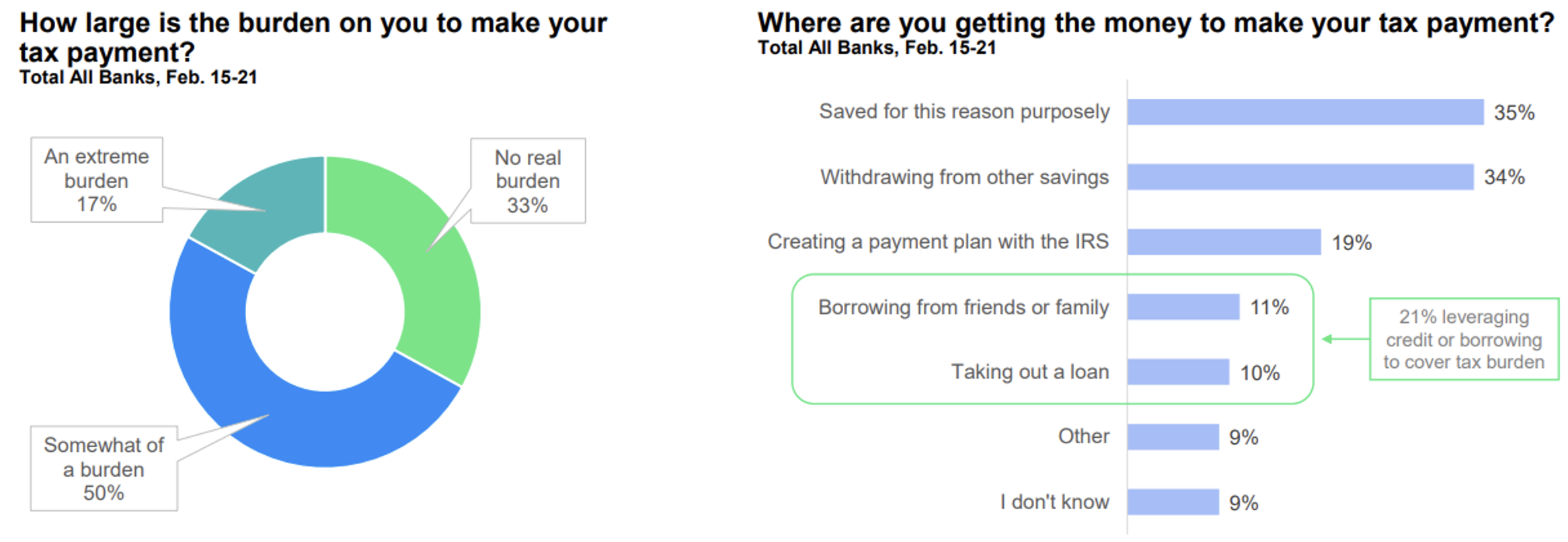
What’s more, half of bank customers (50%) say it is somewhat of a burden to make their tax payment, and 17% say it is an extreme burden. Of banking customers that have tax repayment, 21% are creating new debt by either borrowing from a friend or family member (11%) or taking out a loan (10%) to make that payment. Another 9% said they don’t know where they will get the money for tax repayment.
Banks to the Rescue?
As customers contend with this anxiety, banks are hoping to step up and help guide their customers through it. Some fintech firms are rising to meet this challenge, helping banks install solutions that help their customers make tax-savvy decisions all year long. Yet just 38% say they have received any messaging about tax assistance at all.

While it is encouraging that even a small percentage (12%) of customers indicate having received three or more types of messaging on tax assistance, the market for that help is far more robust. Nearly half (46%) of the vulnerable population and 61% of the stressed population don’t know if they received tax advice from their banks, which clearly shows banks need to find a way to be more proactive and clear in their messaging, particularly to the customers that need it the most.
Building Trust
There remains a wide-open space for both more fintech firms and traditional incumbents to offer services that could bring advantages to customers and their financial institutions. Some customers, particularly those under-40, say their biggest tax worry is trusting their preparer (9%). That number is three-times higher than the over-40 population (3%). If a bank, especially one that has their customers’ trust already, can help a customer make better tax decisions and ultimately get a better return, that customer will likely be far more inclined to stay in-house when using that return, whether that’s in the form of making a down payment on a home, taking out an auto loan, or paying down debt.
Some challenger brands are already rising to meet this challenge. Take CashApp, which acquired Credit Karma Tax in 2020. It offers both federal and state tax preparation services at no charge, on top of offering traditional services around banking, investing, or sending and receiving money. Others, like SoFi, offer everything from basic banking services and credit cards to mortgages and loan refinancing and investing, and even comparison shopping for insurance. But not tax preparation.
Data consistently show that as customers use more bank services successfully, they become further engaged and, therefore, less likely to leave the branch and less likely to move deposits elsewhere. If banks can bolster their services with tax solutions that can have a meaningful effect for their customers, they’ll likely see a significant return on their investment.
Find out More
This Banking and Payments Intelligence Report is based on responses from 4,000 retail bank customers nationwide and was fielded in February 2023. It was authored by Jennifer White, senior director of banking and payments intelligence at JD Power. Please contact us at the numbers below to connect with Ms. White or to learn more about the underlying research.
Media Contacts
Brian Jaklitsch; East Coast; 631-584-2200; [email protected]
Geno Effler, JD Power; West Coast; 714-621-6224; [email protected]
[1] JD Power measures the financial health of any consumer as a metric combining their spending/savings ratio, creditworthiness, and safety net items like insurance coverage. Consumers are placed on a continuum from healthy to vulnerable.