
With the 2022 BMW i4 and the 2022 BMW iX, the automaker best known for building self-proclaimed Ultimate Driving Machines enters a new era of electrification. BMW has two new and competitive electric vehicles coming soon, and they take the forms of a car and an SUV. The car is the i4, and it looks like a BMW 4 Series Gran Coupe. Perhaps except for the oversized kidney grille design, this is a good thing.

The 2022 BMW i4 comes in two model series called eDrive40 and M50. The i4 eDrive40 starts at $55,400 and has rear-wheel drive and an estimated 300 miles of driving range on a single battery charge. The i4 M50 is a performance-tuned version of the car, providing all-wheel drive and an estimated 245 miles of range in exchange for $65,900.
BMW charges an additional $995 to ship the new 2022 i4 from the automaker’s Munich, Germany, assembly plant to your local dealership. The release date for the new BMW i4 is the first quarter of 2022.
With its 5-door sportback body style, flush door handles, and aerodynamically optimized aluminum wheel designs, the new BMW i4 boasts a drag coefficient as low as 0.24 cd (0.25 cd for the M50). Befitting its position as the performance model, the BMW i4 M50 has larger 19-inch or 20-inch wheels, a sportier front bumper design, an M-specific rear spoiler, and unique gray and black exterior detailing.
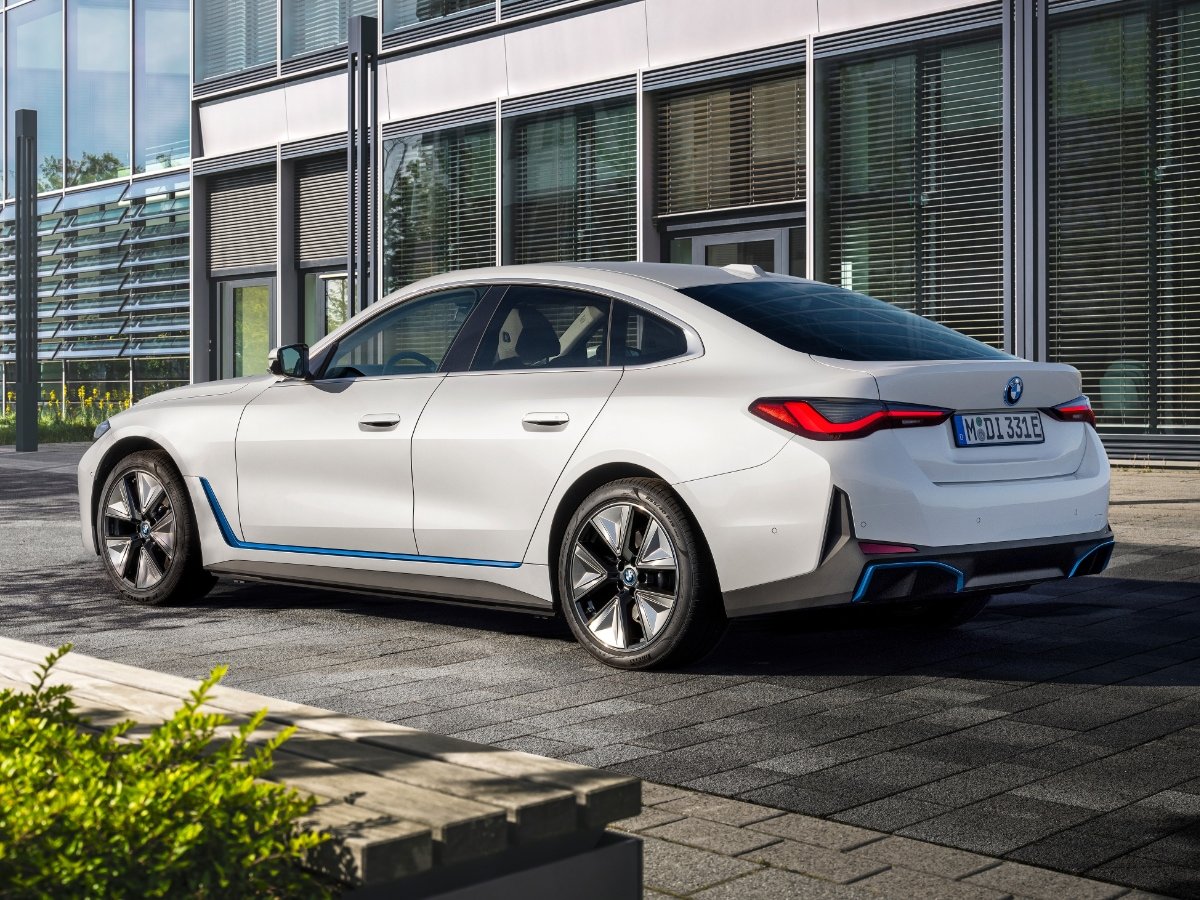
All i4s have standard full LED headlights with U-shaped running lights, while BMW’s Welcome Light Carpet exterior lighting is optional. The automaker says the i4 will emit a “brand-typical” exterior acoustic pedestrian protection system sound.
With the new i4, BMW promises “class-leading” long-distance comfort for up to five people and a high-quality interior making extensive use of recycled plastics.

Sport seats and a multi-function sports steering wheel are standard, along with an oversized glass sunroof. The i4 M50 adds soft knee pads on the center console where the driver and front passenger are likely to brace their legs during a rousing drive on a curvy road. Blue interior accents visually remind the driver of the i4’s electric drive system, and ambient cabin lighting is available.
BMW equips every i4 with a 3-zone automatic climate control system. It features voice control, automatic seat heating and ventilation based on the selected temperature, and a nanofiber air filtration and purification system. Via the car’s My BMW smartphone app, owners can pre-heat and pre-condition the cabin before driving.
A BMW IconicSounds acoustic experience is standard, offering different propulsion sounds based on which i4 model you’re driving and which Driving Experience Control setting you’ve chosen. BMW collaborated with Hans Zimmer to create these sounds.
Every 2022 BMW i4 gets a fifth-generation eDrive propulsion system employing a lithium-ion battery pack delivering 81.5 kilowatt-hours (kWh) of net energy (83.9 kWh gross).
In the i4 eDrive40, the battery pairs with a rear electric motor making 335 horsepower and 317 pound-feet of torque. It powers the car’s rear wheels, and according to BMW, it accelerates the i4 to 60 mph in about 5.5 seconds and can achieve a top speed of 118 mph. The estimated driving range for the eDrive40 is 300 miles.
In the i4 M50, the battery powers front and rear electric motors making a combined maximum of 536 horsepower and 586 pound-feet of torque. The two electric motors create a fully variable all-wheel-drive system, and the estimated driving range is 245 miles. Activate the Sport Boost function, and maximum power and torque are available for ten seconds, accelerating the i4 M50 to 60 mph in less than four seconds, according to BMW. The claimed top speed is 140 mph.
The i4 M50 is the first electric performance car from BMW M GmbH. To maximize driving range and efficiency, it operates as a rear-drive vehicle until lateral acceleration, wheel slip, or Sport Boost activation dictate the use of the front motor. In Sport Boost mode, an M-specific soundtrack accompanies the maximum amount of motive force.
BMW says it has carefully examined every step in the i4’s value chain to reduce the car’s carbon footprint, from sourcing and production to recycling the vehicle in the future.
For example:
To recharge the BMW i4, owners can use a Level 2 home charging station with up to 11 kW of charging capacity. It will take the car eight hours to fully recharge using this solution.
Alternatively, the i4 is compatible with DC fast chargers offering up to 200 kW of power. This type of charger adds 90 miles of driving range in 10 minutes or brings the battery from a 10% charge to an 80% charge in 31 minutes.
BMW has partnered with the electric car charging network EVgo to provide access to public charging stations. The My BMW mobile app tells an i4 driver about charging station availability and status, provides the ability to start a charging session, offers charging status updates during the charging session, and more. There are more than 800 EVgo DC fast-charging stations in the U.S., and the network is growing. EVgo also has 38,000 Level 2 chargers in its network.
BMW promises the i4 will deliver traditional Ultimate Driving Machine dynamics, in part because the battery pack reduces the car’s center of gravity by as much as 2.1 inches compared to a 3 Series sedan.
The Driving Experience Control system offers EcoPro, Comfort, and Sport driving modes to calibrate the car’s dynamics. They adjust drive system behavior as well as the i4’s steering and suspension. A special traction control technology called near-actuator wheel slip limitation is standard, and BMW says it reacts ten times faster than the automaker’s existing Dynamic Stability Control technology.
A regenerative braking system offers multiple settings, including a one-pedal driving mode useful in urban environments. The braking system is also smart, using navigation data and the driving assistance cameras to proactively engage brake energy recuperation.
The i4 rides on a front strut/multilink rear suspension design fortified with shock absorbers engineered to reduce unwanted body movement and a self-leveling rear air suspension that reduces pitch and roll. The i4 eDrive40 has standard 18-inch wheels and tires, with 19s available as an option.
Choose the i4 M50, and you’ll get:
Aside from the apparent branding benefit, one possible reason for the BMW i4’s giant kidney grille design is that it houses an array of advanced driving assistance system (ADAS) equipment. BMW embeds a front camera, ultrasonic sensors, and radar sensors into the grille, and they inform a long list of high-tech driving aids.
Standard equipment includes improved forward-collision warning with pedestrian and cyclist detection and better lane-departure warning and lane-keeping assistance technology. The lane-maintenance tech can now determine when the i4 is driving on a narrow country road and allow the driver to move the car to the outer edge of the lane when oncoming traffic approaches. Front and rear parking sensors are also standard, along with a backup camera.
Optional upgrades start with the Driving Assistant package. It adds blind-spot warning and rear cross-traffic warning with automatic rear braking.
Driving Assistance Professional adds several additional ADAS functions. They include:
Active Cruise Control with Stop & Go with four proximity settings is also an option for the BMW i4. It offers automatic Speed Limit Assist, which uses both a speed sign reader and navigation data to monitor the route ahead and automatically adjust the i4’s speed for curves, junctions, exits, and more. It can also proactively reduce vehicle speed in advance of entering a low-speed zone, such as when passing over a city limit.
Parking Assistant with Active Park Distance Control is also optional. In addition to automatic low-speed front and rear braking, it offers semi-autonomous self-parking capability for parallel and perpendicular spaces. BMW says it handles space detection, steering, acceleration, braking, and gear changes and works to enter or exit a parking space. This upgrade also includes a back-up assistant that reverses on the exact same path a driver took to enter a space for up to 50 yards of distance.
Another option is Parking Assistant Plus. It adds a 360-degree surround-view camera system with 3-D imaging and remote viewing capability via the My BMW smartphone app.
Equipped with BMW Curved Display technology, the new i4 features a 14.9-inch instrumentation screen and 12.3-inch iDrive 8 infotainment touchscreen under a single piece of anti-reflective glass. BMW says free over-the-air software updates keep the entire Live Cockpit Professional technology in tip-top shape.
Navigation is standard, and it uses cloud-based BMW Maps technology with real-time traffic information, public charging station status/availability, and parking space search capability. The system learns the driver’s habits and likely travel routes and automatically sends an owner estimated driving times.
Furthermore, BMW expands the i4’s natural language BMW Intelligent Personal Assistant capabilities. The system can distinguish whether the driver or passenger is speaking. It also learns everyday activities, such as when the driver is entering or exiting a parking garage and needs to lower the window glass.
BMW says iDrive 8 includes deeper embedding of Apple CarPlay and Android Auto functionality. Owners must also set up a BMW ID profile with a PIN code to use iDrive 8. BMW ID prevents other vehicle users, such as a valet parking attendant, from accessing personal data stored within iDrive 8.
A 16-speaker Harman Kardon premium sound system is optional for the new i4. The car also offers a third-generation, configurable head-up display (HUD) that adheres to what BMW calls an “Act, Locate, and Inform” principle. Drivers can quickly cycle through HUD views using a controller on the steering wheel.
When the BMW i4 goes on sale during the first quarter of 2022, it will compete with both the Tesla Model 3 and Model Y. Other similar vehicles include the Audi E-tron Sportback, Ford Mustang Mach-E, Hyundai Ioniq 5, Kia EV6, Mazda MX-30, Polestar 2, and Volvo C40 Recharge.
BMW is the source of information in this article. It was accurate as of June 1, 2021, but it may have changed since that date. Always confirm product details and availability with the automaker’s website or your local dealership.


Although both the 2026 Toyota Corolla and Toyota Camry share Toyota engineering and many standard features, they target different buyers. To see how they compare in value, reliability, performance, ...See More
Read the Full Article
Both the 2026 Toyota Corolla and the 2026 Mazda Mazda3 come with comprehensive safety features and connected services, along with large infotainment screens and premium audio. To see how their ...See More
Read the Full Article
Touchscreens are almost universal in modern cars. However, not all display types are the same. An increasing number of the latest cars use something called an OLED display. But what exactly is OLED, ...See More
Read the Full Article
Although the 2026 Toyota Corolla and the 2026 Nissan Sentra target buyers with similar goals, they take different routes. To see how those approaches translate into real world value, reliability, ...See More
Read the Full Article