No data
No data
375
8 speed, Automatic w/OD
Intercooled Turbo Gas/Electric I-4
Four Wheel Drive
More than just an SUV, the Jeep Wrangler symbolizes freedom. Launched in the 1940s as a World War II (WWII) military vehicle, this Jeep has evolved over the past 80 years into the modern Wrangler. What started as a tool that helped liberate Europe from Nazi control has now become a vehicle built for recreation, helping off-road enthusiasts conquer challenging terrain. To honor the original 1941 Willys MB from which it was derived, Jeep introduces the new 2025 Wrangler 4xe Willys ’41 special edition.
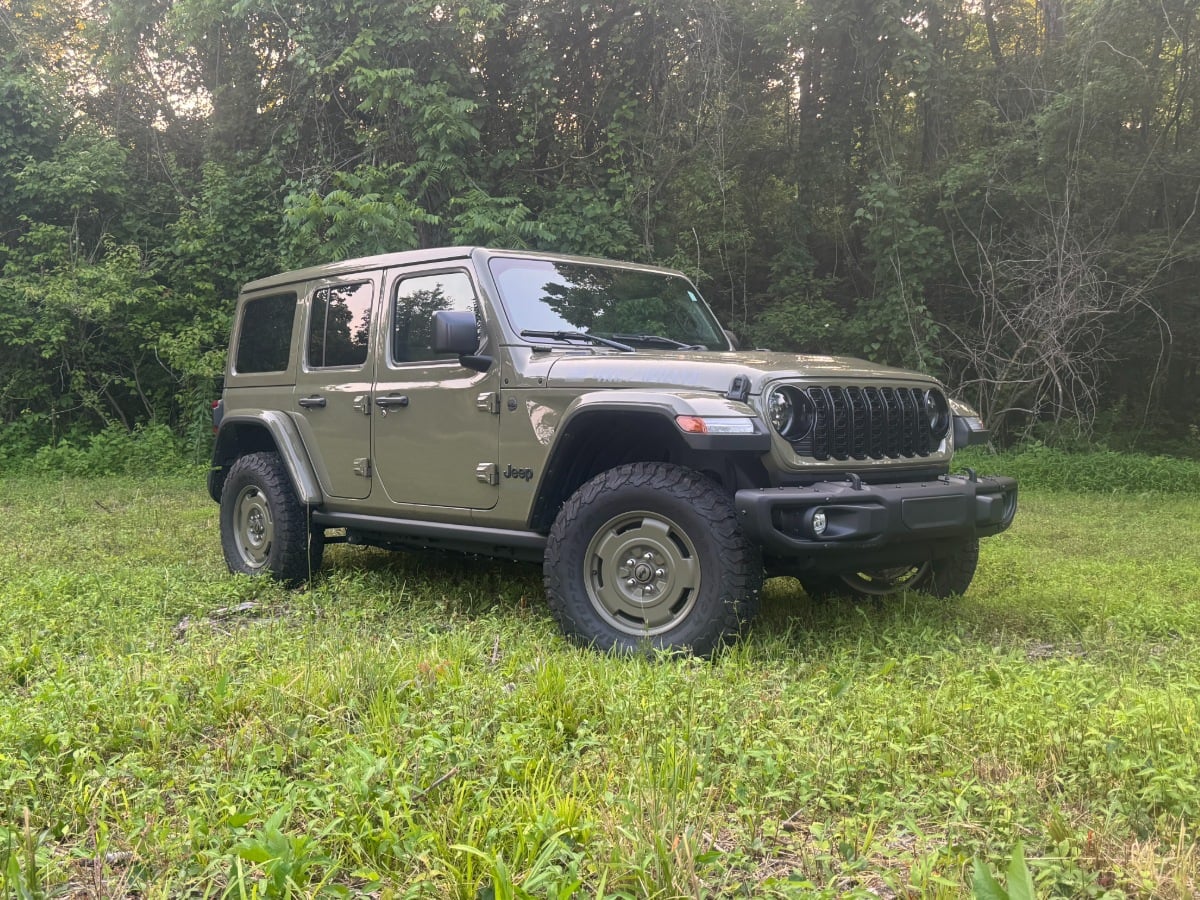
Photo: Jeff Youngs
For 2025, the gas-only Jeep Wrangler Sport now includes standard power locks and windows. Owners of all Wranglers with access to the mobile app can now remotely activate the heating or air conditioning to make the cabin more comfortable before getting in. In addition, a new exterior paint color, a military olive drab-inspired shade called ’41, is now available.
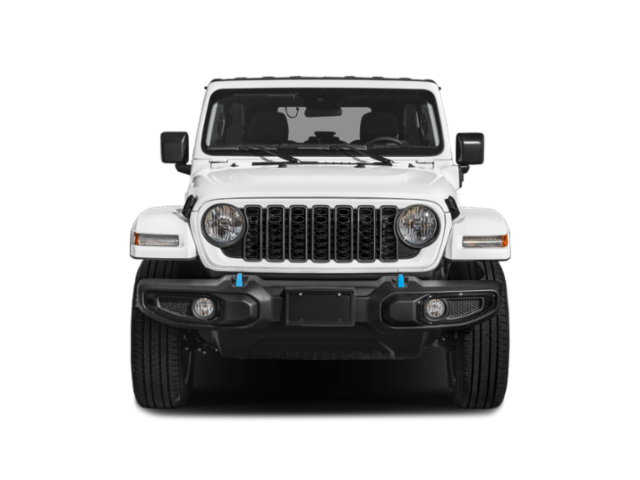
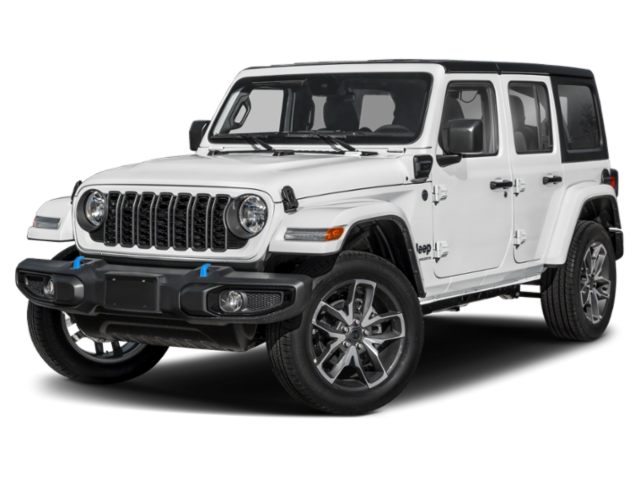
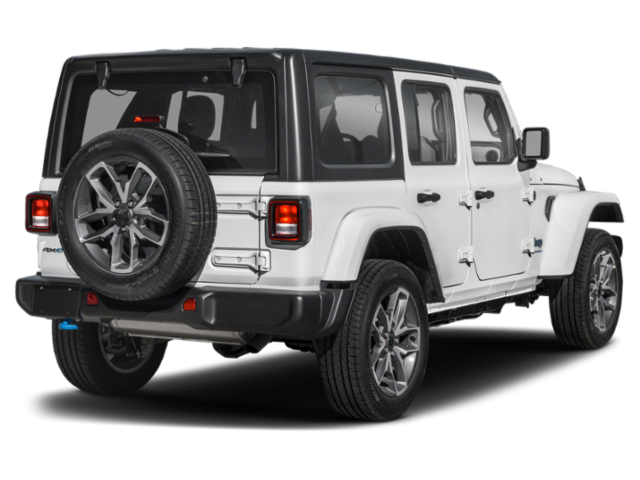
The 2025 Jeep Wrangler comes in two- and four-door configurations with a gasoline engine. Additionally, the four-door Wrangler 4xe model offers a plug-in hybrid (PHEV) powertrain. The gas models offer seven trim levels: Sport, Sport S, Willys, Sahara, Rubicon, Rubicon X, and Rubicon 392. The Sahara and Rubicon 392 are available only with four doors. The Wrangler 4xe PHEV features a slightly different lineup for 2025. It is available in Sport S, Willys, Sahara, Willys ’41, Rubicon, Backcountry, and Rubicon X.
Prices for the 2025 Wrangler range from $34,090 for the base two-door Sport to $101,990 for the Hemi V8-equipped Rubicon 392. Meanwhile, 2025 Wrangler 4xe prices start at $52,690 for the Sport S and go up to $72,935 for the Rubicon X. All prices include the destination charge.
For this 2025 Wrangler 4xe review, Jeep provided a test vehicle equipped with Willys ‘41 trim and the following significant options:
The Convenience Group adds creature comforts like automatic climate control, heated front seats, a heated steering wheel, and remote engine start. The package also includes security features such as emergency calling and front door passive entry and locking, allowing you to keep your key in your pocket.
The Active Safety Group includes automatic high-beam headlights, LED taillights, blind spot warning, rear cross-traffic warning, and rear park assist.
The Technology Group includes the 4xe Trail Power Box, which enables you to turn your Jeep into a portable generator to power various devices through four 120-volt, household-style outlets. This vehicle-to-load (V2L) feature is especially helpful at a remote campsite or during an emergency. The Tech Group also includes a nine-speaker, 522-watt Alpine premium audio system with a 12-channel amplifier and a rear subwoofer.
The test vehicle's manufacturer's suggested retail price (MSRP) was $73,195, including the $1,995 destination charge to ship the SUV to a dealership from the Toledo, Ohio, assembly plant.
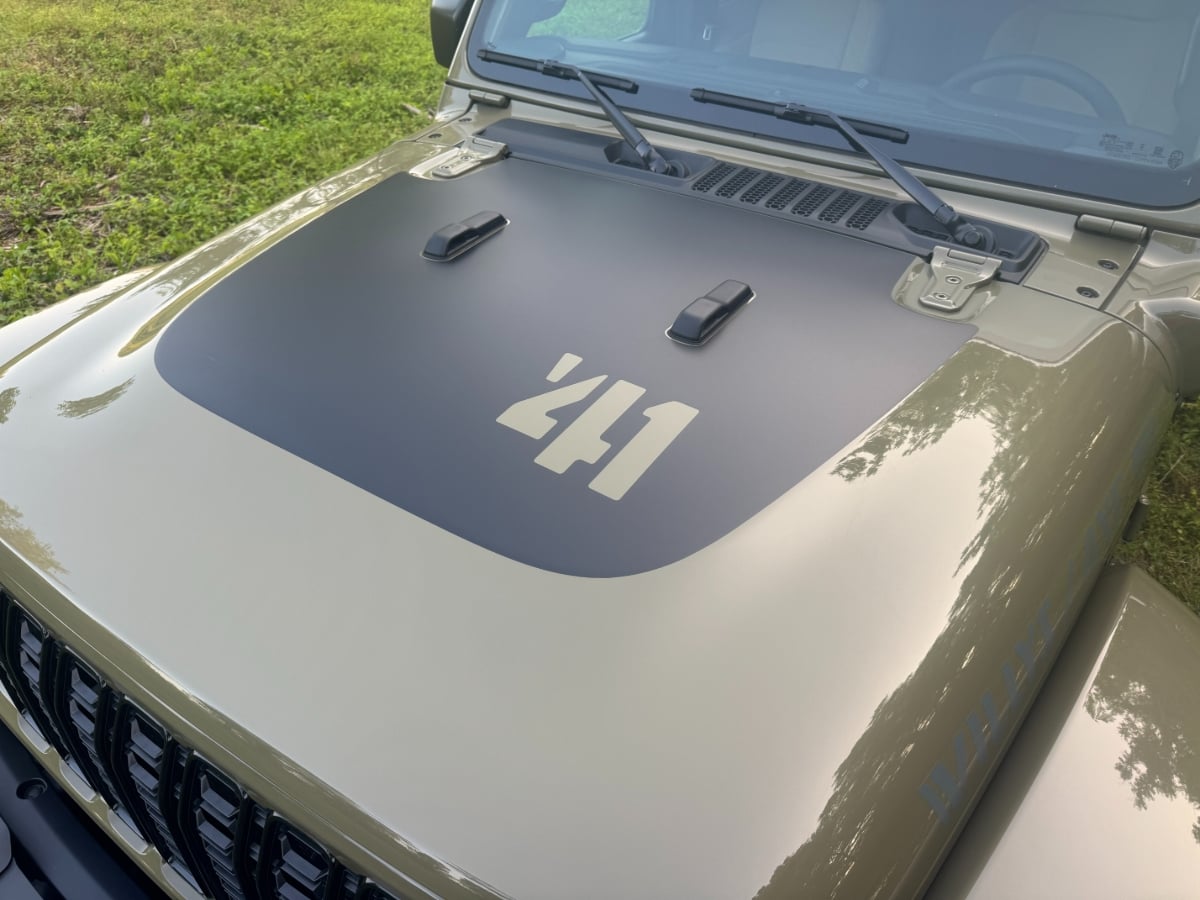
Photo: Jeff Youngs
Today, 80 years after WWII ended, that global conflict remains deeply rooted in American culture. You see it in books, on TV, in movies, and at war memorials in towns and cities across the country. And now, with the release of the 2025 Jeep Wrangler 4xe Willys ’41 special edition, buyers can capture the spirit of U.S. Army soldiers who conquered the most challenging terrain in and around the trenches of continental Europe all those years ago.
Paying homage to the original 1941 Willys MB—the precursor to the modern Jeep Wrangler—the new Willys ’41 Wrangler features a dull, olive green paint that Jeep calls “’41.” It’s nearly an exact match for the color that appeared on the military-spec Willys MB.
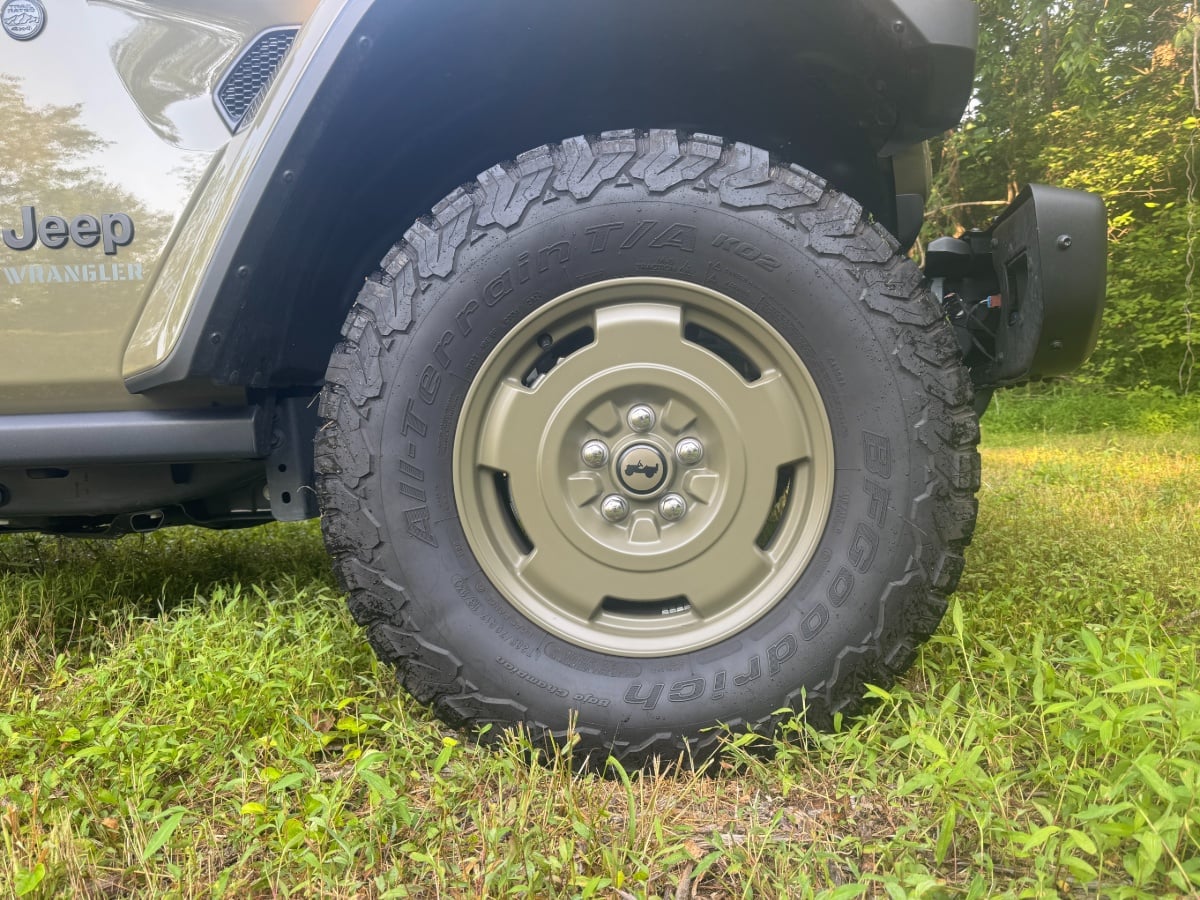
Photo: Jeff Youngs
Jeep fully commits to the look by painting the 17-inch aluminum wheels the same color to mimic the original MB’s color scheme. Take a close look at the wheel center caps, and you will notice a Willys MB decal. Thirty-three-inch all-terrain tires give the Wrangler an aggressive, capable stance.
Although its color is somewhat dull, there is no mistaking it for anything else, it immediately evokes the original MB. While ‘41 probably wouldn’t look right on a Jeep Compass, it works well on the Wrangler. Jeep adds period-correct Drab Blue decals—also inspired by the MB—on the hood, sides, and rear of the Wrangler. However, the Drab Blue color is very light and appears a bit washed out against the lighter green background. It doesn’t really “pop” as much as it could if it were darker.
Buyers can choose from three roof options: a body-color hardtop, a black Sky One-touch power top like on my test vehicle, or a tan soft top.

Photo: Jeff Youngs
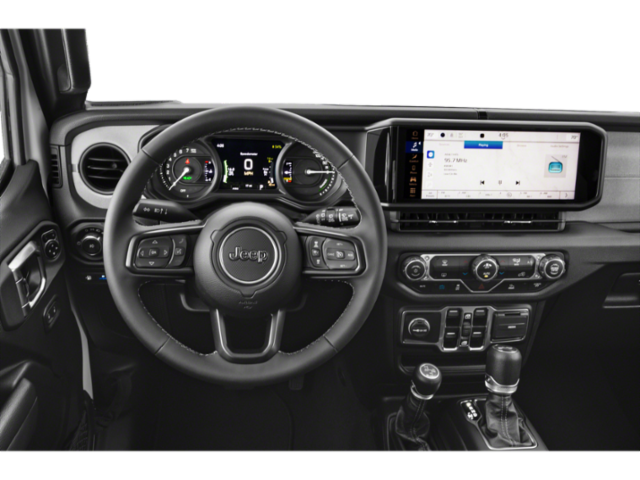
Unique Willys ‘41 interior features include tan cloth seats, an olive drab fabric dashboard insert, and a ’41 medallion on top of the gear shifter. Aside from that, it is essentially a standard issue Wrangler interior. Still, I liked the olive green exterior and light tan interior color combo.
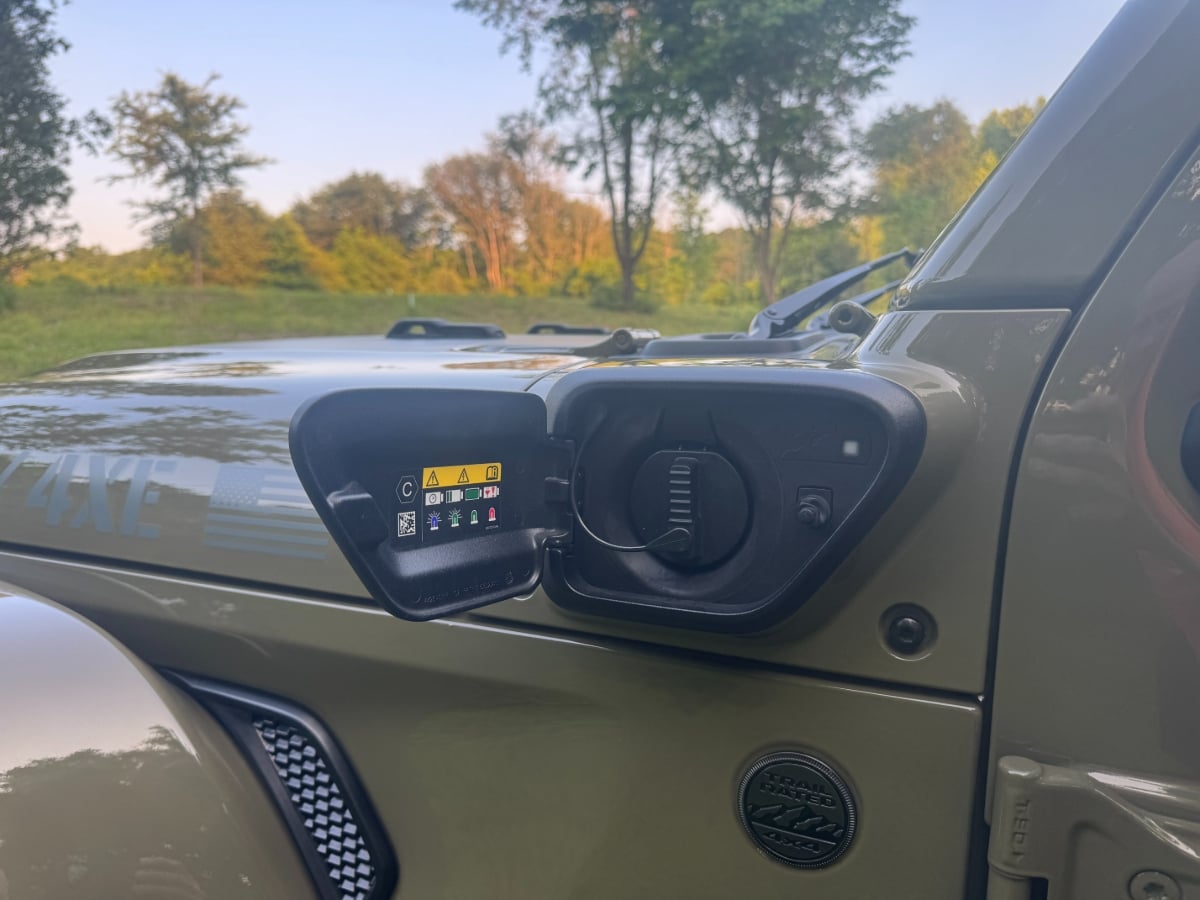
Photo: Jeff Youngs
Besides the Willys ’41’s appearance, another distinguishing feature is its 4xe plug-in hybrid powertrain, which Jeep introduced to the Wrangler lineup in late 2020. Combining a turbocharged 2.0-liter gas engine with two electric motors (one mounted on the engine, the other integrated into the eight-speed automatic transmission) and a high-voltage battery pack, the Wrangler 4xe produces 375 horsepower and 470 pound-feet of torque. The battery’s stored energy allows for 21 miles of all-electric driving.
While having all-electric power for short trips is convenient and can save significantly on fuel costs, it is not very practical on a remote trail. That is why the gas-electric PHEV powertrain is perfect for the Jeep. Better yet, head for the hills in eSave mode—one of three modes on the 4xe, along with Hybrid and Electric—and the system will favor the gas engine, conserving battery power so you can use electric mode for trail work if that is your preference.
According to the Environmental Protection Agency (EPA), the Wrangler 4xe powertrain delivers 49 MPGe and 20 mpg in combined driving. During my evaluation, driven entirely in Hybrid mode and relying on regenerative braking to recharge the battery, I recorded 17.4 mpg.
Although the 17.4 mpg figure is not impressive, the trip computer showed that the battery pack powered 32.6 of the 186.5 total miles instead of the internal combustion engine. This clearly highlights the benefits of the 4xe powertrain compared to the non-4xe Wrangler. Charging the 4xe every night to fully utilize the SUV’s 21-mile all-electric driving range adds even more savings.
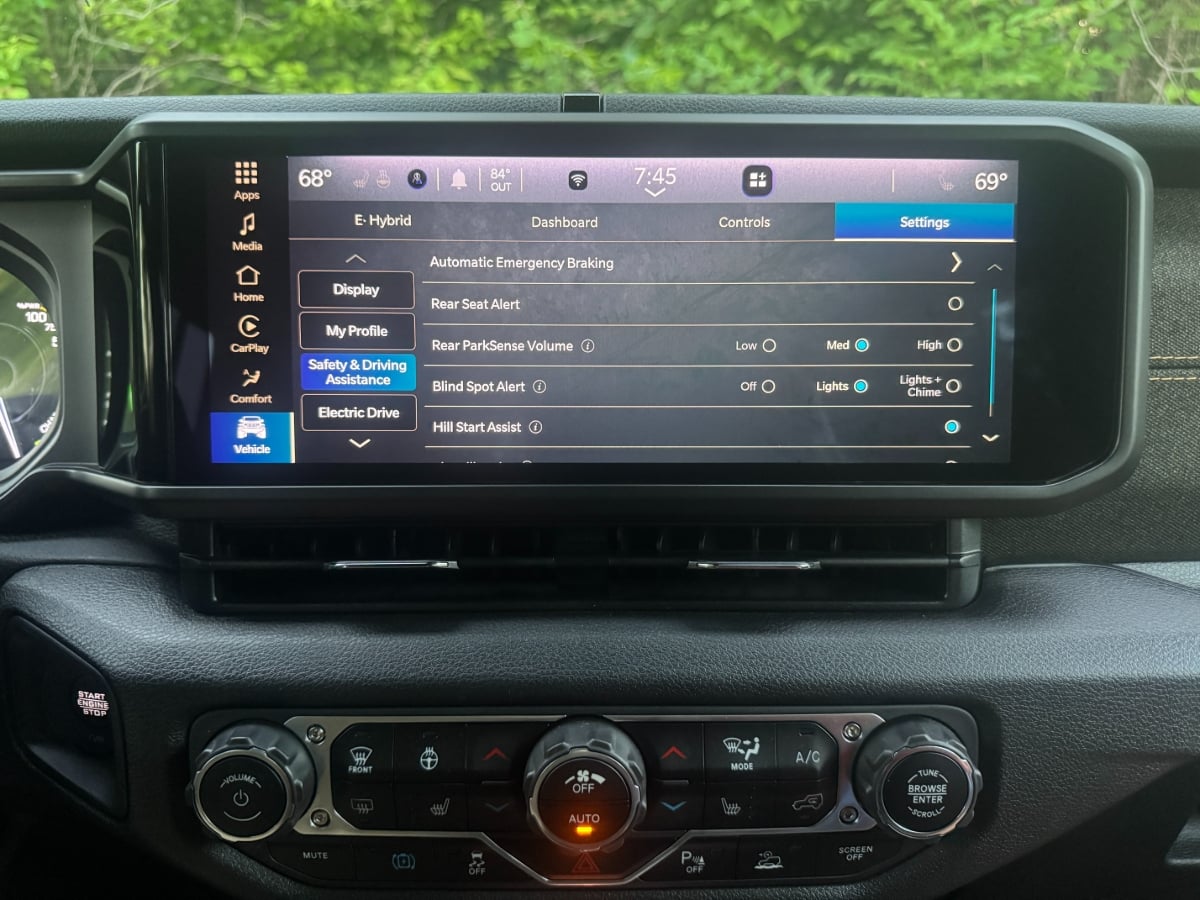
Photo: Jeff Youngs
Beyond its PHEV powertrain, the Willys ‘41 test vehicle also featured advanced driver assistance systems (ADAS) that would have been impossible to imagine in 1941. Systems like blind spot warning, rear cross-traffic warning, and rear park assist—part of the Active Safety Group outlined above—simply did not exist during WWII.
The same applies to every feature in the Technology Group. Imagine if Army soldiers in 1941 had a Power Box on each Willys MB. They could have enjoyed three hot meals a day during winter and powered all kinds of communications and medical equipment out in the field.
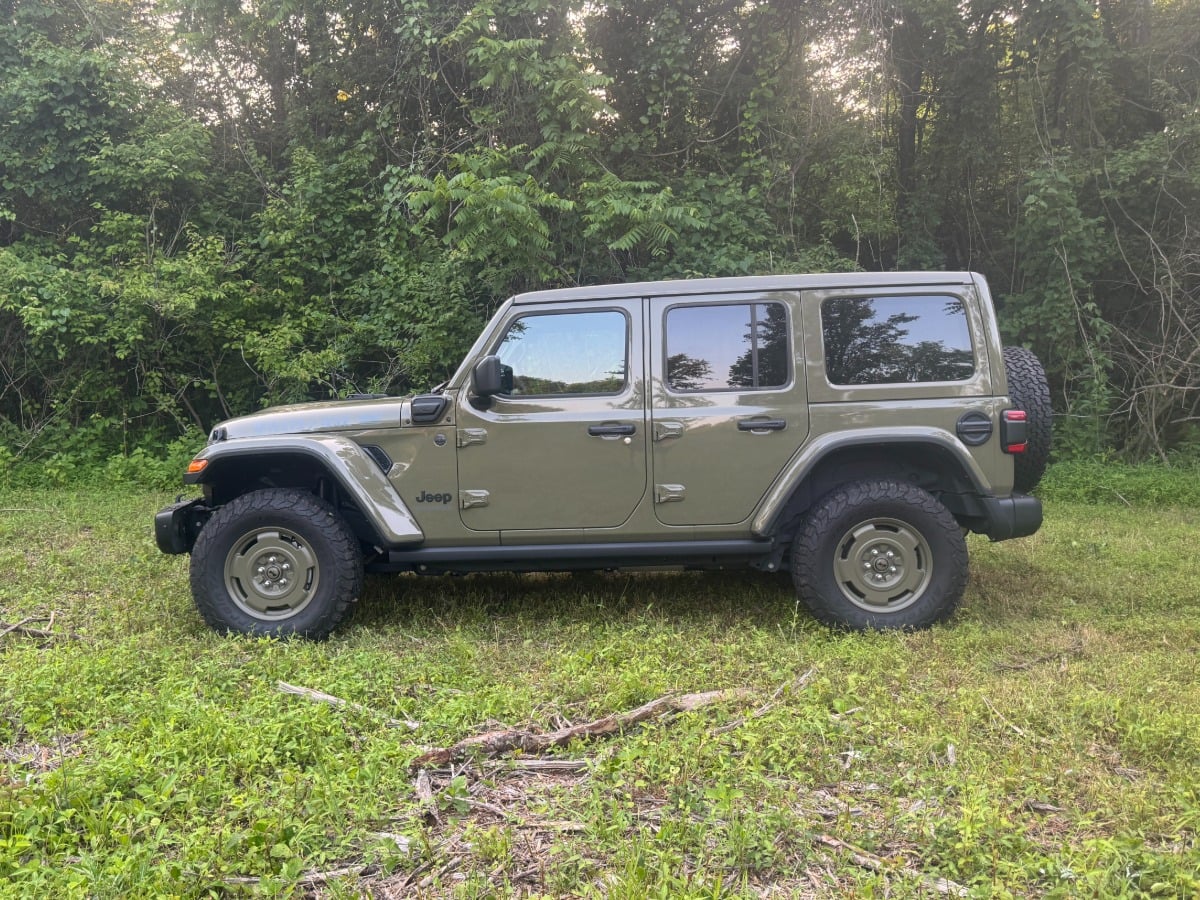
Photo: Jeff Youngs
Admittedly, I have not always been a fan of the Jeep Wrangler. This goes back to the late 1990s, when I drove a two-door soft-top Wrangler on a sweltering Southern California day. The task was simple: drive it across the San Fernando Valley and west Los Angeles on local freeways.
Not wanting to sweat through the entire trip (it was summer) or mess up my hair (I have not always been bald), I kept the roof closed, the windows up, and the A/C on. This also allowed me to hear the stereo better, or so I thought. After the hour-long journey on the freeway, my ears were ringing from the constant buffeting from the soft top.
I also felt like a piñata at the end of my drive, with my body battered for an hour due to the Wrangler’s body-on-frame construction, solid front and rear axles, short wheelbase, and off-road tires that did not cooperate with the freeway expansion joints. In a word, it was exhausting.
Based on this experience, I vowed never to own or even drive a Wrangler again. While I appreciated the Jeep’s off-road abilities and its passionate owners from afar, I had no desire to relive that painful experience from over 25 years ago. After all, I am not an off-road enthusiast, and I spend a lot of time driving on the interstate, shuttling kids around, in weather that is not very conducive to top-down driving. Most of the time, where I live now, it is either too hot and humid, too cold, or raining.
Two and a half decades is a long time to hold a grudge, so when I had the chance to drive the latest Wrangler, I set aside those old biases and kept an open mind. Honestly, from the moment I first saw the Wrangler Willys ’41 4xe parked in my driveway, I was intrigued. The first thing that catches your eye is the olive green paint on the body and wheels, which immediately evokes the old 1940s-era Willys MB that served in Europe for the U.S. Army during WWII. It is truly unique.
While the interior is not luxurious, the Wrangler ’41 offers all the essential comforts. That is part of its charm: everything you need, nothing you don’t.
With a bit of trepidation, I set out on the interstate for a 25-mile trip to soccer practice. Since the weather was nice that day—and because I did not want to relive my traumatic buffeting experience from years ago—I decided to roll down the side windows and open the large, power-operated soft top for that classic Jeep open air feeling.
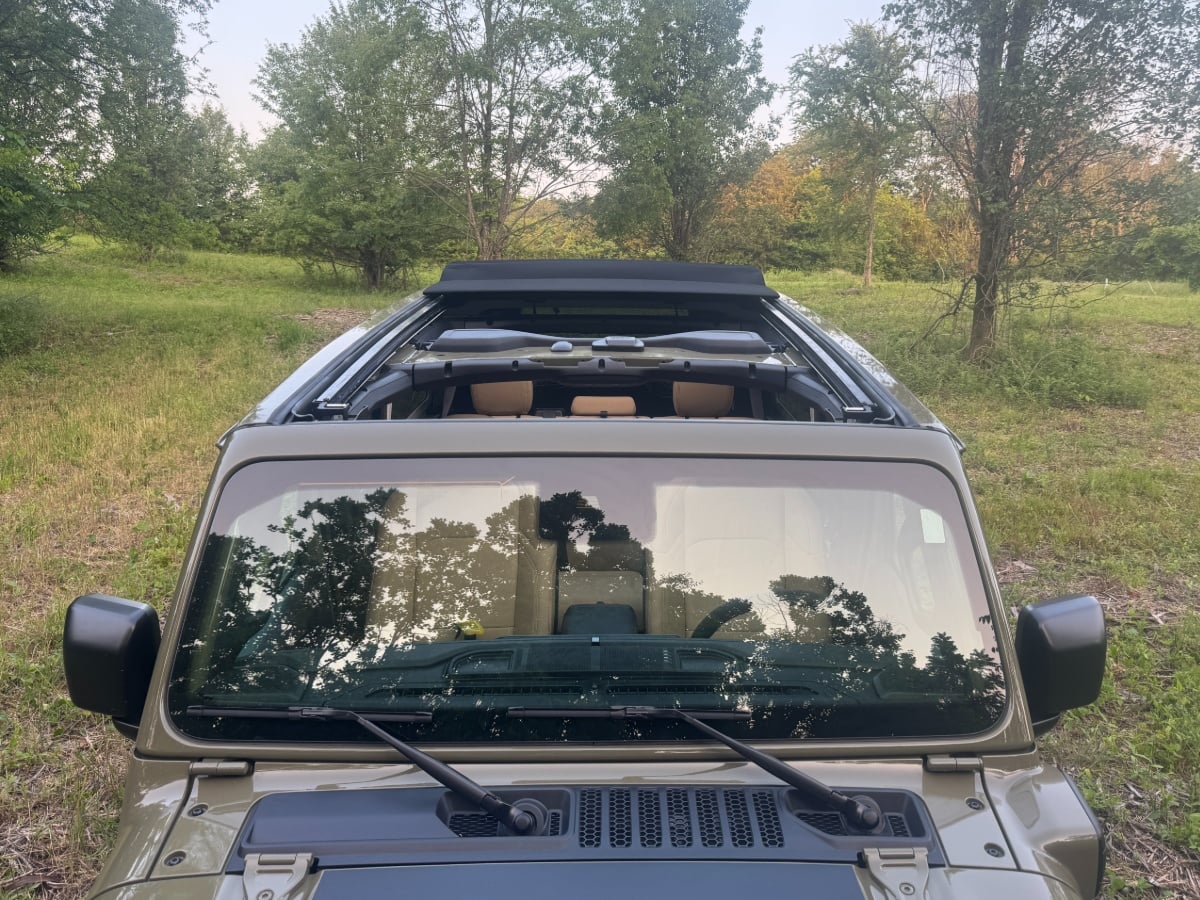
Photo: Jeff Youngs
The test vehicle’s optional Sky One-Touch Power Top made it very easy to enjoy open air driving. With just the push of a button, the body-colored hardtop’s entire center canvas roof automatically folded back to the rear, fully exposing both rows of seats to the sky above. There was no manual unlatching of individual roof panels or folding or disassembling a fabric top, like with the Wrangler’s other roof options. Similarly, closing the roof required only a simple button press.
To my delight, I did not hate the Wrangler drive experience. On the contrary, I rather enjoyed it, and so did my wife and daughters, who usually dislike convertibles because they mess up their hair. Being in a Jeep, rather than a typical two-door convertible, puts you in a different, more relaxed state of mind. It is almost therapeutic. Instantly, I could see what all those Jeep owners have been seeing for all these years. Now, I understand.
As for the ride quality, while the body-on-frame Wrangler 4xe does not soak up bumps as smoothly and efficiently as most of today’s car-based crossover SUVs, it was a million times better than the short-wheelbase, two-door model I drove all those years ago. Still, for longer trips, I would leave the Wrangler at home in favor of something with a softer ride.
While the Wrangler’s off-road skills are well known, I still wanted to take the Willys ’41 4xe off pavement and explore a nearby wooded area. The hilly terrain mainly consisted of tall brush and numerous dry creek beds. There was also a section with more trees, but to avoid scratching the Wrangler’s paint, I mainly stuck to the partially cleared areas.
While I would not call my trail making a serious off-roading adventure, I definitely needed 4WD because the hilly terrain, combined with dew-covered brush, was a bit too much for 2WD, even with the standard 33-inch all-terrain tires. A quick shift to 4Hi and the Wrangler easily handled everything. I did not need 4Lo, but it is there if needed.
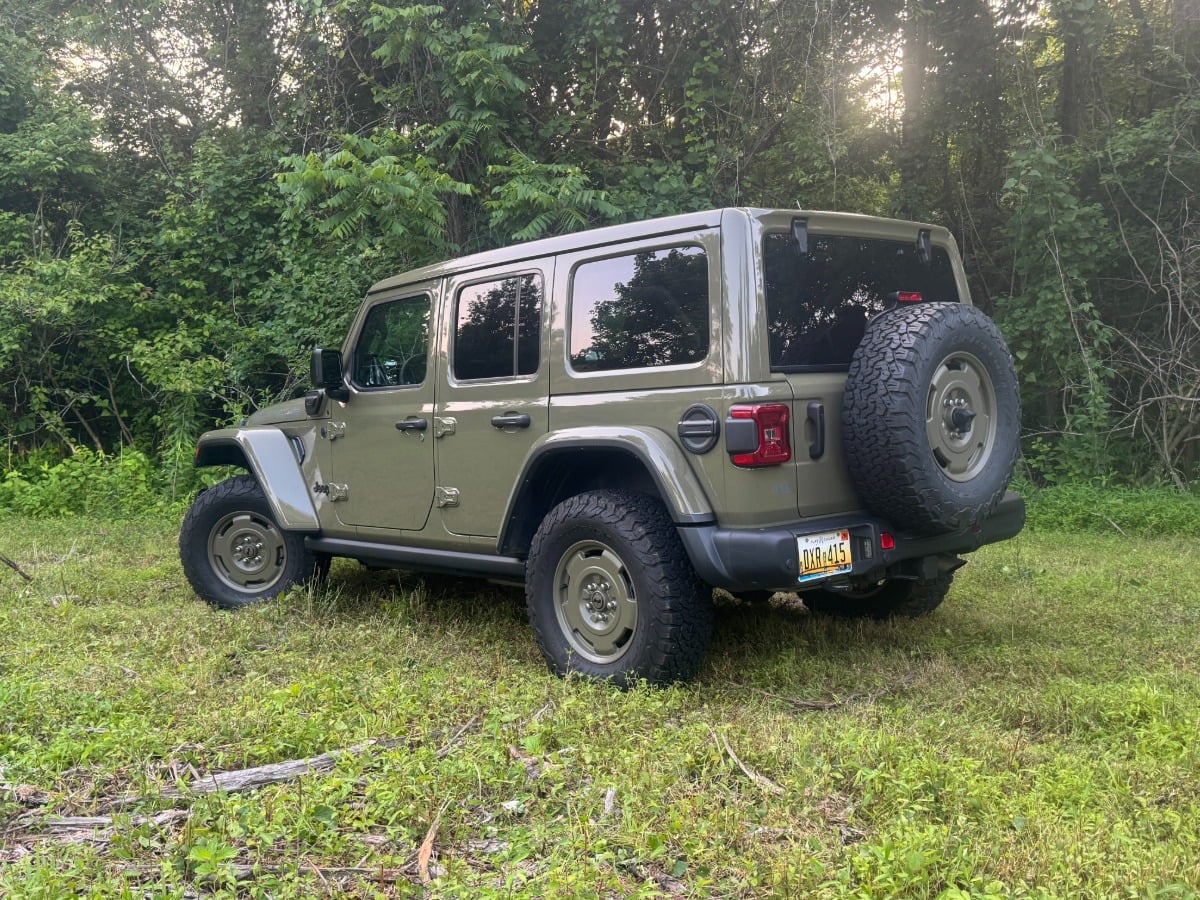
Photo: Jeff Youngs
Not enjoying my previous Wrangler experience, I approached the 2025 Wrangler 4xe with some trepidation. However, I quickly warmed up to its charm. I believe the Willys ‘41’s aesthetic played a major role in the Jeep experience. It gave me a strong sense of nostalgia, even though the vehicle I drove was nothing like the capable but comparatively archaic Willys MB from 80 years ago.
Having an open air experience instead of just driving the SUV on the interstate with the windows and top up really helped me capture the essence of the Wrangler. While I still have no plans to buy one, I now understand what all the fuss is about. If you want an open air experience in a highly capable off-road vehicle from an iconic brand, you cannot beat the Jeep Wrangler.
Jeff Youngs has over 30 years of experience in the auto industry, including 19 years with JD Power in marketing and editorial management roles. He also spent five years with General Motors as a media relations professional. More recently, as the owner and founder of Blue Line Auto Media, his work has appeared on Autotrader, Autolist, Capital One Auto Navigator, CarGurus, iSeeCars, JDPower.com, and Kelley Blue Book.