See answers to common EV questions, tax incentives, charging maps & more.
Explore EV
12 - 16
18 - 25
106 - 670
8 speed, Automatic
Gas V8
All Wheel Drive, Rear Wheel Drive
At 233 mph, you cover more than a football field every second. That's ridiculously fast—hypercar fast—and it's the kind of performance offered by the 2025 Chevrolet Corvette ZR1. This time, the engineers at Chevrolet set their sights on some of the greatest cars in the world, machines like the Lamborghini Revuelto and the Ferrari SF90. They created a Corvette with speed and handling like nothing that's come out of Bowling Green before.

Photo: Tim Stevens
The ZR1 has several substantial changes over the base Corvette Stingray:
The 2025 Chevrolet Corvette ZR1 is available as a coupe or hardtop convertible with two primary trim levels: 1LZ and 3LZ. Stepping up to the latter adds niceties like heated seats and an upgraded 14-speaker Bose Performance Series sound system. Buyers can also add the ZTK package, which includes a carbon fiber wing and aerodynamic appendages, Michelin Pilot Sport Cup 2 R tires, and a stiffer suspension.
Pricing for the Corvette ZR1 starts in the mid-$170,000 range for a 1LZ coupe, with the convertible costing $10,000 more. The 3LZ begins in the mid $180,000 range, with the ZTK and the Carbon Fiber Aero packages costing a combined $9,995 more.
For this 2025 Corvette ZR1 review, Chevrolet provided several different Corvette models and trims, but I spent much of my time in a top-shelf ZR1 3LZ Coupe with the following options:
The test vehicle's manufacturer's suggested retail price (MSRP) was $201,875, including the $3,000 gas guzzler tax and the $1,895 destination charge to ship the sports car to your local dealership from the Bowling Green, Kentucky, assembly plant.
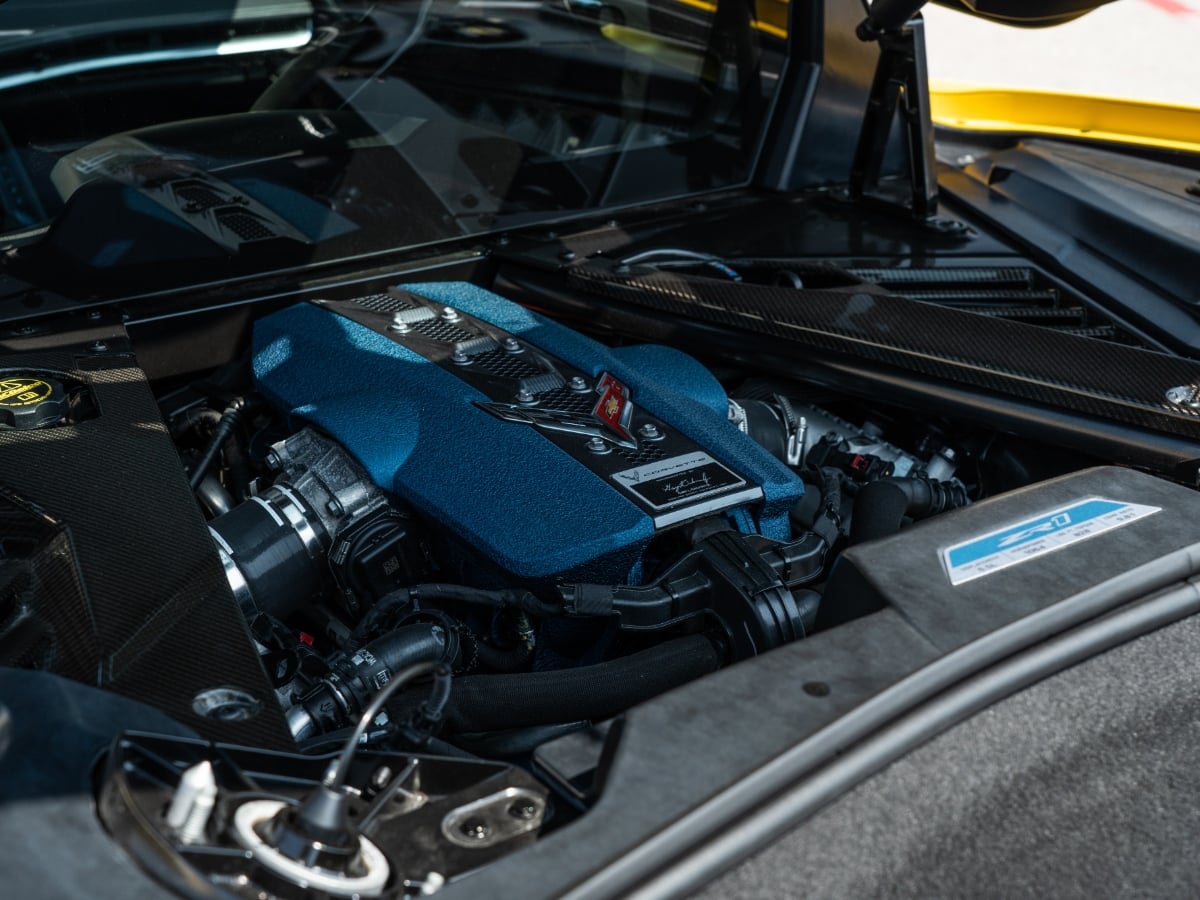
Photo: Tim Stevens
Electric cars making power figures measured in four digits are increasingly common, but extracting that kind of power from a humble V8 takes some serious engineering. To achieve the ZR1’s prodigious power, Chevrolet's engineers extensively reworked the base Stingray's V8 inside and out.
The most obvious change is the pair of turbochargers—76 mm units that provide plenty of boost. Chevy pairs the turbos with some trick anti-lag software that helps maintain throttle response despite their extreme size. More air needs more fuel to match, and the resulting bigger bangs in the combustion chamber require internal upgrades, including beefier pistons and connecting rods.
Again, the result is 1,064 hp and 828 pound-feet of torque. Chevrolet channels that output through an eight-speed dual-clutch automatic transmission and directs it only to the rear wheels. Despite not having all-wheel drive, Chevy says the ZR1 can accelerate to 60 mph in just 2.3 seconds and cover a quarter mile in 9.6 seconds.

Photo: Tim Stevens
That V8, of course, lives behind the cockpit of the ZR1, like on all Corvettes in this eighth generation. The base Stingray offers a small storage compartment with no engine up front. The ZR1 does away with that, instead creating an aerodynamic pass-through—a big vent that moves air from under the car through a heat exchanger and up over the windshield.
This creates a substantial amount of downforce, which helps keep the front tires stuck to the road when traveling at top speed. However, considerable downforce up front is no good if you don't have the grip at the back to match.
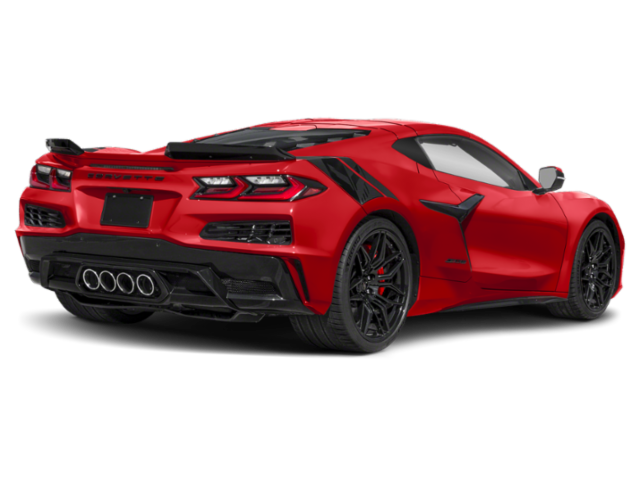
Chevrolet's engineers hung a positively massive wing off the car’s rear to provide the desired downforce. It's enormous, but its carbon fiber construction keeps its weight relatively low. That, plus several other aerodynamic tweaks and devices stuck on and under the car, results in a whopping 1,200 pounds of downforce in the new ZR1.
Downforce is all about enhancing the tires' grip, and ZR1 buyers will have two types of tires from which to choose, both in 20-inch front and 21-inch rear sizes. By default, you'll get a car rolling on Michelin Pilot Sport 4S tires, which, in my opinion, are still among some of the best performance-oriented street tires on the market.
If you want more extreme grip, opt for the ZTK package and get a set of Michelin Pilot Sport Cup 2 R tires. These are far more aggressive in terms of both the rubber compound (stickier) and the tread pattern (hardly any).
To cope with the extra grip, the ZTK package also includes a retuned suspension, which is stiffer and sharper, helping to deliver a substantially different feel. Where the base ZR1 feels like a Stingray on steroids, the ZTK car feels like the far more intense Z06 but raised to another level of performance.
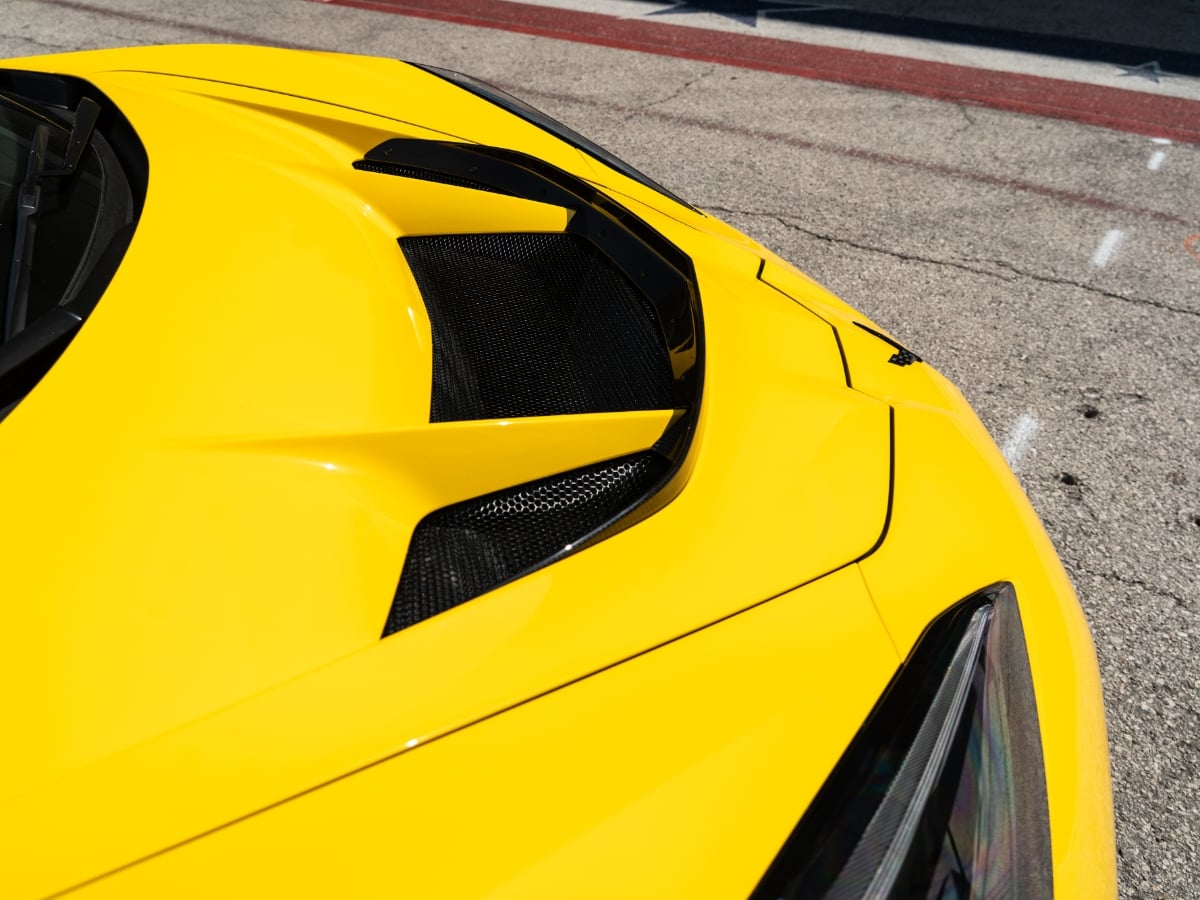
Photo: Tim Stevens
When testing a car with the kind of outrageous power promised by the new ZR1, you need a pretty big racetrack to take full advantage. Thankfully, Chevrolet provided exactly that, renting out the Circuit of the Americas (COTA) outside of Austin, Texas, for precisely that purpose.
Circuit of the Americas is a world-class performance track that's played host to everything from Formula One to the FIA World Endurance Championship over the years, and it was a perfect place to play with all 1,064 ZR1 horses. Chevrolet not only secured the track but also brought out a series of increasingly quick Corvettes, starting with a base Stingray.
On the track, the base Stingray tends to feel safe. Yes, it's fun and extremely capable, but push it too hard and it tends to wash the nose away in the corners. You must give it a slight provocation to get the rear to step out. Lapping in the base ZR1 surprisingly felt a lot like that, except that everything happens much quicker. It has the same playful but safe handling characteristics, such that over-exuberance when cornering usually results in some extra complaint from the front tires and a missed apex.
But, obviously, with 1,064 hp to the rear wheels, inducing oversteer is just that much easier. It's made more so by the ZR1's anti-lag system. Older, more basic turbochargers take time to spool up, resulting in an annoying delay between putting your foot on the accelerator and anything substantial happening. The ZR1's turbo system maintains charge in the induction system to ensure that the engine has power waiting for you as soon as you get on the gas.
The result was a car that felt precise and willing as I leaped out of COTA's tighter turns, but the truly remarkable moment was keeping my foot to the floor all the way down the track's long back straight. It was only when the speedometer was about to tick over 180 mph that I finally got on the brakes.
And what powerful brakes they are. The Corvette ZR1 features 400 mm carbon-ceramic brake discs up front, squeezed by six-piston calipers. Out back, those discs measure a still-huge 390 mm. They provided impressive braking, but it was truly and literally breathtaking in my laps with a car outfitted with the ZTK package.
With the additional aerodynamics and the grip provided by those sticky Michelin Cup 2 R tires, stomping on the brake pedal at the end of the long back straight at COTA was like being kicked in the chest. The seat belt locked, and I immediately felt like I was standing on the brake pedal as more than 1.5 G of deceleration flung me forward.
But the ZTK-equipped car really impressed through the circuit's fast, sweeping first corners. Swinging left and right and up and down, these corners are a great test of a car’s handling ability, and the ZR1 stayed remarkably planted and sure. Through the sweeping right-hand bends that finished the lap, the car was smooth and controllable, leaving me every time feeling like I'd not carried nearly enough speed through.
Only in the low-speed turns did things become a bit more of a handful. Here, the aerodynamics were less of a factor, meaning it was up to me to manage the grip and the car's pace through the turn. Any slight over-exuberance with the right pedal was met with a quick shot of oversteer, and that's despite me driving with the car's stability control still on.
So, while it felt lively, it was still easy to control. For a car with that much power and speed, it only took a few laps for me to get comfortable pushing through the turns. The limits on the ZTK-equipped car are high, and they will test your fitness as well as your resolve, but the returns are well worth it.

Photo: Tim Stevens
That the ZR1 offers remarkable speed is not a surprise. With that much power, it had to be fast. Instead, what surprised me about the ZR1 was its poise. The base model was fun and brutally fast without feeling like it wanted to kill me. While the ZTK-equipped car certainly required more resolve, it, too, was nicely balanced.
The ZR1 may lack some of the more advanced tech toys or prestige of its European competition. Still, none of that changes the car’s incredible performance and how approachable it is. Despite the Corvette costing a fraction of what you'd spend on either, I'd readily pit it against something like a Lamborghini Revuelto or Ferrari SF90. The new ZR1 isn't just the fastest Corvette ever; it's the greatest and a truly world-class competitor.
Tim Stevens is a veteran automotive and technology journalist with over 25 years of experience covering everything from smartphones to supercars. In addition to JDPower.com, his expert perspectives have appeared in numerous national and international outlets, including print, online, and broadcast television.