E-Vision Intelligence Report
September 2025
Key Findings
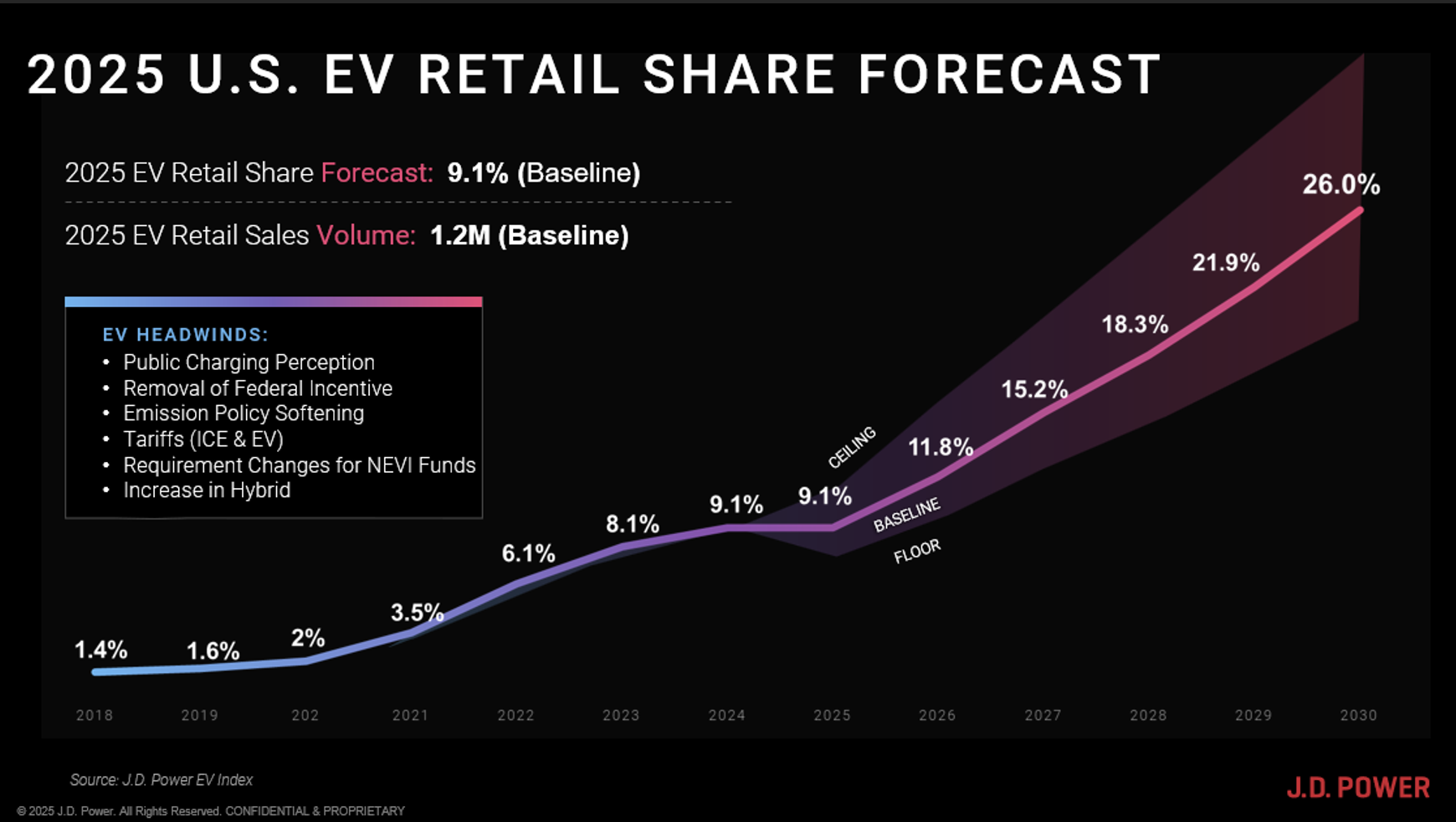
- EV Retail Market Share Surges Ahead of Tax Incentive Expiration: The total share of new electric vehicles (EVs) as a percentage of all new vehicle sales rose to 11.2% in August, an increase of 1.7 percentage points versus the same period one year ago. August’s EV share hit a level only achieved once before in December of 2024. That surge in market share is far above the 9.1% EV market share projected for calendar year 2025 as consumers raced to take advantage of the $7,500 federal tax credit on EVs that will expire on midnight September 30, 2025.
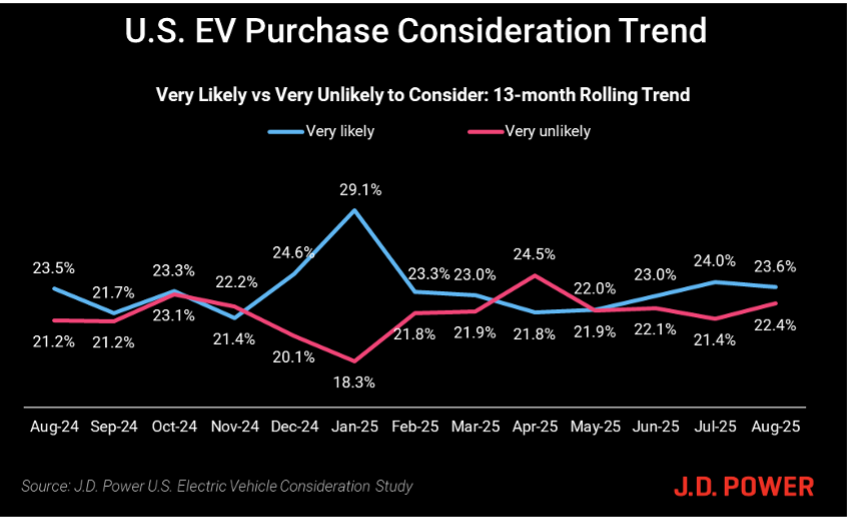
- EV Consideration Data Shows Continued Consumer Interest in EVs: Nearly one-fourth (23.6%) of new-vehicle shoppers say they are “very likely” to consider buying or leasing an EV in the next 12 months. Another 34.9% of new-vehicle shoppers say they are “somewhat likely” to consider an EV in the next 12 months. Both rates have been largely unchanged for the past 12 months, suggesting consistent consumer interest despite widely publicized market changes.
- Germany and Canada Offer Preview of Near-Term Sales Trend: Germany and Canada both had national EV subsidy programs in place that were phased out, similar to what is about to happen in the United States. In both cases, EV sales volumes dipped sharply in the immediate aftermath of the subsidy phase-out before climbing back to more normalized volumes.
Executive Summary
Is this the end of the road for EVs? Between the threat of tariffs and the repeal of $7,500 tax credit on new EV sales, pundits and speculators have had a field day forecasting the demise of the EV segment of the auto industry. In reality, the situation is quite a bit more nuanced than the social media chatter might suggest. EV sales have been surging in advance of the tax credit expiration, and major manufacturers have doubled-down on their EV initiatives in a strong signal that the market will not suddenly disappear.
In fact, when we look to current trends in consumer sentiment and track how the removal of similar EV tax credits has affected EV sales in other parts of the world, we see a fairly predictable trend in supply-demand dynamics taking root in the U.S. market.
This E-Vision Intelligence Report dives into key data points gathered from JD Power studies and proprietary market data, to offer a data-driven consumer perspective on the EV customer experience.
Getting in on the EV Goldrush
We wrote in our May 2025 E-Vision Intelligence Report that new-car shoppers were entering a once-in-a-lifetime buying opportunity for EVs. Inventory on dealer lots was high; the $7,500 tax incentive was still in effect; and the variety of models available to choose from had never been larger. Consumers took note. EV sales skyrocketed throughout the summer. In August alone, when it became clear that the federal tax credit would be phased out on September 30th, EV share of sales returned to record level, reaching a total of 11.2% of total new-vehicle retail transaction market share. That tied the previous one-month record for EV market share, which was set in December of 2024 as manufacturers offered year-end incentives and consumers speculated the end of federal incentives was near.
To put that in perspective, prior to May 2025, average EV market share had been hovering in the 8% range, and our forecast for full year 2025 EV market share was 9.1%.
EV Consideration Rates Remain High Among New-Vehicle Shoppers
Consumers currently planning to purchase or lease a new vehicle in the next 12 months do not appear to be factoring the end of the $7,500 EV tax credit into their vehicle selection process. More than half (58.5%) of new-vehicle shoppers say they are “very likely” (23.6%) or “somewhat likely” (34.9%) to consider buying an EV in the next 12 months—rates that have been largely consistent for the past 12 months.
Sticker price will still be a factor for these shoppers, however. Among those new-vehicle shoppers who are unlikely to consider an EV for their next vehicle, 45% indicate that purchase price is a major reason for their decision. The percentage of EV rejectors pointing to price as a primary barrier to consideration is up three percentage points from 42% in July.
Looking for Clues in Other Countries
The expiry of the U.S. federal EV tax credit will not be the first time a government has removed a financial incentive to encourage consumer adoption of EVs. In Germany, for example, new light-duty EV sales reached 22.2% market share before the country’s EV subsidy program was removed in December of 2023. By February of 2024, total EV market share dropped to just 9.9% of total vehicle sales. Full calendar year EV market share for 2024 was 12.6% as consumer EV purchases began to rebound. Through July of 2025, however, total EV market share has climbed back up to 16.8% of the total market.
A similar trend played out in Canada, where a federal EV incentive program was paused in January of 2025. Total EV market share climbed to 16.8% prior to the pause, then quickly fell to 6.8% market share by February of 2025. Through July, EV market share in Canada has slowly climbed, reaching 8.0%.
Meanwhile in France, where federal EV incentives were reduced beginning in 2024, and largely eliminated at the end of June 2025, EV market share has continued to climb steadily from 15.2% when the incentive was discontinued, to 15.8% for the current year through July. Likewise, in the UK, where an EV tax credit expired in June of 2022, EV market share fell to 9.9% in the month following discontinuation, before accelerating to 19.8% through July of 2025.

Methodology
This JD Power E-Vision Intelligence Report is based on data and insights from the JD Power 2025 U.S. Electric Vehicle Experience (EVX) Ownership Study, the JD Power 2025 U.S. Electric Vehicle Experience (EVX) Public Charging Study, the EV Volumes Country Share Tracker, and the JD Power 2025 U.S. Electric Vehicle Consideration (EVC) Study.
Find out More
This report was authored by Brent Gruber, executive director, electric vehicle practice. The JD Power E-Vision initiative is a company-wide program focused on maximizing JD Power industry-leading EV data, analytics, insights and solutions. Please contact us at the numbers below to connect with Mr. Gruber or to learn more about the underlying research.
Media Contacts
Shane Smith; East Coast; 424-903-3665; [email protected]
Joe LaMuraglia, JD Power; East Coast; 714-621-6224; [email protected]