E-Vision Intelligence Report
March 2024
EV Consideration Trends Down for Fourth Consecutive Month as Public Charging Experience Continues to Deteriorate
Key Findings
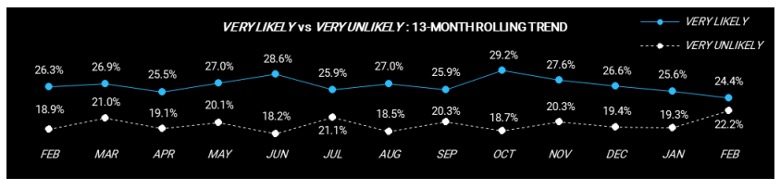
- Consumer Interest in EVs Declines for Fourth Consecutive Month: The percentage of automobile shoppers who say they are “very likely” to consider an electric vehicle (EV) for their next purchase or lease declines to 24.4% through the end of February 2024, the fourth consecutive monthly decline in EV consideration. Meanwhile, the percentage of shoppers who say they are “very unlikely” to consider an EV has climbed to 22.2% during the same period.
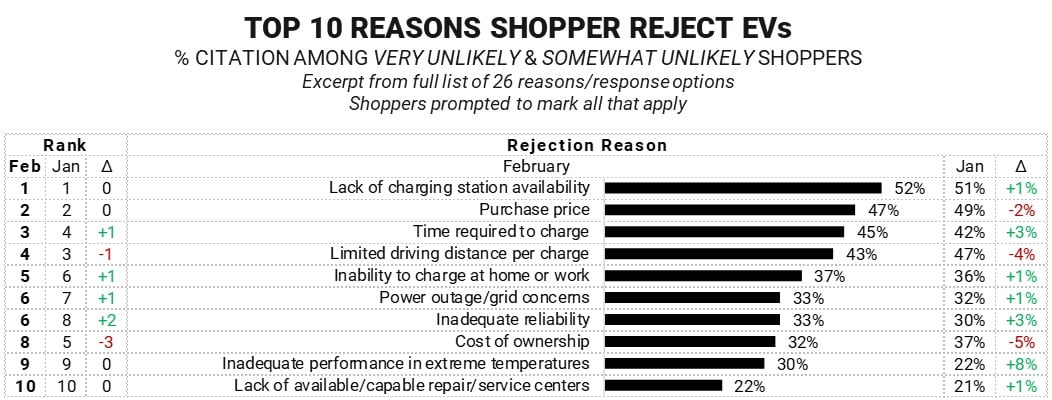
- Charging Infrastructure Remains Stumbling Block to Mainstream Adoption, and it’s Getting Worse: The top reason for not considering an EV, cited by 52% of consumers, is lack of charging station availability. According to the JD Power 2024 U.S. Electric Vehicle Experience (EVX) Ownership Study,SM satisfaction with public charger availability among non-Tesla owners is 32 points (on a 1,000-point scale) lower than a year ago.
- All Eyes on Tesla Charging Network: Tesla has been the sole EV manufacturer to deliver a consistently positive public charging experience through its proprietary charging network. Soon, EVs from more than a dozen different manufacturers will be compatible with Tesla’s North American Charging Standard (NACS), and if that positive customer experience holds, we could see a reshuffling of the ranks of most popular EV brands as models from BMW and Rivian start to impress owners with a stand-out customer experience.
Executive Summary
Consumer interest in EVs is being put to the test as the nation’s foundering public charging network continues to disappoint users. Will mass access to Tesla’s NACS network fix the problem? And if it does, how will that influence consumer interest in non-Tesla models?
This E-Vision Intelligence Report dives into key data points trending in each monthly EV Index update, along with other data points gathered from JD Power studies and pulse surveys, to spotlight emerging trends and important shifts in EV consumer sentiment.
EV Consideration Declines
Two important EV adoption trendlines are converging in a way that should signal some concern for automakers. The percentage of consumers who say they are “very likely” to consider an EV for their next vehicle purchase or lease is declining, while the percentage who say they are “very unlikely” to consider an EV for their next purchase or lease is on the rise. This is the fourth consecutive monthly decline in EV consideration and the lowest level recorded since JD Power started tracking the trend in June 2022.
Public Charging Experience Goes from Bad to Worse
The majority (52%) of consumers who say they would not consider an EV for their next vehicle purchase or lease cite lack of charging station availability as a key reason for their decision. Other charging-related concerns, such as time required to charge (45%), limited driving distance per charge (43%), inability to charge at home or work (37%) and power outage/grid concerns (33%) are all among the top drivers of EV rejection.
EV customer experience with the public charging network and widespread media reports about EV owners struggling to charge their vehicles in harsh winter conditions is exacerbating these concerns. Among mass market EV owners, satisfaction with public charger availability declined 32 points during the past year. We also find that the percentage of EV rejecters citing “inadequate performance in extreme temperatures” rose 8 percentage points in February from January—an indication of the influence news reports of “Chicago’s EV Apocalypse” likely had on consumer sentiment.
How Will the Opening of Tesla’s Chargers Shuffle the Deck?
Tesla has consistently earned significantly higher customer satisfaction scores than rival EV manufacturers when it comes to using public charging networks. According to our data, overall satisfaction with DC fast charging (Level 3) among Tesla vehicle owners in 2023 was 738, while the industry average for all other brands is just 569. With 17 automotive corporations now having signed agreements with Tesla to use their NACS standard and many non-Tesla vehicles soon-to-be compatible with the Tesla network, the big question is: Will it work?
Will non-Tesla vehicles suddenly enjoy the same great public charging experience that Tesla owners have had for the past several years? Or will there be issues with capacity, conversion equipment or software that blunt the positive effects of the transition? We’ll soon find out.
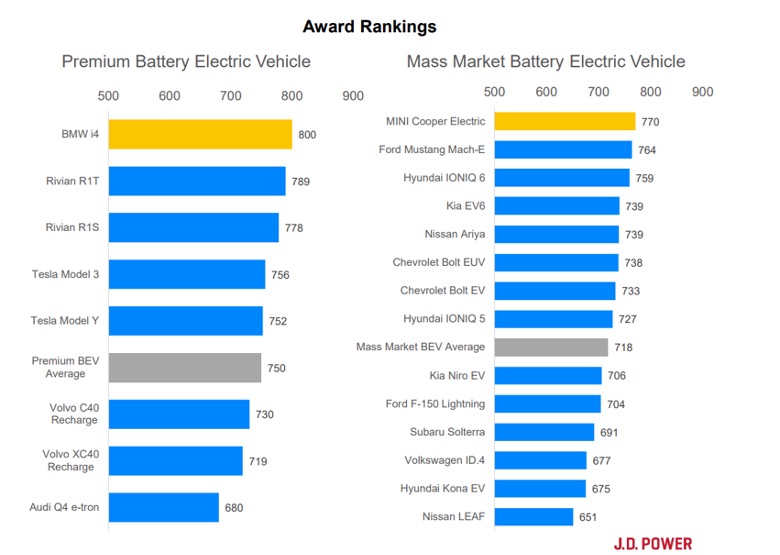
If the plan does work, non-Tesla brands could see a significant bump in consumer demand. The BMW i4, Rivian R1T and Rivian R1S recently took the top three spots in the JD Power 2024 U.S. Electric Vehicle Experience (EVX) Ownership Study,SM significantly outperforming Tesla in key areas like satisfaction with vehicle quality and reliability. However, like other non-Tesla models, these vehicles dramatically underperformed Tesla in satisfaction with the availability of public charging. If that problem were to improve substantially with greater access to fast charging through usage of Tesla’s Supercharger network, we may see a significant change in the competitive dynamics with the ownership experience among EV models.
Methodology
This JD Power E-Vision Intelligence Report is based on data and insights from the JD Power EV Index, the JD Power EV Retail Share Forecast, the JD Power 2024 U.S. Electric Vehicle Experience (EVX) Ownership Study, the JD Power 2023 U.S. Electric Vehicle Experience (EVX) Public Charging Study and the JD Power U.S. Electric Vehicle Consideration (EVC) Study. The JD Power EV Index is an analytics tool to benchmark the growing EV market in the United States. It tracks millions of data points aggregated into six categories—interest, availability, adoption, affordability, infrastructure and experience—to evaluate the progress to parity of EVs with gas-powered vehicles in the U.S. Each month, the JD Power electric vehicle practice will analyze these data points, and others to spotlight emerging trends and important shifts in consumer sentiment that are helping to define the fast-moving EV marketplace.
Find out More
This report was authored by Elizabeth Krear, vice president, electric vehicle practice; Brent Gruber, executive director, electric vehicle practice; Stewart Stropp, executive director, electric vehicle practice; and Kristen Richter, senior manager, electric vehicle practice. The JD Power E-Vision initiative is a company-wide program focused on maximizing JD Power industry-leading EV data, analytics, insights and solutions. Please contact us at the numbers below to connect with the authors or to learn more about the underlying research.
Media Contacts
Shane Smith; East Coast; 424-903-3665; [email protected]
Geno Effler, JD Power; West Coast; 714-621-6224; [email protected]