
Advanced driver assistance systems (ADAS) have become a cornerstone of vehicle safety and fatigue-free driving. These technologies serve as co-pilots that not only make the driver aware of potentially dangerous situations but, in many cases, can initiate maneuvers through steering, braking, and acceleration to avoid an accident altogether. One such system is Volkswagen’s Travel Assist feature, which provides lateral and longitudinal guidance, making highway driving safer during daily commutes and long road trips.
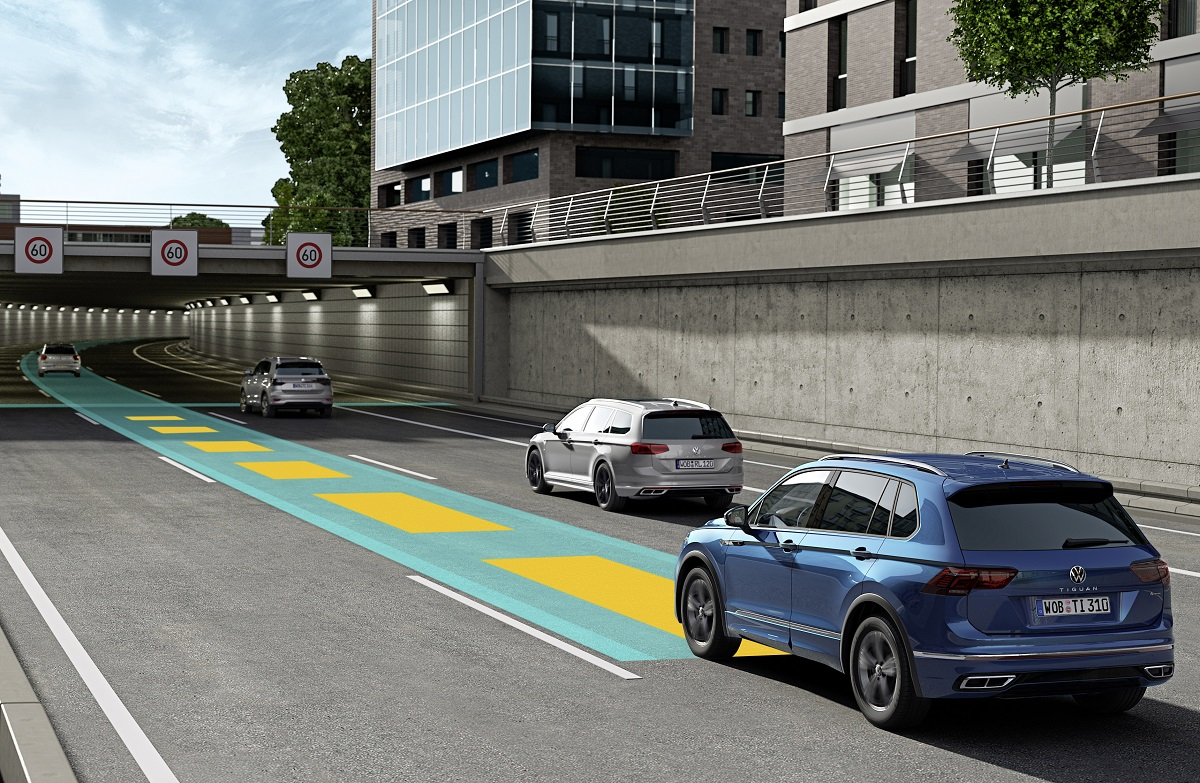
Volkswagen’s Travel Assist is a package of ADAS technologies that enables Level 2 autonomous driving, similar to Ford’s BlueCruise, GM’s Ultra Cruise, and Tesla’s Handsfree systems. It combines adaptive cruise control, lane-guidance technology, and an Emergency Assist feature, all operating from data gathered by cameras, radar, and sensors. As a result, the vehicle can partially drive itself while on highways.
When engaged, Travel Assist independently controls acceleration, braking, and steering. Its primary goal is to keep the vehicle in the center of its lane while actively maintaining safe distances from other cars up to a speed of 130 miles per hour.
To activate Travel Assist, two conditions first need to be satisfied:
Once these two conditions are met, the driver can engage Travel Assist by pressing a button on the steering controls. A green symbol will appear in the instrument panel, indicating the system is on and active.
To deactivate the system, the driver can press the same button or apply slight pressure to the brake pedal. To reactivate, the driver must again accelerate to their desired speed and press the Travel Assist button.
Lane-guidance technology is a key component of Volkswagen’s Travel Assist system. Although lane guidance itself is not a new feature, its inclusion within the broader Travel Assist system makes it more effective overall. Its primary function is to keep a vehicle from driving into the path of another vehicle traveling in the same direction.
Generally speaking, standard lane-keeping assistance technology refers to an ADAS system that uses the vehicle’s cameras and sensors to track road lines and thus knows when a driver begins to drift out of the current lane of travel unintentionally. It provides audio, video, and haptic feedback but takes no corrective action. In other words, it makes the driver aware that a correction needs to be made by them.
With Volkswagen’s Adaptive Lane Guidance, the system takes a certain degree of automatic control over steering. It will continually make slight steering adjustments to keep the vehicle in the center of its lane. The driver can assume full steering control at any time and must put their hands on the wheel every few seconds to let the system know they are alert to the road ahead.
The system will allow lane changes as usual. The driver must use their turn signal to indicate their intention to merge into another lane. At that time, the system yields, and the driver takes full control of the steering wheel.
Emergency Assist is a component of Travel Assist. While Travel Assist helps maintain lane position and safe distances from other vehicles in the same or adjacent lanes, it is not, by definition or operation, a fully autonomous driving system. As a Level 2 system, it is considered semi-autonomous. It cannot drive under its own control for long periods or through variances in the road without driver involvement. Therefore, drivers must always keep their hands on the steering wheel while using it.
The purpose of Emergency Assist is to stop the vehicle if the driver becomes unresponsive due to fatigue or illness. It is a failsafe mechanism that operates and takes effect depending on how long the driver is absent from operating the vehicle. At the base level, Emergency Assist reminds drivers to keep their hands on the steering wheel. If it detects that the driver’s hands are off the wheel for more than a few seconds, it will display a message on the dash reminding the driver to retake control of the wheel. This message turns red after a few more seconds, followed by an audible warning to capture the driver’s attention.
If the system does not detect driver input, Emergency Assist intercedes by applying the brakes and slowing the vehicle while keeping it within its current lane. Unless the driver takes control of the steering wheel, the system will continue to slow the car down until it stops. Once stopped, the Emergency Assist system will activate the vehicle’s hazard lights.
Although this technology is considered Level 2, the Emergency Assist function takes complete control of the vehicle for the time it takes to bring it to a stop. Ultimately, its premise is to prevent the car from veering off the road or into other vehicles if the driver becomes incapacitated.
Volkswagen Travel Assist technology does two things: It keeps a vehicle in its lane and other cars at a safe distance. The result is a safer highway driving experience with less fatigue and more peace of mind.
Jessica Shea Choksey is an experienced writer in the automotive field. In addition to JDPower.com, she was a correspondent for PBS’s MotorWeek. Her work has also appeared in AutoTrader.


The Ford Transit is the automaker’s full-size cargo and passenger van offering, designed to serve a wide range of commercial and lifestyle applications. With 37 available configurations, the platform ...See More
Read the Full Article
The Chevrolet Tahoe is a full-size, three-row SUV with a standard V8 engine and available diesel power. Built on the same platform as the Chevrolet Silverado 1500 pickup, the Tahoe benefits from its ...See More
Read the Full Article
It is the end of the line for the Ford Escape. After 25 years as a fixture of Ford’s lineup, 2026 will be the compact SUV’s last model year.
Read the Full Article
The Colorado is Chevrolet’s midsize pickup. It ranks among the segment’s most capable trucks for payload and towing, and can be configured for both work and off-road adventures. For 2026, the ...See More
Read the Full Article