How To Change Brake Pads

Dustin Hawley | Dec 18, 2022

The brake system is essential for road safety, so you shouldn’t really skimp on maintenance. Learning how to change brake pads, DIY-style, can save you a significant amount of cash and help you be knowledgeable about any potential problems. 
How To Change Brake Pads

So, let’s explore the topic and discuss how and when you should change the pads. 

When To Change Your Brake Pads

You must change the pads every 25 000 to 75 000 miles depending on how and where you drive. If you hear them squeak or grind, it could be a dead giveaway, but to make sure, you always need to check the pads visually.

As statistics or a general amount of time that should pass until you must change the pads can be inaccurate, all pads have wear-out indicators. Alternatively, you could just check out the friction parts, and if they have thinned out, it’s definitely time to go for a replacement. 

When Should I Attempt To Change The Pads Myself?

As a general rule of thumb, most cars have highly reliable disc brakes that wear out faster and must be replaced often. Changing the pads here is relatively easy to do on your own and will help you save around $300-$500. As to how you should do it, we’ll get to that later in the article. 

But if you have brakes of the drum variety, it’s best to leave changing the pads to a professional. It’s a big hassle to do on your own, not to mention that sometimes you may even have to change the rotor, which goes beyond the simplicity of replacing the pads.

What Instruments And Materials Are Required To Change Brake Pads

Before even attempting to change the pads yourself, you should gather the right tools and materials, which include the following:

  • Brand new brake pads. You can order original ones from the manufacturer or check other reliable brands. Make sure you buy the same type of pads as already installed. Check on the internet or in the car shop.
  • Brake fluid. Consult the manual to pick the right type.
  • A small sachet of brake grease. It usually comes with new pads.
  • Jack
  • Socket wrench
  • Lug wrench
  • Plastic ties or a piece of wire
  • Wooden plank or C-clamp

The procedure itself is straightforward if you know what you’re doing. But, if you are trying your hand at it for the first time and are double-checking every step, expect to spend more than an hour.

How To Change Brake Pads Yourself

Now it’s high time we discuss changing brake pads step by step. All you need to do is follow these simple instructions: 

  • Take care of safety. Make sure the vehicle is stable, and fix the wheels on the ground with some stops. Place the jack only on a firm, even surface.
  • Remove the wheel. First, loosen the lug nuts with a socket wrench but don’t unscrew them. Jack up the car from the wheel’s side, unscrew the bolts and remove the wheel. Now you have access to the brake assembly.
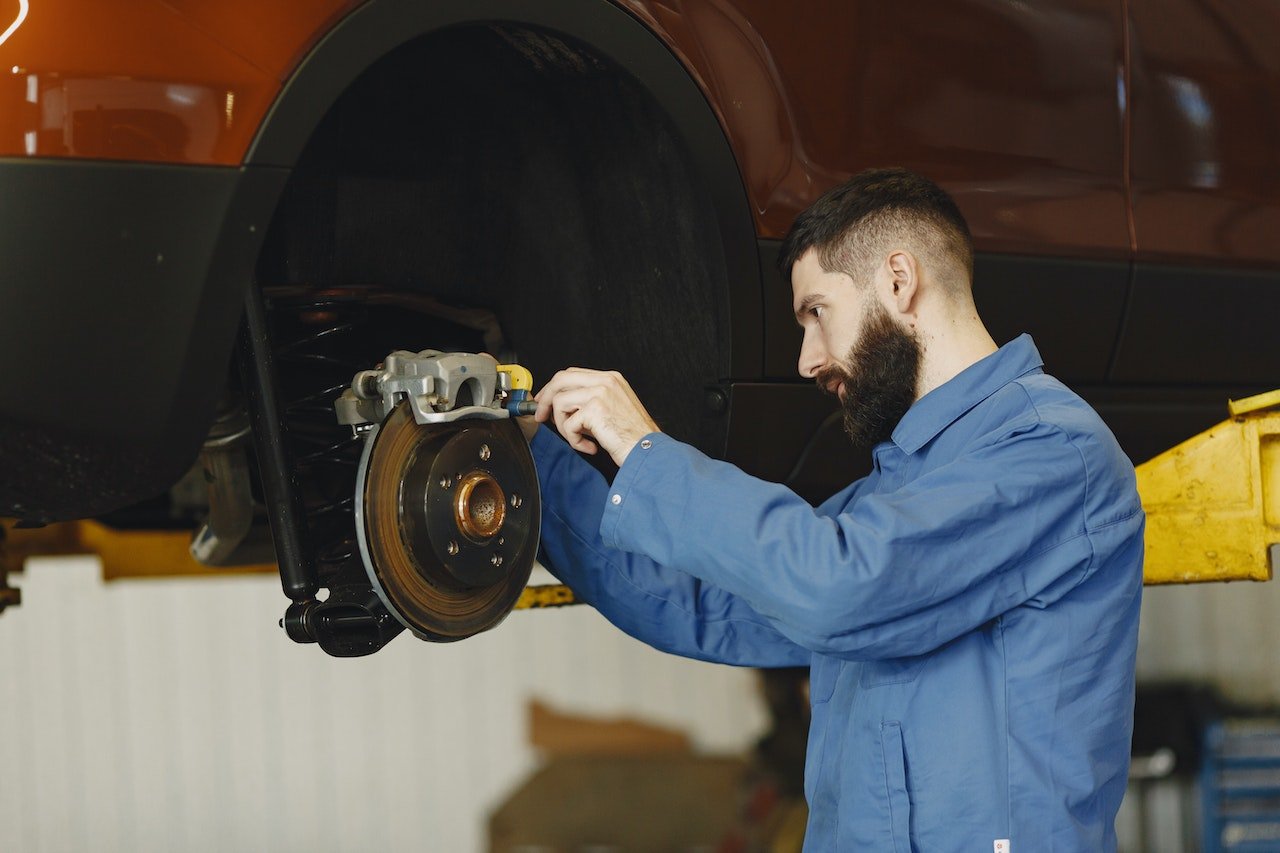
  • Remove the caliper. It is fixed with two slider bolts; you need to unscrew and remove the bottom one and loosen the one at the top. Then you need to lift and recline the caliper to access the rotor. You don’t need to disconnect the brake hose as it moves with the caliper. Fix the caliper with a wire or a plastic tie, and don’t let it hang on its hose, as you can cause a brake fluid leak. Here you also need to examine the pads.
  • Remove the old brake pads and place the new ones. Usually, new pads come with new retaining clips and a small sachet of graphite-based grease. Change the clips and put some fresh grease on them to avoid squeaking. Insert the new pads, add some grease on metal plates, and the “ears” inserted in clips - the pads should slide effortlessly in place.
  • Retract the piston (or pistons) and reposition the caliper. To push the pistons back in place, use something thin and flat, like a wood plank or a C-clamp. After that, the caliper should slide easily on the newly installed pads.
  • Put back the slider pin and tighten both of them. Put the wheel back in place, tighten the lug nuts, and lower the vehicle. Don’t forget to tighten all the bolts, as your safety depends on them. 
  • Do the same for other wheels.
  • Do the test drive in safe conditions. Start on neutral and try to press the brake pedal to see how it works. Start the movement slowly to check if the new brakes work fine.

If you feel that you did something wrong, we recommend double-checking with a mechanic at a repair shop. 

Summary

Changing the brake pads on your own is not highly complex and could be done in your home garage. If you feel confident, we encourage you to try and do it yourself. But, if you feel like you can make a mess of things, don’t hesitate to delegate to a professional. 

In any case, we hope our articles were helpful and that you got the hang of what goes into changing the brake pads. 

What’s Next?


Cars for Sale
Want to Take Action?
Shop Cars for Sale

Car Trade-in Values
Curious About Your Car’s Trade-in Value?
Find out With Our Car Trade-in Values Tool

Best Cars and Trucks
Want to Maximize Your Purchasing Power?
Explore Our Listings of the Best Cars and Trucks

EV Charging Stations Near Me
Need to Find EV Charging Stations Near You?
Check Out Our EV Charging Stations Map

Explore New Car Previews

2026 Ford Transit Preview

2026 Ford Transit Preview

The Ford Transit is the automaker’s full-size cargo and passenger van offering, designed to serve a wide range of commercial and lifestyle applications. With 37 available configurations, the platform ...See More

Read the Full Article
2026 Chevrolet Tahoe Preview

2026 Chevrolet Tahoe Preview

The Chevrolet Tahoe is a full-size, three-row SUV with a standard V8 engine and available diesel power. Built on the same platform as the Chevrolet Silverado 1500 pickup, the Tahoe benefits from its ...See More

Read the Full Article
2026 Ford Escape Preview

2026 Ford Escape Preview

It is the end of the line for the Ford Escape. After 25 years as a fixture of Ford’s lineup, 2026 will be the compact SUV’s last model year.

Read the Full Article
2026 Chevrolet Colorado Preview

2026 Chevrolet Colorado Preview

The Colorado is Chevrolet’s midsize pickup. It ranks among the segment’s most capable trucks for payload and towing, and can be configured for both work and off-road adventures. For 2026, the ...See More

Read the Full Article