14 - 20
305 - 540
8 speed, Automatic w/OD
Gas/Electric V-6, Twin Turbo Premium Gasoline I-6, Twin Turbo Regular Gasoline I-6
Four Wheel Drive, Rear Wheel Drive
The Ram TRX is dead. Long live the Ram TRX. I never drove one, but I understood that truck’s appeal, and I don’t think the new 2025 Ram RHO can match that supercharged V8-powered beast when it comes to sheer visceral enjoyment. It just doesn’t sound right in the same way the standard Ford F-150 Raptor never has , but a Chevy Silverado ZR2 still does.

Photo: Christian Wardlaw
Otherwise, the RHO appears just as capable, comfortable, and rewarding to drive off-road as the TRX was. And, with a claimed acceleration time to 60 mph in 4.6 seconds courtesy of its high-output, twin-turbocharged inline six-cylinder engine, the $28,000 you save compared to the old TRX goes a long way toward making the RHO’s exhaust note acceptable if not enticing.
Ram sells the 2025 RHO in a crew cab, shortbed configuration. Including the destination charge, it costs $71,990 before you add any options, and the biggie is the RHO Level 1 Equipment Group, which installs nearly 10 grand in extras. For comparison, the less powerful Chevrolet Silverado ZR2 is $5 more than the Ram (yes, five bucks) in the base specification, while a Ford F-150 Raptor carries a starting price of $81,000.
For this review of the 2025 RHO, Ram provided a test vehicle equipped with the following options:
The RHO Level 1 Equipment Group adds 28 items to the truck. The highlights include:
The test vehicle’s price was $84,420, including the $1,995 destination charge to ship the truck to your local dealership from the Ram assembly plant in Sterling Heights, Michigan.

Photo: Christian Wardlaw
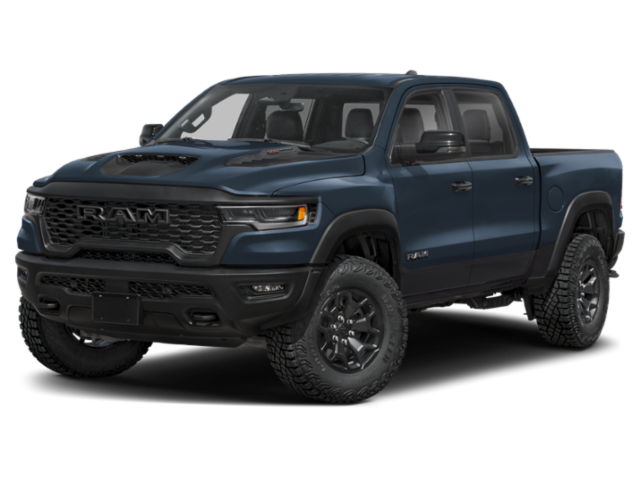
The 2025 Ram 1500 RHO replaces the Ram TRX, offering a similar look and capability but at a lower price that positions it against its rivals from Chevy and Ford.
The main difference between the RHO and TRX lives within the engine bay. The TRX had a supercharged 6.2-liter Hemi V8 generating 702 horsepower and 650 pound-feet of torque, while the RHO employs a twin-turbocharged 3.0-liter Hurricane inline six-cylinder engine making 540 hp and 521 lb-ft. Unexpectedly, the RHO’s high-output Hurricane gets the truck to 60 mph in a claimed 4.6 seconds, just a tick behind the TRX, which Ram said could do the deed in 4.5 seconds.
So, the RHO is nearly as quick as the TRX. It also offers more towing and payload capacity. The TRX topped out at 8,100 pounds of trailer and 1,310 lbs of payload, while the RHO can handle a trailer up to 8,380 lbs and 1,520 lbs of payload.
Like the TRX, the RHO is a performance truck specializing in high-speed desert driving, so a Baja driving mode is standard. However, Auto, Mud/Sand, Rock, Tow, Snow, Sport, Custom, and Valet modes ensure you can tailor the RHO’s demeanor to multiple driving situations.
The Ram RHO sits on an exclusive Bilstein Black Hawk e-Shock adaptive suspension with 11.8 inches of ground clearance, 13 inches of front suspension travel, and 14 inches of rear suspension travel. In addition, it provides a high-speed electronic locking rear differential, 35-inch Goodyear Territory all-terrain tires, and available 18-inch beadlock-capable wheels.
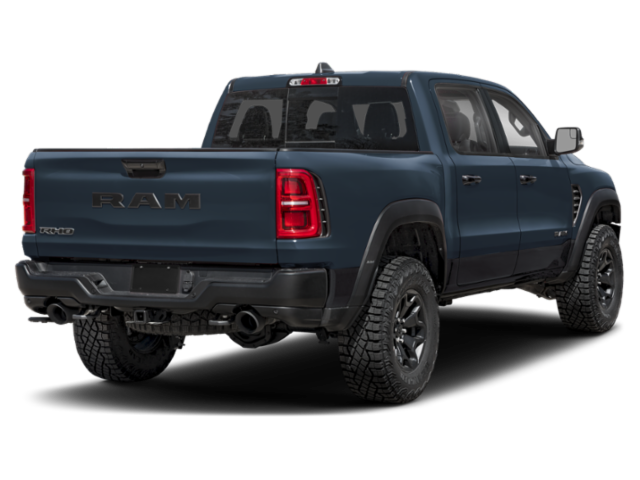
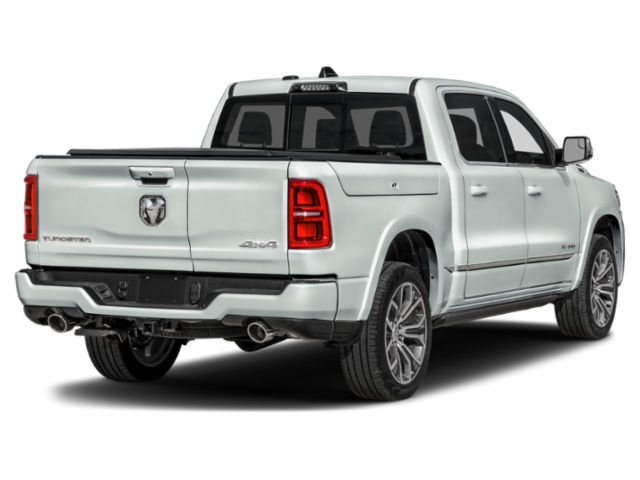
Ram makes sure the RHO looks like a performance truck. It has a unique grille insert, different bumper, blistered fenders with extra wheel flare cladding, dual 5-inch exhaust outlets, and recovery hooks front and rear. Decals and badges pronounce the truck as an RHO equipped with a high-output engine.

Photo: Christian Wardlaw
The Ram RHO sits high off the ground, making it a challenge to enter and exit, especially if you have short legs. The test truck’s optional step rails made it a little easier, but they’re mounted high to preserve the RHO’s breakover angle and off-road capability. Also, I had trouble with clearance between the seat and the steering wheel, but that’s because I prefer a towering driving position.
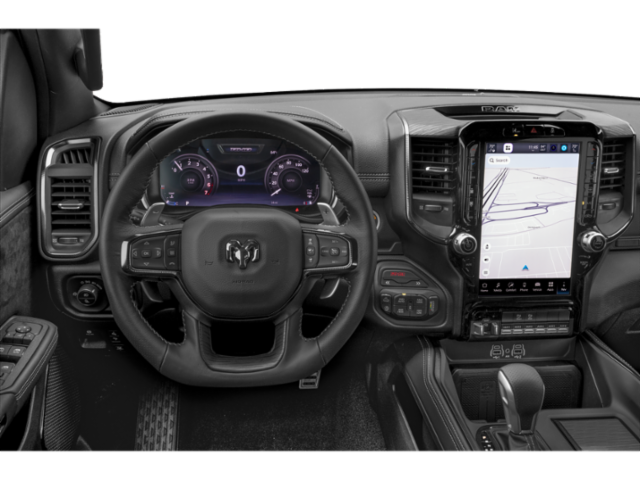
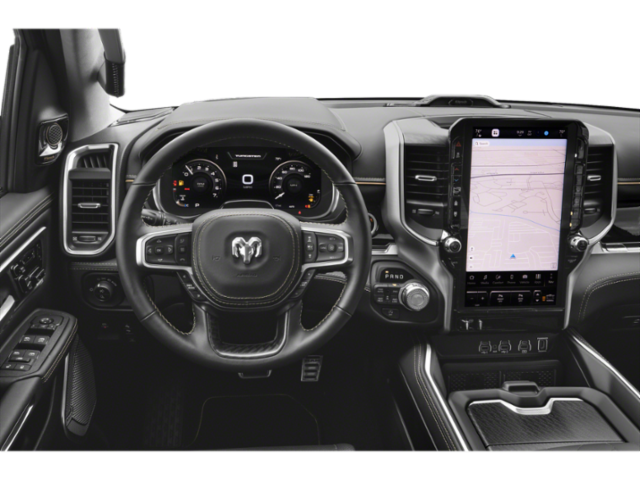
Once everyone is aboard, the RHO is exceptionally comfortable and Ram uses a mix of durable materials in the cabin. With a digital driver display, a large center touchscreen, a passenger touchscreen, and plenty of gloss black plastic trim, this truck’s dark interior is a dust magnet. Glare and reflections on all displays, including the camera-based digital rearview mirror, are problematic.
The RHO is quick but emits a dissatisfying buzzy growl instead of a rumbling bellow. Around town, the suspension soaks up speed humps, but speed bumps and sharper cracks in the pavement unsettle the RHO more than expected. The bulging 35-inch all-terrain tires free you from concern about scuffing a wheel, and the ride height means you never worry about crunching an air dam on a parking block. The available surround-view camera is genuinely helpful when parking.
On the highway, the RHO can bound excessively, especially in front, and some stretches of sectioned concrete freeways in Los Angeles created a busy ride. I was surprised that tire whir wasn’t evident at higher speeds, perhaps masked by wind noise.
When traveling to far-flung destinations, it’s common to drive secondary roads. The RHO’s sheer size demands extra care to keep the truck on your side of the double-yellow line when rounding blind curves, and the tires offer squishy handling at best.
According to the EPA, the Ram RHO should return 15 mpg in combined driving, a substantial increase over the TRX’s dismal 12 mpg. I observed 14 mpg during a round trip from the L.A. suburbs to the desert that included freeway, two-lane mountain road, off-roading, and city driving.

Photo: Christian Wardlaw
Blasting down trails on the western fringes of the Mojave Desert, the RHO proved terrific fun to drive and felt unstoppable. That is, of course, an illusion. You still must be careful. At one point, I did get up to 55 mph, but only on a stretch of the trail I’ve traveled before, which offers long-distance visibility, so I knew it would be safe. That experience demonstrated that Ram has correctly set this truck up for high-speed desert running.
However, it’s also capable in slow- and low-speed situations. When I encountered ruts carved by recent rains and scrambled up a rock-strewn mountain, the RHO effortlessly picked its way across, around, and over various obstacles. The truck’s sheer size is a liability when passing through thickets of brush, and getting it turned around when reaching an impasse is a challenge, but overall, the RHO is a talented off-roader.
The test truck’s surround-view camera offered a forward view, which I used when cresting one particularly steep hillside. What showed amidst the dust and glare on the screen didn’t look treacherous, but I decided to get out and look anyway. It’s a good thing I did because directly ahead was a descent that would be ill-advised for anyone without plenty of off-roading experience and a proper truck setup.
Regarding visibility, it is also hard to discern secondary roads on the navigation system’s map because sunlight and glare can wash out the display. Getting your bearings is a challenge when you’re out in the middle of nowhere.
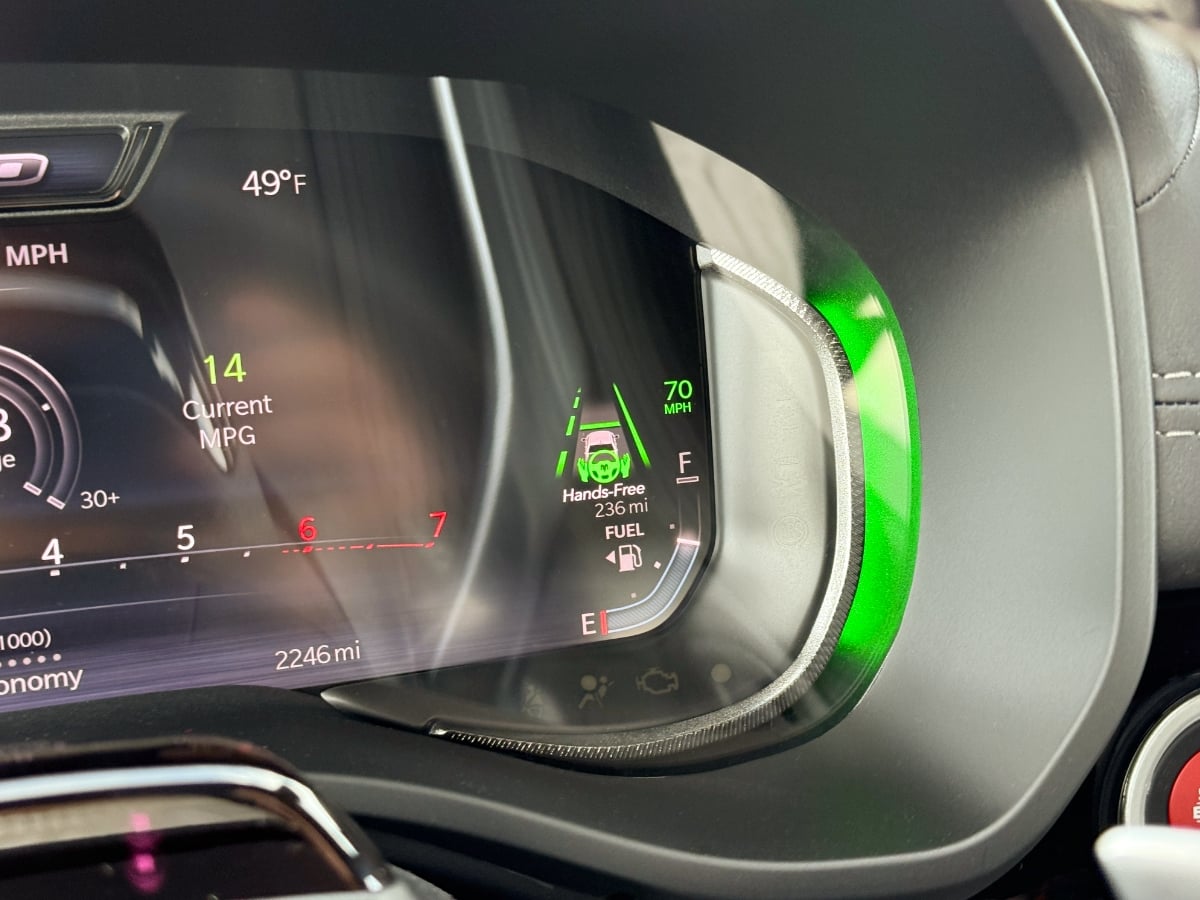
Photo: Christian Wardlaw
Screen dust and glare are problems no matter where you drive the RHO. I evaluated this truck on a sunny February day and frequently struggled to reference the digital gauges, center touchscreen, and rearview camera mirror.
The 14.4-inch Uconnect 5 touchscreen is mounted portrait style, flanked by buttons and knobs for the stereo and climate systems. I prefer landscape-oriented systems, but this one is wide enough and mounted high enough that it didn’t bother me much.
Uconnect 5 offers voice recognition technology and a digital voice assistant, but it’s not as sophisticated as expected. Sometimes, you must follow specific prompts on the display to get the desired result. Other times, such as when asking for directions to a hospital, you get suggestions that are not hospitals. In addition to my local ER, the potential destinations included a ketamine clinic, a veterinarian, and an eye surgery center.
Active Driving Assist is available on the RHO. It is a hands-free driving assistance system incorporating adaptive cruise control, lane-centering assistance, and lane-change assistance. Unfortunately, this technology did not work well in this truck.
While traveling in a carpool lane, Active Driving Assist allowed the truck to get uncomfortably close to the concrete divider wall and bridge abutments, putting me in a constant state of alert, prepared to intervene when necessary. That’s tiring.
In regular traffic lanes, the tech allowed the truck to drift off-center. When it corrected itself just as the truck entered a gentle bend in the freeway, it usually drifted wide when entering the curve due to delayed automated steering input, the tires slapping on the Botts’ Dots California uses as tactile lane markers.
On a perfectly straight stretch of freeway, I traveled under an overpass. Upon entry into the shadows, the RHO drifted left to the lane markers until it emerged back into the sunlight and corrected course.
Ultimately, I did not like this application of Active Driving Assist. I didn’t trust it, and it stressed me out. So, I turned it off for the remainder of our journey to the desert.

Photo: Christian Wardlaw
The 2025 Ram RHO might not be as aurally satisfying as the old TRX, but it is nearly as quick, just as capable off-road, and provides more towing and payload capacity. In addition, it travels farther on each gallon of gas and costs substantially less to buy. As some people might say, “winner winner chicken dinner.”
Nevertheless, if you just can’t live without the intoxicating sound of a V8 engine, you can choose the similarly priced Chevrolet Silverado ZR2 with a normally aspirated 5.3-liter or 6.2-liter V8 or the substantially more expensive Ford Raptor R with a supercharged 5.2-liter V8.
Christian Wardlaw is a veteran automotive journalist with 30 years of experience in the field and has held automotive editorial leadership positions at Edmunds, JD Power, and The New York Daily News. Today, Chris owns a content agency called Speedy Daddy Media, and in addition to JDPower.com, his work appears on Capital One Auto Navigator, CarGurus, and Edmunds.