See answers to common EV questions, tax incentives, charging maps & more.
Explore EV19 - 20
26 - 27
269
8 speed, Automatic w/OD
Intercooled Turbo Regular Gasoline I-4
All Wheel Drive, Front Wheel Drive

Photo: Perry Stern
The Volkswagen Atlas Cross Sport competes in the Upper Midsize SUV market segment. According to data collected from verified new-vehicle buyers for the JD Power 2022 Automotive Performance, Execution and Layout (APEAL) Study, 52 percent of new Upper Midsize SUV buyers are male (vs. 62 percent for the industry), and the median age of a new Upper Midsize SUV buyer is 52 years (vs. 54).
As part of the APEAL Study, owners rated the Upper Midsize SUV segment in 10 primary categories. Listed below in descending order, you'll find their preferences, from their most favorite thing about the vehicle to their least favorite:
In the following sections, our independent expert analyzes an Atlas Cross Sport equipped with the following options:
The test vehicle's price was $53,190, including the $1,350 destination charge.
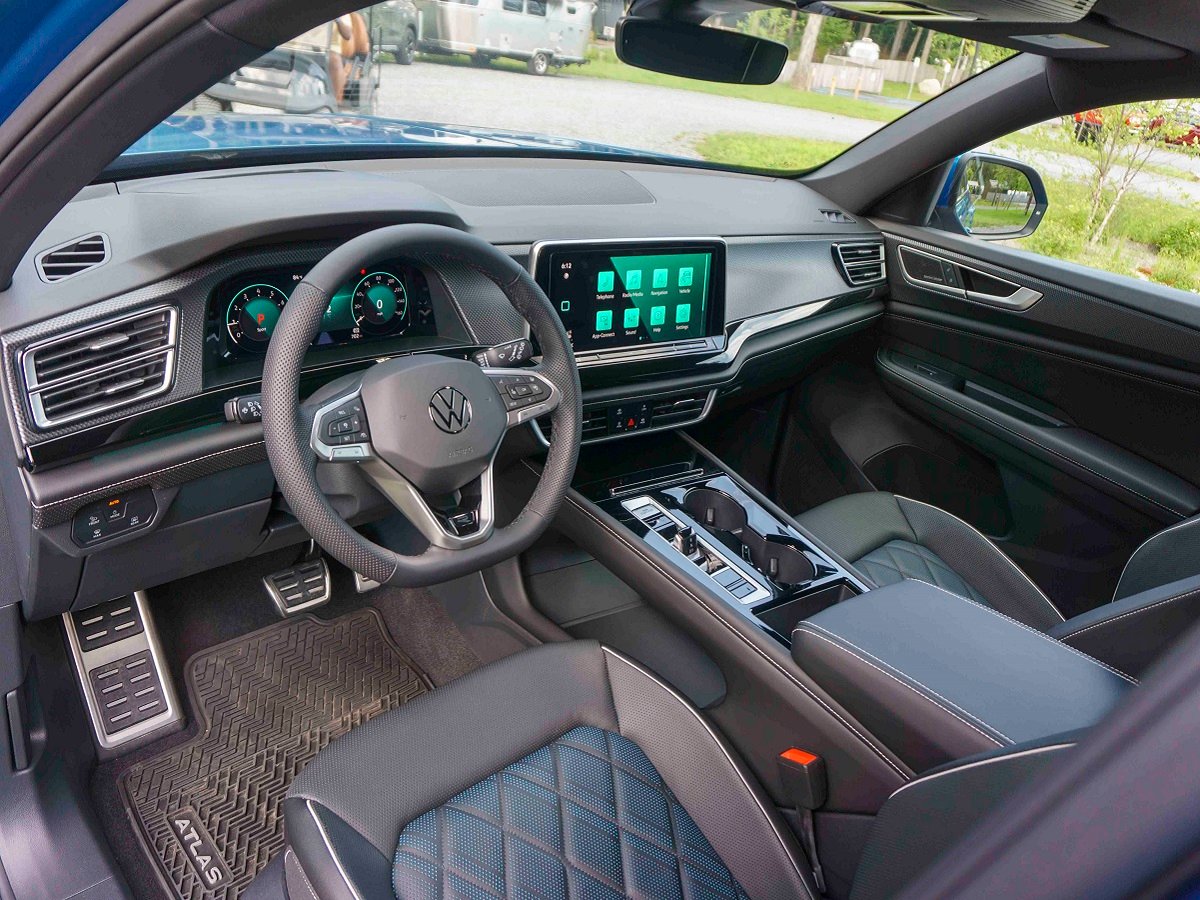
Photo: Perry Stern
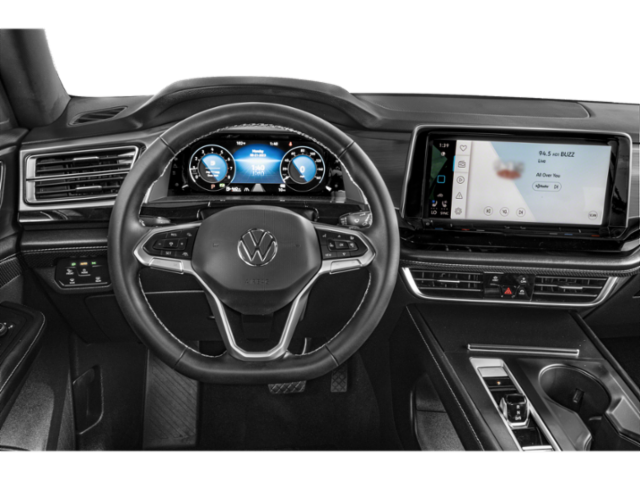
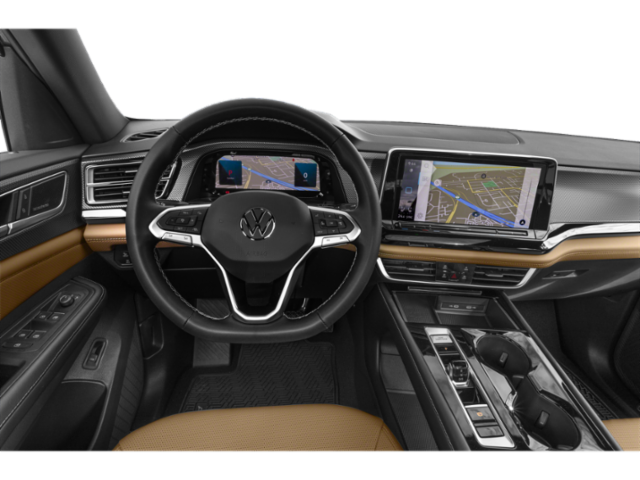
Volkswagen gives the 2024 Atlas Cross Sport an upgraded look inside with leatherette-trimmed soft-touch surfaces and greater use of premium materials throughout. The top-level Premium R-Line goes further with quilted leather seats featuring a diamond pattern with contrasting underlay for a stylish look. Dual-zone climate control is standard across the board.
The Atlas Cross Sport is also available with 30 colors of ambient lighting. The selected color appears all around the cabin and is the color theme for the infotainment display.
The redesigned center console provides additional storage space for the cabin. Taking advantage of the shift-by-wire gear selector that takes up less room, a sizable storage area underneath the console can easily hold a large bag or purse. There is also a large, covered bin and several cubbies for smaller items.
A larger space ahead of the cupholders features a wireless device charger and two USB ports. As a cool extra feature, a USB port near the rearview mirror is ideal for plugging in a dash cam or GoPro.
The primary differentiator between the standard Atlas and the Cross Sport is that the latter has just two rows of seats. The rear seat in the Cross Sport is quite comfortable, with plenty of headroom and legroom. However, the center console from the front does take up some of the legroom for the middle passenger. Outboard seats are heated, and there are multiple USB ports for rear-seat passenger use. Unlike the standard Atlas, captain's chairs are unavailable in the Cross Sport.
With only two rows of seats, the Atlas Cross Sport boasts a spacious cargo area. There's more than 40 cubic feet of space behind the rear seats, which can expand to 77.6 cubic feet with the 60/40 split second row folded flat.
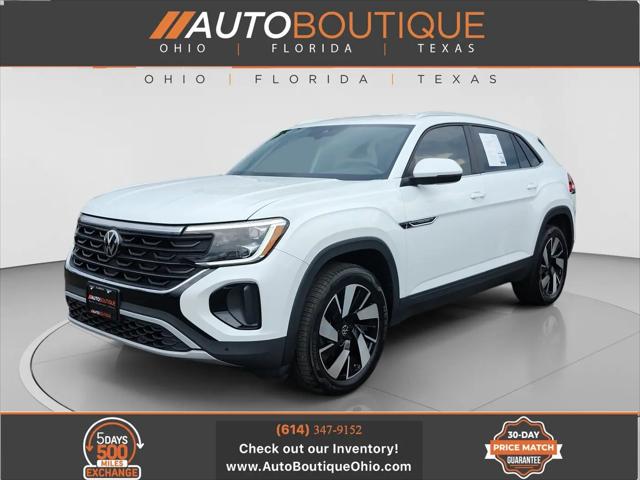
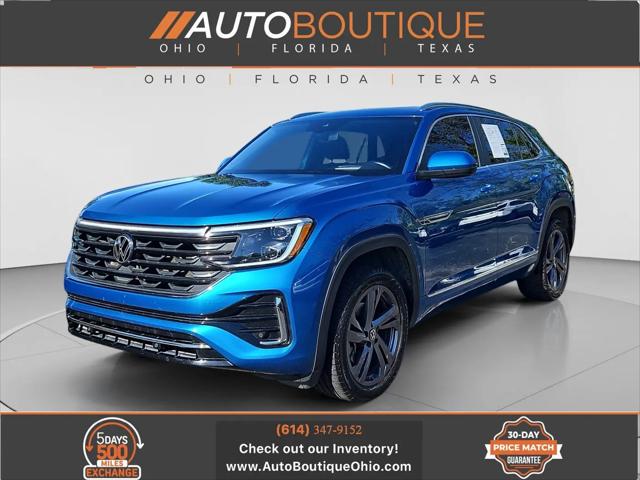
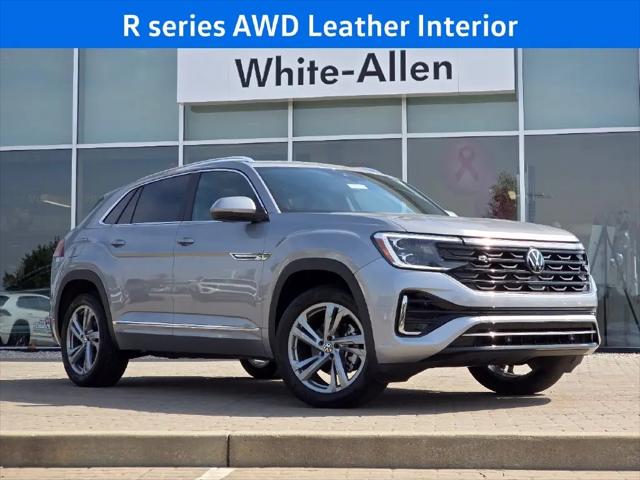
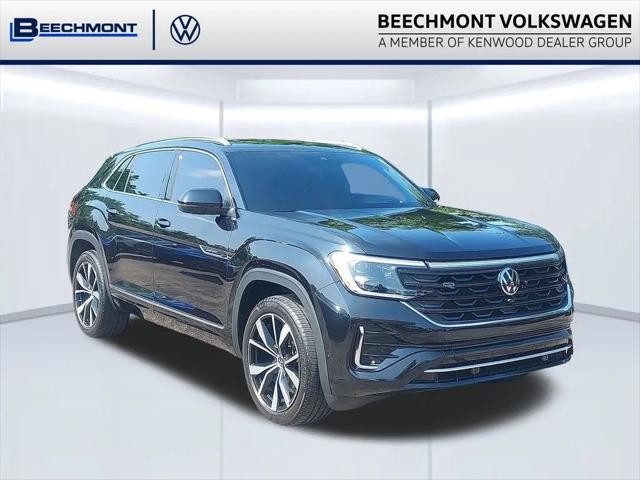
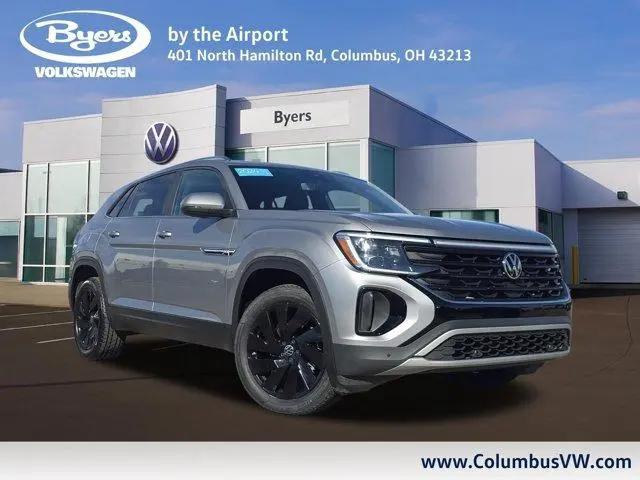
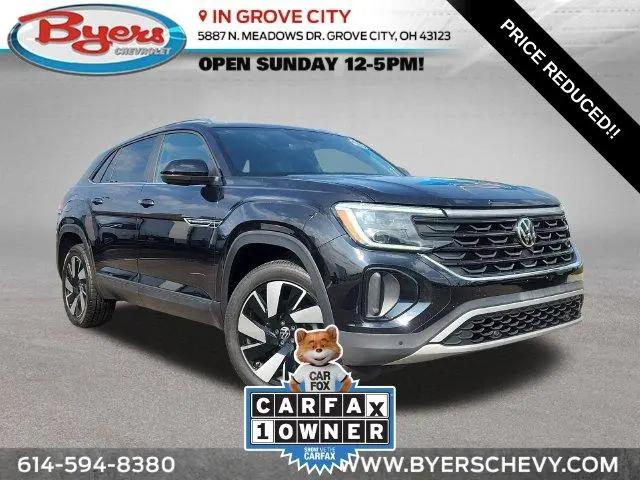
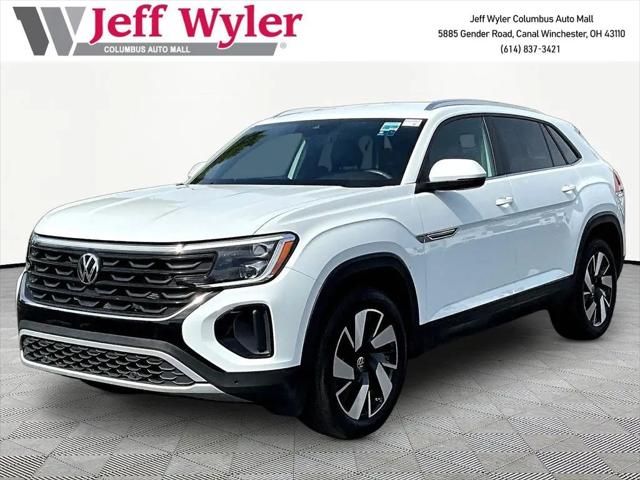
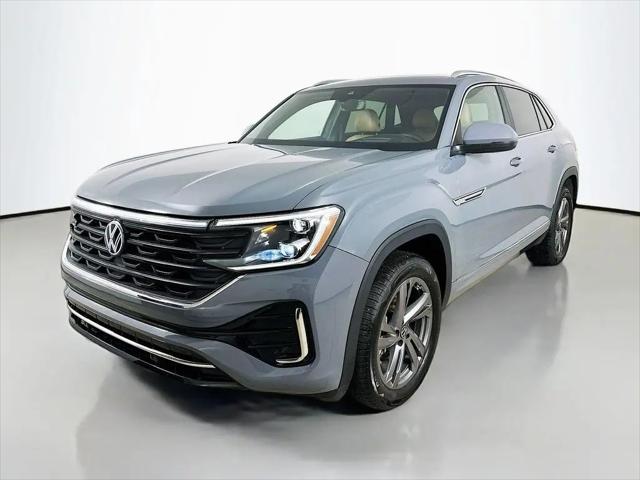
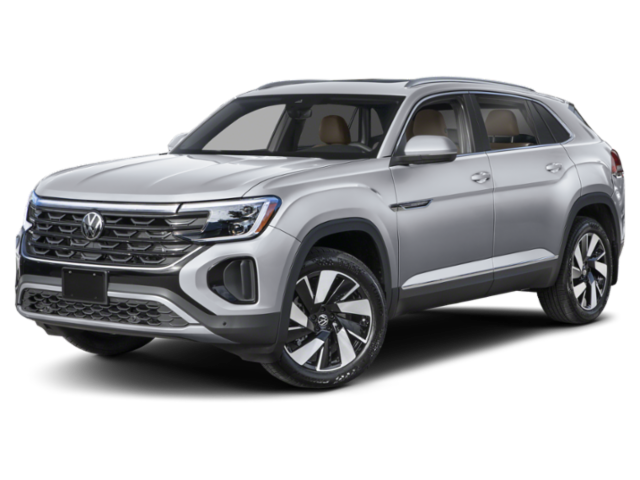
The 2024 Atlas Cross Sport immediately stands out from the previous model year with new front-end styling that gives the SUV a wide stance. New LED headlights flank the updated gloss-black grille. LED running lights surround the headlights and connect via an LED light bar that lines the forward edge of the hood. New larger air intakes in the front fascia further differentiate the 2024 model from its predecessor. Completing the new look is the illuminated VW logo in the center of the grille.
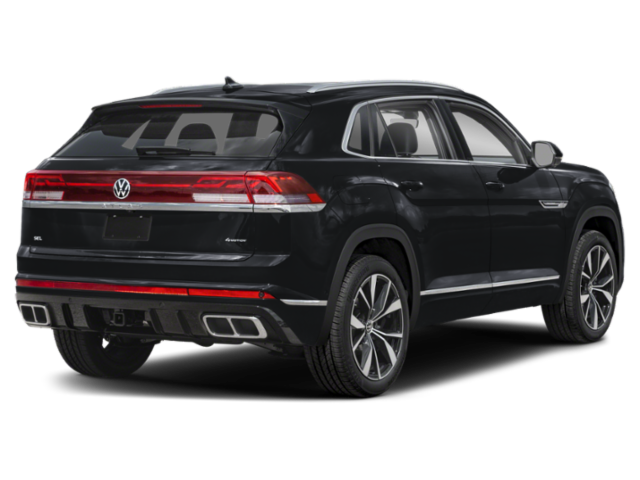
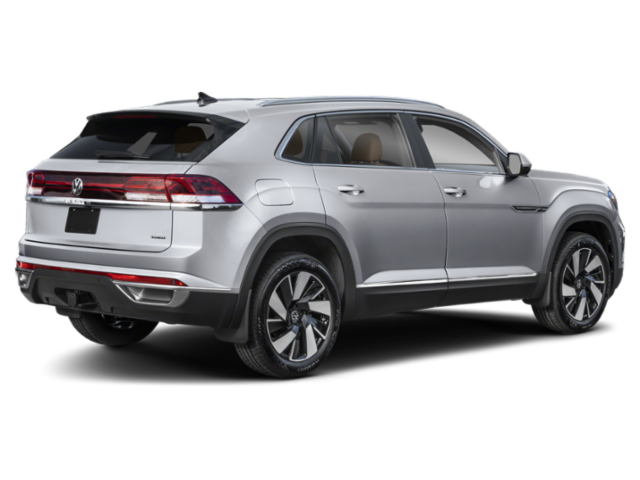
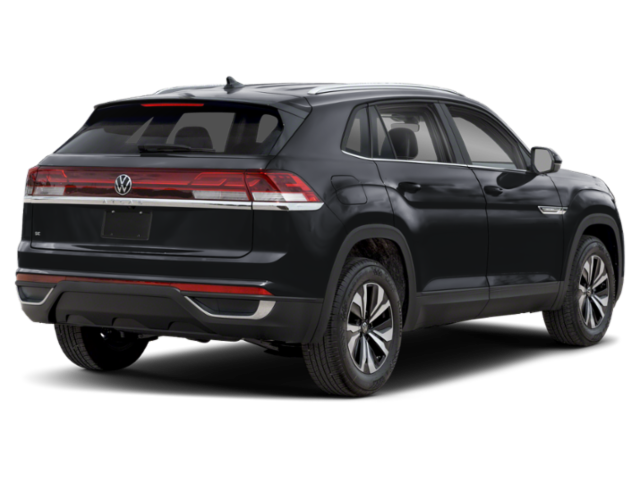
The sloping roofline with sharply angled rear window helps set the 2-row Cross Sport apart from its larger 3-row Atlas sibling. The side profile gets a sleeker look thanks to the new, larger rear spoiler at the top of the rear hatch. All trim levels get new wheels, ranging from the base-level 18-inch aluminum-alloy wheels to the 21-inch two-tone machined alloy wheels on the top-level SEL Premium R-Line.
At the rear is a lighting style that mimics front lighting, a lighted VW logo, and an LED bar that spans the vehicle's width. Embossed on the chrome strip below the taillights is the Atlas name. The Atlas Cross Sport gets a sporty look from the simulated quad exhaust, but I'm not a fan of this style of pretend exhaust outlets.

Photo: Perry Stern
The primary feature inside the refreshed Atlas Cross Sport is the new floating 12-inch infotainment display, standard on every trim level. The large display is clear with large icons and pages that swipe left or right. A Home button remains static on the left, changing to an 'X' when on a sub-menu to quickly close the screen and return home.
Apple CarPlay and Android Auto integration is standard with wireless connectivity. Setting up my Samsung Galaxy S23+ was quick and straightforward, and Android Auto loaded every time the car started.
While this new display looks great and gives the Atlas Cross Sport a high-tech cabin, it's more challenging to use than the outgoing version. In an attempt to create a clean, completely digital cabin, Volkswagen has eliminated virtually every physical button and knob, so there are no buttons that provide quick access to audio, navigation, or other oft-used features. Volume control is via a soft-touch slider, which is challenging to use while driving and much more complicated than a simple knob.
A static climate control section at the bottom left of the display shows the dual-zone temperature settings and quick access to the seat heater/ventilation menu. Soft-touch buttons adjust the temperature for the driver and passenger. All other climate functions, like fan speed and airflow direction, require access to a climate sub-menu. This complexity shouldn't be necessary for such essential everyday functions.
Adding to the high-tech look is the standard 10.25-inch driver display featuring the Volkswagen Digital Cockpit Pro. The screen is configurable with multiple views and a selection of information that can display on the right, left, or center screen. The system can provide full-screen navigation with the speedometer overlayed. A head-up display projects speed and other information onto the windshield for easy viewing without looking away from the road.
For the 2024 model year, Volkswagen eliminates the two engine options from the previous version of the Atlas Cross Sport. Instead, every version comes standard with a new turbocharged, 2.0-liter 4-cylinder engine with 269 horsepower and 273 pound-feet of torque. While the new engine is not as large as the outgoing V6, horsepower is similar, and torque increases by 28 percent. An 8-speed automatic is the only transmission option.
According to VW, this updated powertrain will move the Atlas to 60 mph slightly quicker than the previous version, with AWD models doing it in 7.5 seconds. Towing capacity remains at 5,000 pounds.
While it's not the slowest SUV off the line, the Atlas Cross Sport is not very quick from a stop. Mashing the throttle to get across a busy road resulted in a few stressful seconds as the big SUV did not jump across as quickly as expected. Performance is much better once the vehicle is moving. Accelerating from 40 mph produces a smooth downshift and quick increase in speed, making it easy to pass slower cars on a two-lane road.
According to the Environmental Protection Agency (EPA), the 2024 Atlas Cross Sport FWD achieves 20 mpg city/27 mpg highway/23 mpg combined. These figures match the 3-row standard Atlas. Models with AWD get one less mpg across the board. These figures were close to what I experienced during my drive in the Atlas Cross Sport. After a 75-mile drive through the backroads around New York's Catskill Region in the AWD Cross Sport, the trip computer indicated just over 18 mpg.

Photo: Perry Stern
For the 2024 model year, Volkswagen offers a wide range of advanced safety features for the Atlas Cross Sport. These include the expected features like automatic emergency braking with pedestrian detection, blind-spot warning, rear cross-traffic warning, lane-keeping assistance, and adaptive cruise control.
The Atlas Cross Sport features Automatic Post-Collision Braking, which will apply brakes following a collision to reduce or eliminate any secondary impacts. Also standard is an Intelligent Crash Response System that shuts off the fuel pump, switches on the hazard lights, and unlocks the door in the event of a crash.
Volkswagen Travel Assist is standard on all variants of the Atlas Cross Sport, providing a semi-automated hands-on driving experience. Using adaptive cruise control and lane-keeping, the system will hold the vehicle in its lane and at a set distance from the car ahead. That said, the driver's hands must remain on the steering wheel. In real-world driving, the system also recognized a speed limit drop for a sharper turn, reducing speed until I was through the turn, then returning to the originally set speed.
Travel Assist worked well during my drive in the Atlas Cross Sport. Still, there were instances when the lane-keeping system seemed to mistake road patches for lane markers, and I had to take over the steering. Even without Travel Assist, the lane-keeping assistance system seemed overly aggressive, and I finally had to disengage it.
The 2024 Volkswagen Atlas Cross Sport received the highest-possible 5-star overall safety rating from the National Highway Traffic Safety Administration (NHTSA). However, the Insurance Institute for Highway Safety (IIHS) has yet to rate the updated 2024 model.

Photo: Perry Stern
The 2024 Volkswagen Atlas Cross Sport gets significant updates for the new year with fresh styling, an upgraded interior, and a new engine. At the same time, the large 2-row SUV maintains many qualities that have made it so popular.
The updated styling puts a new face on the Atlas Cross Sport, giving it an appealing look with a wide stance. Inside, the changes are equally welcome, with comfortable, stylish seating and a range of feature updates. While the new infotainment system isn't as easy to use as the previous version, it does add a high-tech vibe to the cabin. Ultimately, the 2024-model-year updates to the Atlas Cross Sport should keep this 2-row crossover SUV competitive in the tough 5-passenger SUV market.
Perry Stern has worked in the automotive industry for over 30 years and has always been a car enthusiast. Driving almost every new car on the market, Perry has written for multiple publications in addition to his work for JDPower.com. Living in the Pacific Northwest, Perry is still crazy about cars, especially his 2006 Mazda MX-5 Miata.