
Although most people have heard of a radiator, they may not be aware of its purpose or importance. In the simplest terms, the radiator is the central component of a vehicle's cooling system. Its primary function is to monitor and regulate a vehicle engine's temperature and prevent it from overheating.

A vehicle's engine gives it the power it needs through the burning of fuel and the creation of energy from its many moving parts. This power and movement can generate a tremendous amount of heat throughout the engine. It is essential to vent this heat from the engine during operation to avoid overheating, which can result in severe damage.
A radiator helps to eliminate excess heat from the engine. It is part of the engine's cooling system, which also includes a liquid coolant, hoses to circulate the coolant, a fan, and a thermostat that monitors the coolant temperature. The coolant travels through the hoses from the radiator, through the engine to absorb the excess engine heat, and back to the radiator.
Once it returns to the radiator, thin metal fins release the heat from the coolant to the outside air as the hot liquid passes through it. Cool air flows into the radiator through the car's grille to aid in this process, and when the vehicle isn't moving, such as when you're idling in traffic, the system's fan will blow air to help reduce the heated coolant's temperature and blow the hot air out of the car.
After the coolant passes through the radiator, it recirculates through the engine. This heat exchange cycle is continuous to maintain an optimal operating temperature and prevent the engine from overheating.
A radiator has three main parts: the core, the pressure cap, and the outlet and inlet tanks.
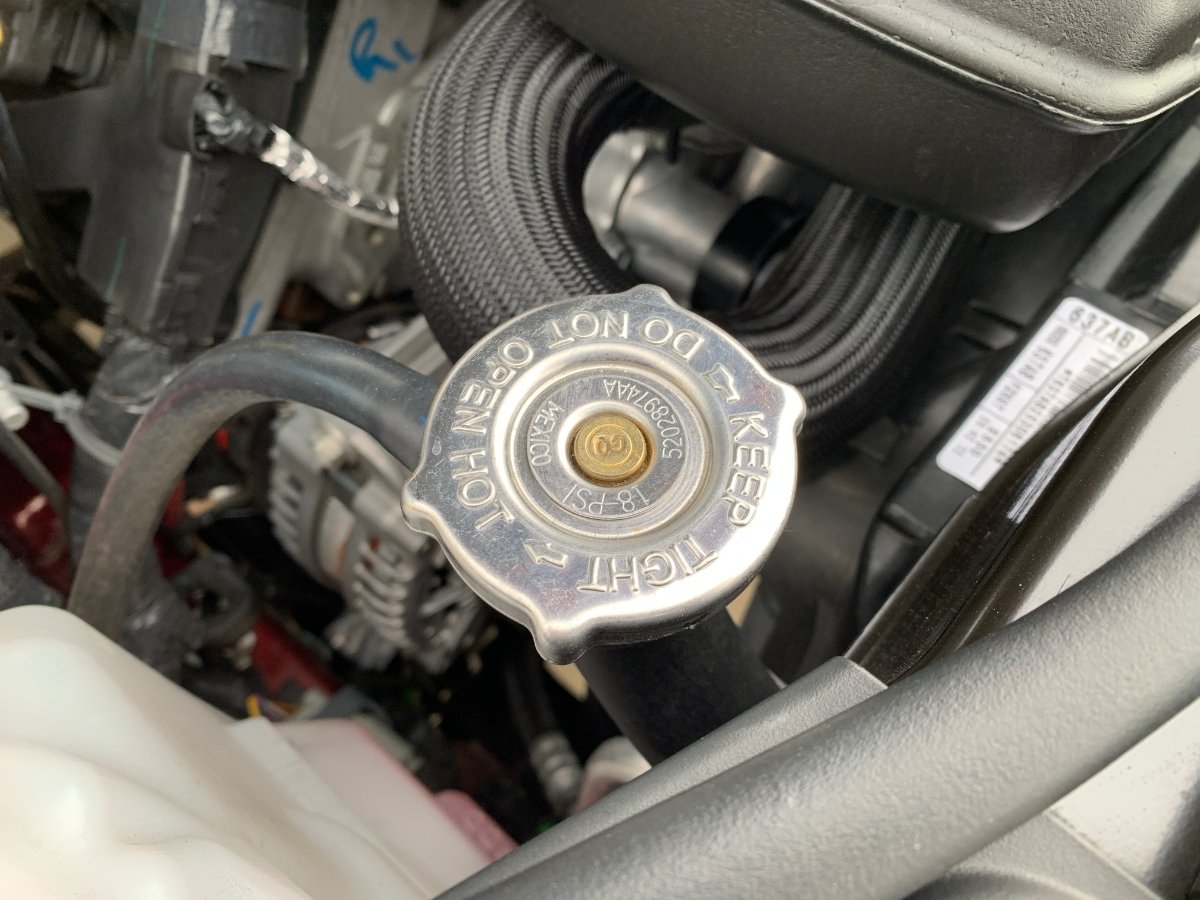
Photo: Christian Wardlaw
The core is the main section defined by a large metal block with rows of narrow metal fins. This is where hot coolant that has flowed through the engine releases its heat and where the radiator cools it for its next trip around the heat-exchange circuit.
The pressure cap seals the cooling system and ensures that it remains pressurized. This pressure is essential for the radiator to operate efficiently as it keeps the coolant from boiling and overflowing./p>
The outlet and inlet tanks direct coolant to the radiator after it has circulated through the engine. These tanks manage the liquid when it is very hot.
Another primary component of the radiator is the coolant itself. Even though it is not a mechanized part, it is the critical ingredient that conducts heat away from the engine and allows the radiator to do its job.
An engine can overheat whenever it operates in sweltering weather. But the risk of overheating goes up considerably if the radiator is low on coolant or there is a leak in one of its hoses. Other possible radiator failures include a malfunctioning thermostat, a mechanical issue with the fan, or a faulty pressure cap that cannot pressurize the system, resulting in an overflow of coolant. In any of these cases, the engine can overheat, resulting in severe damage.
To avoid costly repairs, car owners should be aware of the signs of radiator failure. Symptoms include:
A professional mechanic should examine the cooling system and radiator if any of these symptoms become apparent.
Like any other vehicle component, the radiator requires specific maintenance to assure its longevity and proper operation:
1. Replace radiator hoses every three years or 36,000 miles. Since hoses are rubberized and can dry out and break over time, they should never exceed 50,000 miles of driving.
2. Check coolant levels regularly. If the fluid level is noticeably dropping between checks, there may be a leak in the cooling system. It is important to pay close attention as slow leaks may be difficult to detect.
3. Have the coolant flushed every 25,000 miles to remove any contaminants in the radiator and its hoses. This service also conditions the cooling system to help prevent the components from rusting and allows the radiator to operate at peak performance throughout its life.
Being on the side of the road with an overheating engine is a circumstance every driver wants to avoid. Fortunately, radiators prevent this from happening by relieving the engine of excess heat during operation. Understanding the importance of this cooling mechanism, the signs of potential failure, and the necessary maintenance methods will help keep the radiator – and the engine – running smoothly for years to come.



The new 2027 BMW i3 boasts an estimated range of up to 440 miles, 400-kilowatt DC fast charging capability, bidirectional charging to a home or the grid, and next-generation technology.
Read the Full Article
Facing renewed competition in the full-size, light duty pickup truck segment, the 2027 Ford F-150 receives subtle styling updates, a new standard engine, broader availability of its 5.0-liter V8, and ...See More
Read the Full Article
The 2027 Civic Type R goes on sale in October 2026, and it starts at $49,990, including the $1,295 destination charge.
Read the Full Article
Part of BMW’s Neue Klasse (new class) rollout of redesigned models, the 2027 BMW 3 Series is all-new and goes on sale in the first quarter of 2027.
Read the Full Article