See answers to common EV questions, tax incentives, charging maps & more.
Explore EV24 - 26
29 - 33
187
8 speed, Automatic w/OD
Regular Unleaded I-4
All Wheel Drive, Front Wheel Drive

Photo: Ron Sessions
Data gathered from verified owners for the JD Power 2020 Automotive Performance, Execution and Layout (APEAL) Study shows that 44% of previous-generation Hyundai Tucson owners are male (vs. 51% for the segment), and the median age of a Tucson owner is 58 years (vs. 59).
Owners indicate their favorite things about the previous-generation Tucson were (in descending order) the:
Owners say their least favorite things about the previous-generation Tucson were (in descending order) the:
In the JD Power 2020 APEAL Study, the Tucson ranked number 10 out of 15 compact SUVs.
In the following sections, our independent expert gives an analysis of the well-equipped, top-of-the-line Tucson Limited all-wheel drive equipped with carpeted floor mats. The price of the Limited AWD came to $37,454, including the $1,185 destination charge. The author also sampled the Tucson Hybrid.

Photo: Ron Sessions
By moving North American variants of the 2022 Tucson to a long-wheelbase layout, designers added passenger and cargo space. In hybrid and gas-only variants, Hyundai’s compact SUV now offers more rear-seat legroom than its top-selling competitors, the Honda CR-V and Toyota RAV4. A trio of six-footers will be able to sit comfortably in the aft row for more than just short hops, something that can’t be said for many compact SUVs.
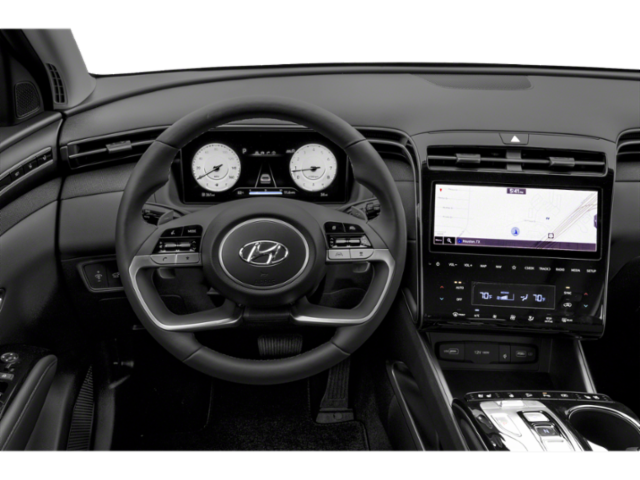
The new Tucson’s cabin feels roomier as well. A dual-cockpit instrument panel sweeps seamlessly into the front doors. The low-and-away dashboard provides excellent forward visibility. And the interior is airy and quiet, courtesy of an acoustic laminated windshield and extensive body sealing.
Storage inside the passenger area is decent. While there’s no open area under the console to store a purse or tablet as in the Hyundai Santa Fe, the Tucson offers ample storage for front passengers. You can store items in the glovebox, covered console cubby, and generously sized dual cupholders, as well as in the door and console side pockets. There’s also a deep console bin under the center of the dashboard with USB and 12-volt power ports right where you want it for stashing road-trip electronics and miscellaneous detritus.
There are two available driver instrumentation displays. A 4.2-inch screen flanked by traditional analog gauges is standard with SE, Blue, and SEL trims. A driver-configurable 10.25-inch digital display is standard fare in the Tucson N Line and Limited, and optional with SEL and Blue trims. When the driver activates the turn signal in a Tucson Limited, one of the two major virtual analog gauges is transformed into a live blind-spot rear-quarter view display.
The Tucson’s front bucket seats are all-day comfortable with added lateral bolstering for good torso support on the seatbacks. All but the base SE trim come with front seat heaters and a power driver seat with power lumbar adjustment. The Limited trim checks all the boxes with standard leather seat coverings, heated and ventilated front seats, heated outboard rear seats, a power front passenger seat, and driver seat memory functions.
A manual tilt-and-telescoping steering wheel is standard fare; leather-wrapped for N Line and Limited and heated for Limited. All but the base SE have standard dual-zone automatic climate control.
The rear seatback is split 60/40 with a fold-down center armrest and a pair of cupholders. Two convenient rear seatback-release levers are located just inside the cargo liftgate opening, accessed via a hands-free power opener in N line and Limited trims.

Photo: Ron Sessions
Two different infotainment systems are available for the 2022 Tucson. The SE, SEL and Blue models come with:
The advantage of the 8-inch touchscreen is standard wireless Apple CarPlay and Android Auto. This wireless feature eliminates the tangle of USB cords and allows your phone to be safely sequestered in the glove box or in a purse or briefcase where it won’t present a driving distraction. Hyundai makes connecting a phone for mirroring easy; all you need to do is click on the onscreen widget.
The Tucson’s infotainment system has gone all-digital for 2022. That means last year’s convenient analog knobs for volume and tuning have been replaced by attractive but tiny arrows and plus or minus symbols that are less easy to use on the fly. Hyundai also provides volume and tuning toggles on the steering wheel.
The new infotainment display is so bright and sharp that a hood is not required. The N-Line model adds an 8-speaker Bose stereo. This system is richer-sounding than the standard 6-speaker audio system and features digital processing, custom equalization, and dynamic speed compensation.
The Limited models have the Bose stereo, as well as these standard features:
Although the larger screen currently offers only wired Apple CarPlay and Android Auto, Hyundai says a wireless system is coming.
One neat feature with the upgraded infotainment is the “Sounds of Nature” function. It’s accessible by selecting the media button, and it allows cabin occupants to chill to a variety of soothing sounds. Options include idle café banter, waves pulsing on a tropical island, a crackling fireplace, and more.
All 2022 Tucson models come with enhanced voice recognition that uses speech-to-meaning and deep-meaning technology to assist with voice commands. I used the push-to-speak button on my Limited test vehicle to find a zip-line operation in a nearby town. My request was quickly and correctly executed via helpful map directions and voice prompts.
The voice recognition system can handle a wide gamut of voice requests. In the Limited test vehicle, I used it to adjust climate control settings instead of pecking at the small touchscreen arrows.
As with other new Hyundai vehicles, the 2022 Tucson features the Blue Link connected car system. This technology allows drivers to remotely use the MyHyundai smartphone app to lock and unlock doors, find the car in a parking lot, start the engine, and set the climate control. You can also operate the heated and cooled seats remotely. Hyundai offers full access to Blue Link at no cost for the first three years of ownership. Blue Link also now works with smartwatches, and it connects with devices inside the home using Amazon Alexa or Google Assistant.
Digital Key turns any Android smartphone, even those of friends or family, into a vehicle remote using Near Field Communications. Digital Key allows the holder to lock and unlock doors, activate the panic alert, and to start and drive the car; however, it only works when you’re in close proximity to the vehicle. The owner can set how long the Digital Key remains active, and it can be remotely revoked.
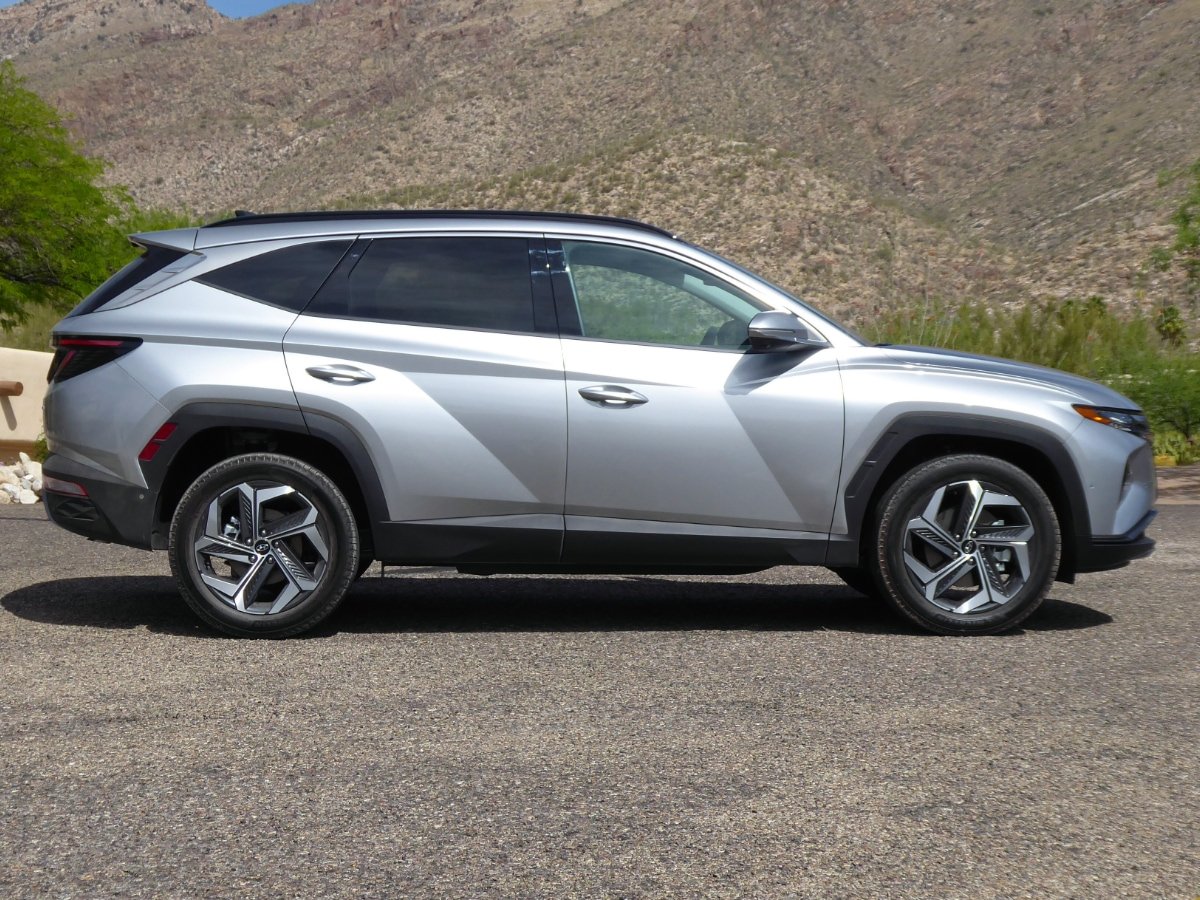
Photo: Ron Sessions
Relative to the previous model, the 2022 Hyundai Tucson is roomier and built on a stiffer platform that improves handling response and crashworthiness. With greater use of high-strength steel, the larger, more rigid 2022 model weighs about the same as the previous version.
A new naturally aspirated 2.5-liter Smartstream 4-cylinder engine with dual (direct and multi-port) injection for cleaner emissions and better fuel economy replaces last year’s 2.0-liter and 2.4-liter 4-cylinder gas engines. In the Tucson, the 2.5-liter generates 187 horsepower and 178 pound-feet of torque, a slight improvement in output over last year’s top 2.4-liter offering. It’s paired with a smooth-shifting 8-speed automatic in the 2022 model. Overall, the new setup nets an EPA-estmated fuel economy improvement of 3-4 mpg.
Also currently available is a gas-electric hybrid powertrain, the first ever in the Tucson. The Tucson Hybrid is equipped with a new 1.6-liter turbocharged 4-cylinder and an electric motor, and it produces a combined 226 horsepower. It is mated to a 6-speed automatic transmission.
Later this year, a plug-in hybrid will join the lineup with 261 system horsepower and a larger battery capable of delivering 32 miles of electric-only range on a full charge.
I spent nearly four hours driving the 2.5-liter gas-powered Limited all-wheel drive, equally divided between suburban residential and 55-mph highway roads and primitive dirt fire trails. The 2.5-liter delivered segment-appropriate performance with sufficient acceleration to deal with the ebb and flow of urban traffic and ample reserve for relaxed highway driving.
It is pleasantly smooth and quiet in operation, its 8-speed step-shift transmission executing seamless ratio changes in the bargain. The Tucson’s 8-speed is a refreshing change from the continuously variable transmissions in some competing compact SUVs that can sometimes drone on at wider throttle openings.
More notable than the engine were the new Tucson’s chassis improvements. Aside from the cohesive feel of the body structure, the 2022 model’s quicker and more organic responses to steering inputs and a reassuringly solid feel to the brake pedal made the morning drive an enjoyable exercise. The Limited trim’s 19-inch all-season tires delivered an agreeable ride and handling balance, firm enough to make you feel in control but never conveying harsh impacts over rough pavement. Body lean in some of the sharper curves was kept to a minimum.
On the hour-long dirt road section, the Hyundai Traction (HTRAC) AWD kept sliding to a minimum, seamlessly varying drive torque up to a 50:50 front-to-rear split as required to maintain traction. Chatter-bump surfaces, however, occasionally set up some minor steering-rack rattle.
The afternoon drive was a shorter one, all on pavement, and it offered a chance to experience the different driving characteristics of the Tucson Hybrid. The extra 100-150 pounds (depending on trim) of the hybrid are carried low in the chassis and help mitigate the Tucson’s front-heavy weight distribution.
All Tucson Hybrids are equipped with all-wheel drive and feature Hyundai’s new E-handling technology. The system sharpens the hybrid’s cornering performance by lightly applying braking force to the front wheels when steering into a corner, enhancing steering response. Then, when exiting the corner, it applies an extra dollop of torque to the rear wheels. All of this happens seamlessly and in the background, but the end result is a vehicle with more responsive handling.
What separates the Tucson Hybrid from most other hybrids is its step-shift 6-speed automatic transmission, which gives a more traditional shifting-through-the-gears feel as the SUV accelerates. Most other hybrids use a CVT, which tends to drone under acceleration, feeling as though the engine speed has no bearing on how fast the SUV is going.

Photo: Ron Sessions
The 2022 Tucson is equipped with Hyundai’s SmartSense suite of advanced driving assistance systems (ADAS). These technologies are expanded for 2022 and offer improved functionality. Standard features on all models include:
SEL, Blue HEV, and higher models add more SmartSense features, including:
N Line and higher models add:
Limited models add still more SmartSense features, including:
In light of the lengthy list of driver-assistive technology offered in the 2022 Tucson, Hyundai is notable as one of the companies leading the way to democratize ADAS in its mainstream products.
For the most part, these systems work in the background, providing assistance or intervening only in the split second when you need them. Blind-spot and rear cross-traffic warning with collision avoidance and forward-collision assistance with automatic emergency braking are must-haves for safe driving.
Most of these systems work seamlessly, but there are some minor quibbles. In the Tucson, it’s important to set a following distance when using the adaptive cruise control. The adaptive cruise includes a stop-and-go feature that enables the SUV to come to a full stop behind traffic without depressing the brake pedal. Depending on the following distance setting you use, the adaptive cruise control may wait until the last minute to slow down for traffic stopped ahead, resulting in an abrupt stop. Also, the warning triangle in the side mirrors for the blind-spot system is too small and may go unnoticed when it illuminates in bright sunlight.
Lane-keeping and lane-centering assistance usually help maintain the car in its lane, but in the absence of well-defined lane markings, this technology can sometimes let the SUV wander off course.
The bottom line is this: ADAS is a great backup, but it’s no substitute for an alert driver with eyes on the road and two hands on the steering wheel.

Photo: Ron Sessions
The Tucson has up to 38.8 cubic feet of cargo space behind the rear seat and 74.8 with the rear seat folded flat. When it comes to cargo space, it’s 20% larger than the previous Tucson. It also has more cargo space than the Toyota RAV4 and Hyundai’s own Santa Fe SUV.
According to EPA estimates, the 2022 Hyundai Tucson with its new 2.5-liter 4-cylinder gets 29 mpg in combined city/highway driving when equipped with front-wheel drive and 26 mpg with AWD. On our testing loop -- which was capped at 55 mph -- we saw an average of 31.7 mpg. Factoring in the SUV’s 14.3-gallon fuel tank, the gas version’s driving range on this trip would have topped 450 miles.
The gas-electric hybrid version of the 2022 Tucson with standard AWD receives EPA fuel economy estimates of 37-38 mpg in combined city/highway driving. That falls in line with the 36.2 average mpg I observed during a brief 47-mile drive of a new hybrid-powered Tucson. At 13.7 gallons, the hybrid’s fuel tank is a bit smaller than the gas version’s but still is capable of delivering a driving range close to 500 miles.
As this review was published, neither the National Highway Traffic Safety Administration (NHTSA) nor the Insurance Institute for Highway Safety (IIHS) had published crash-test results for the 2022 Hyundai Tucson.
However, the NHTSA gave the 2021 Tucson a full five out of five stars for overall crash protection, and the IIHS named the 2021 Tucson a Top Safety Pick. Given the structural and safety improvements of 2022 model, it’s likely the new SUV will match or improve upon the scores of the previous model.
Prices for the front-wheel-drive gas-powered Hyundai Tucson range from $24,950 for the base SE to $34,700 for the range-topping Limited. All-wheel drive is a $1,400 upcharge for non-hybrid Tucson SUVs.
The gas-electric Tucson lineup spans between $29,050 for the entry-level Blue HEV to$37,350 for top-of-the-line Limited HEV. All Tucson Hybrids are equipped with AWD.
The destination charge for all models is $1,185.
In the JD Power 2020 Initial Quality Study (IQS), the previous-generation Hyundai Tucson was the highest-ranked model in the segment. The Kia Sportage was the second highest-ranked model in the compact SUV segment, followed by the Chevrolet Equinox.
In the JD Power 2020 Automotive Performance, Execution, and Layout Study (APEAL), the Ford Escape and Mazda CX-5 tied for the top ranking in the compact SUV segment for overall appeal. The GMC Terrain ranked in third place.
Other competitors to the 2022 Tucson include the Honda CR-V, Nissan Rogue, and Toyota RAV4.

Photo: Ron Sessions
Over the past few years, Hyundai has gone from being SUV-deficient to offering one of the most complete and diverse lineups of SUVs and crossovers in the business. The Tucson has been the best-selling Hyundai SUV in recent years, both in the U.S. and worldwide.
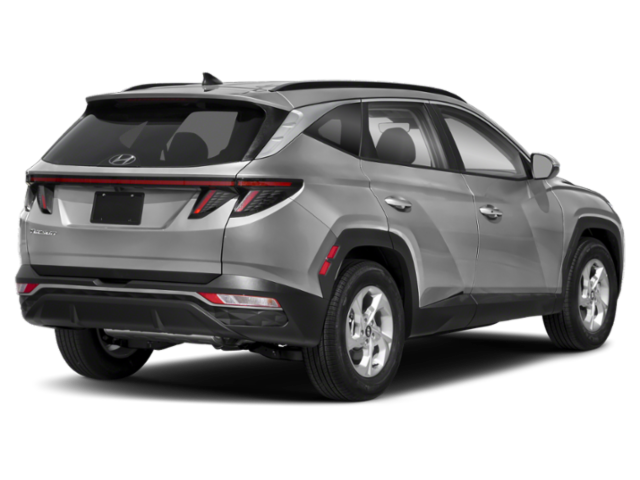
The all-new 2022 Hyundai Tucson gives buyers a diverse engine selection, modern infotainment technology, and segment-leading driver-assistive systems, all at an affordable price. Putting a bow on it is an evocative design, inside and out, that stands out from the crowd.
Better yet, it’s all backed by one of the best vehicle warranties in the business. The Tucson’s warranty includes 5-year/60,000-mile bumper-to-bumper protection and 10-year/100,000-mile powertrain coverage. And, in addition to the free Blue Link subscription for three years, Hyundai also covers all scheduled maintenance for the first three years or 36,000 miles of driving.
Ron Sessions is a seasoned vehicle evaluator with more than three decades of experience. He has penned hundreds of road tests for automotive and consumer web sites, enthusiast magazines, newsletters, technical journals and newspapers.