89 - 111
84 - 95
214 - 389
1 speed, Automatic
Electric
All Wheel Drive, Front Wheel Drive
Nissan was the first automaker to sell a viable electric vehicle in the United States. The 2011 Leaf was homely and offered just 73 miles of range, but with a base price in the low $30,000s, it was affordable for early adopters who wanted a practical electric car.
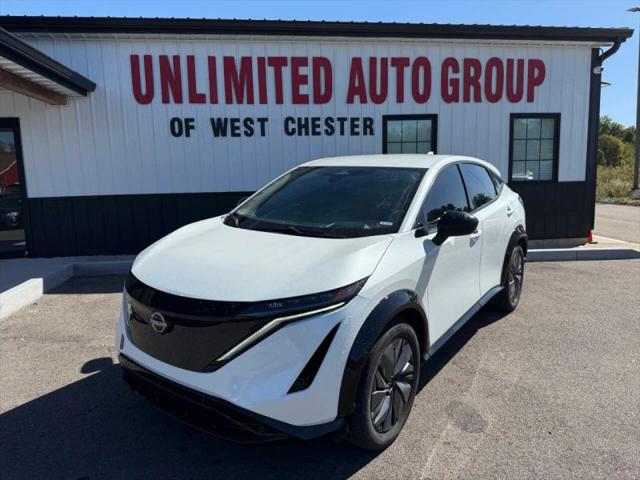
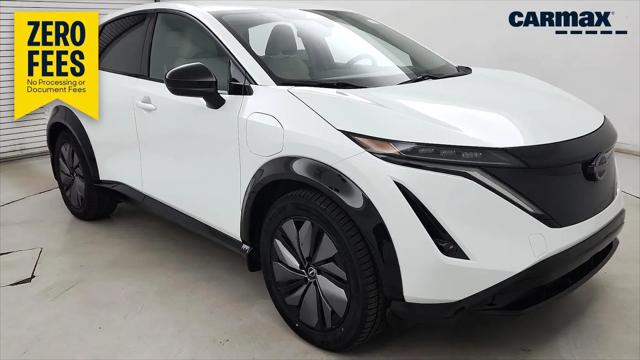
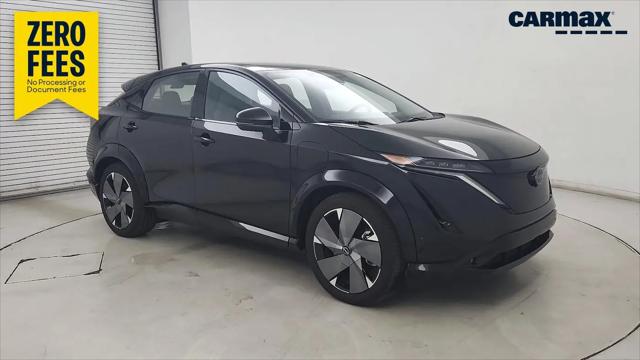
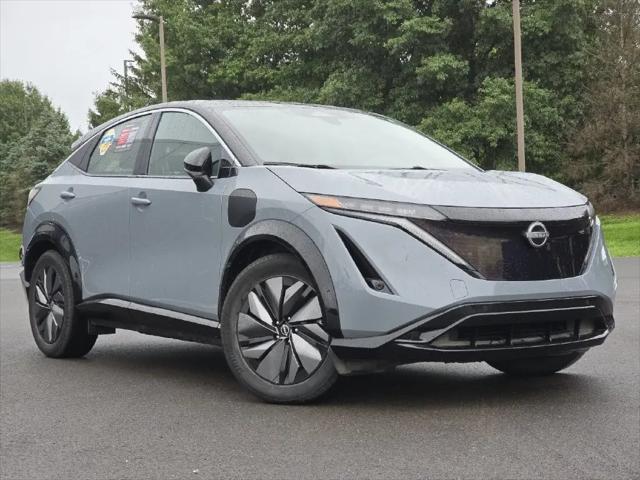
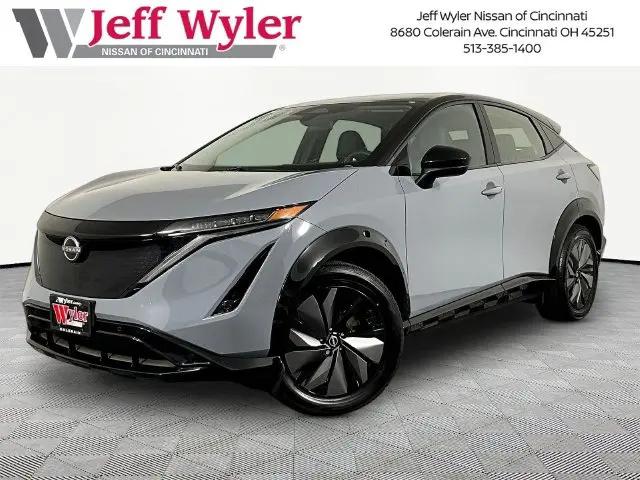
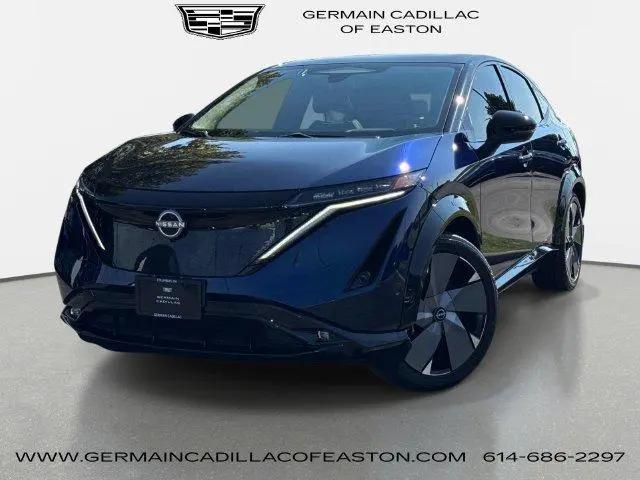
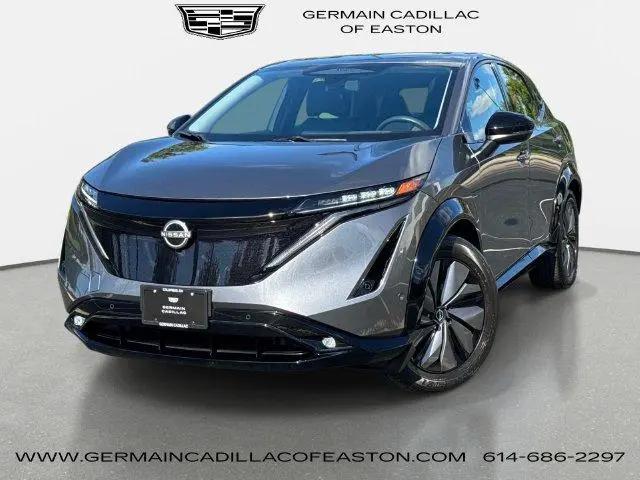
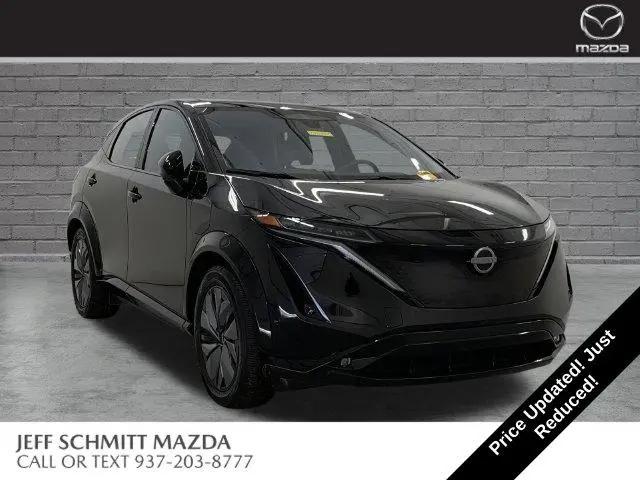
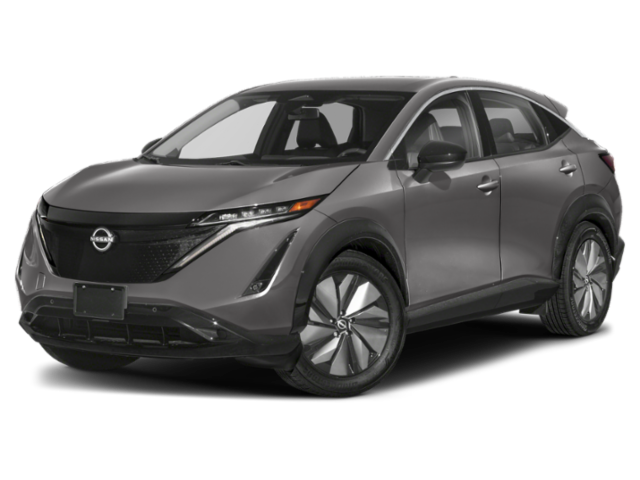
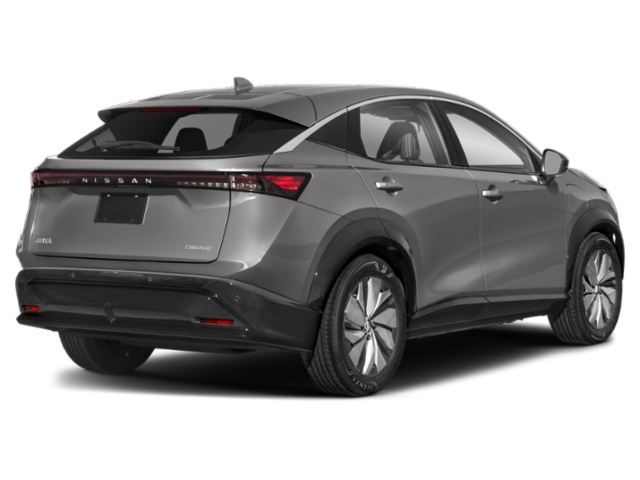
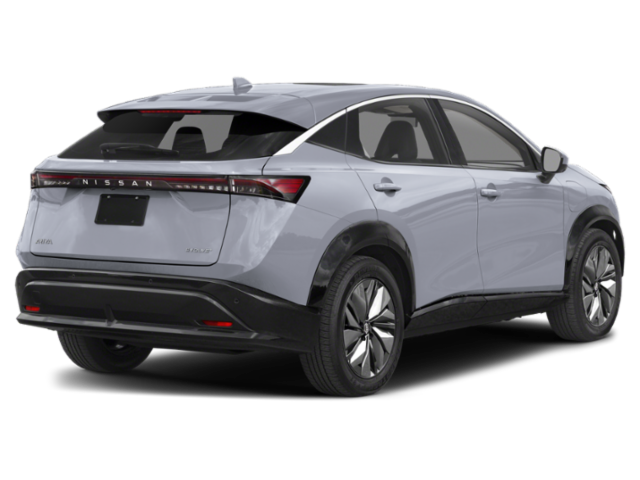
It took Nissan 12 years to launch its follow-up, the 2023 Nissan Ariya. It's a crossover SUV with seating for five people, which is precisely what many people want to buy. It offers a maximum driving range of 304 miles, holds 22.8 cubic feet of cargo behind its back seat, and looks just different enough from Nissan's existing SUVs to set itself apart as something special.
Unfortunately for Nissan, the world didn't stand still during the time between the first Leaf and the first Ariya.
Tesla happened. Other automakers developed EVs. And then, just as Nissan was ready to roll out the Ariya, the rules governing EV federal income tax credits changed to favor those built in North America. Electrifying and innovating at the speed of lightning bolts, car companies dropped numerous Ariya rivals into the market. Its dominance threatened, Tesla launched a price war. Competitors skirted the tax credit issue with lease deals and began building assembly plants in the U.S.

Photo: Christian Wardlaw
To say things have been chaotic is an understatement. However, after a rocky launch year, the 2024 Nissan Ariya returns with more affordable prices. The base model is $3,600 lower than before, and across the lineup, Nissan has reduced prices by up to $6,000.
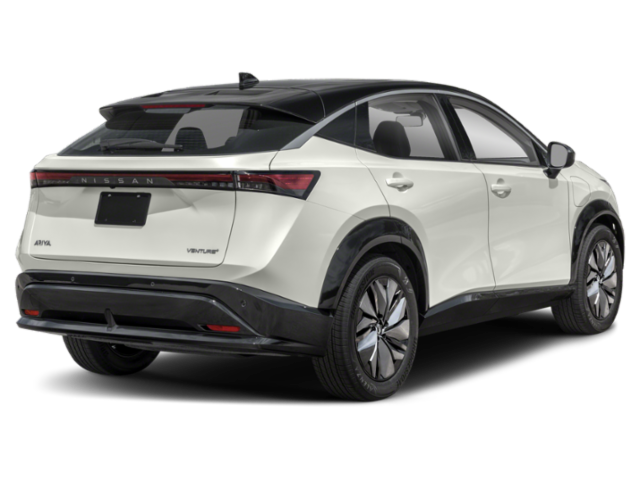
You can get a 2024 Ariya in single-motor front-wheel-drive and dual-motor e-Force all-wheel-drive configurations with a 63-kilowatt-hour (kWh) or 87-kWh battery. Nissan offers the Ariya in Engage, Venture, Evolve, Empower, and Platinum trim levels. Versions with the larger battery have a "+" in their names. Prices range from $39,950 to $54,190, not including the $1,390 destination charge to ship the EV from the Tochigi, Japan, assembly plant to your local dealership.
For this review of the 2024 Ariya, Nissan provided a Platinum+ e-Force test vehicle equipped with the following options:
The test vehicle's price was $56,940, including the destination charge.
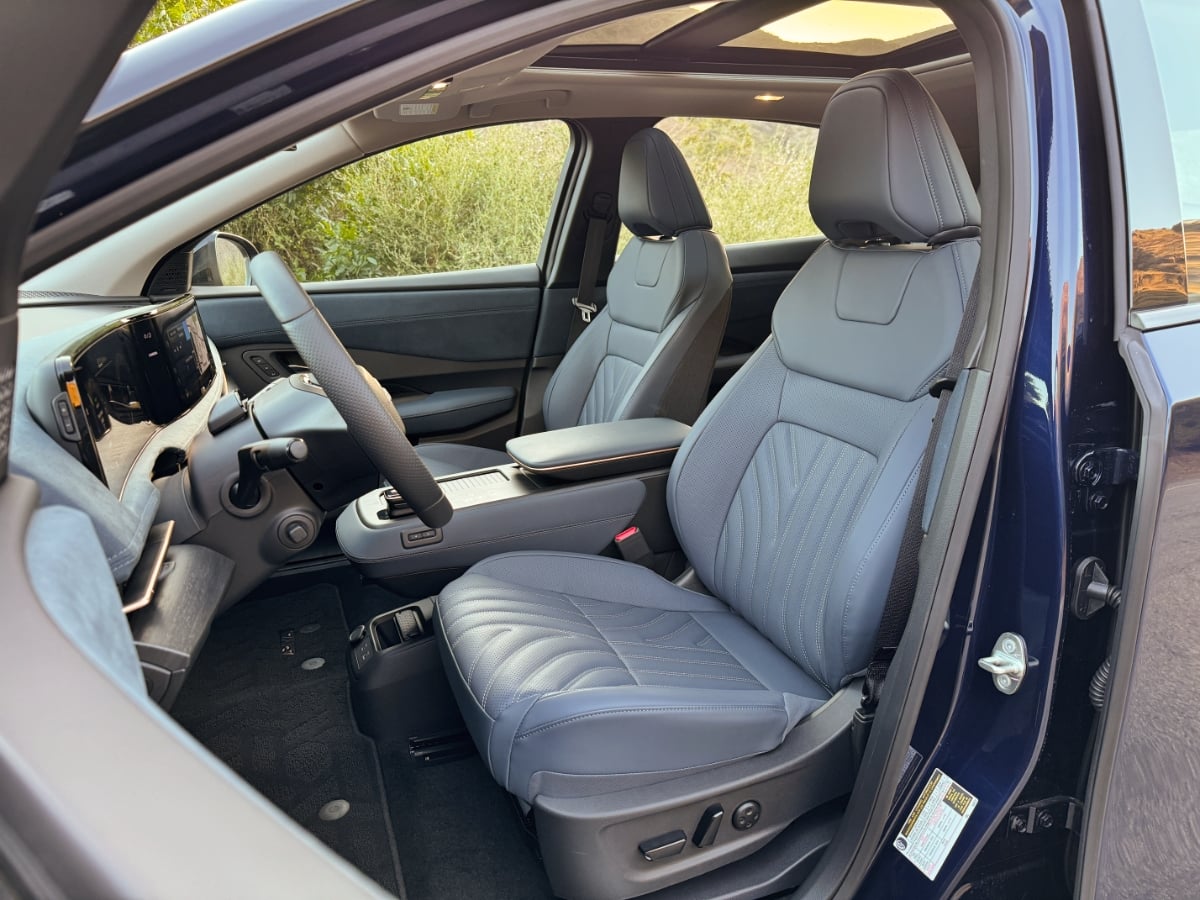
Photo: Christian Wardlaw
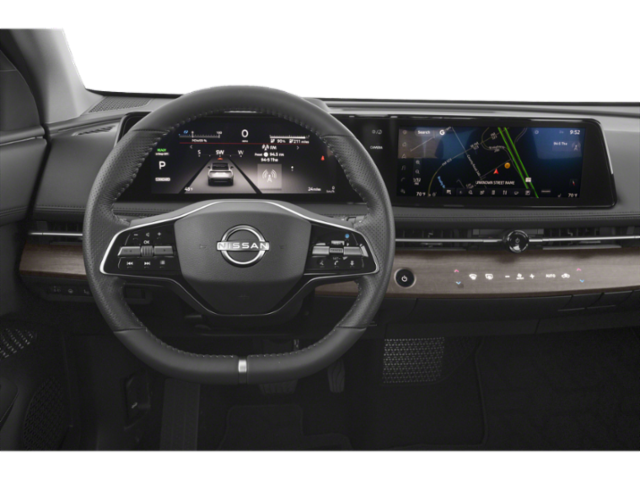
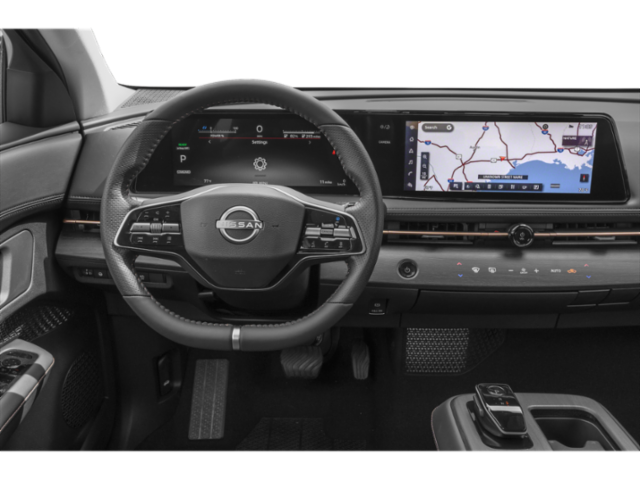
Shaped to reduce aerodynamic drag, the Ariya is nevertheless an appealing EV. That sentiment extends to the interior, where you'll face a bisected dashboard with few physical controls. Digital instrumentation and infotainment displays live side by side under a single screen, underlined by deftly integrated air vents and a seamlessly executed touch-sensing climate control panel. The turn signal has a pleasing wood-clack sound but irritatingly returns to center when used.
The center console does not attach to the dashboard, giving the cabin an open and airy look and feel. In addition, that console powers forward and back, making it adjustable to drivers with different preferences. There isn't much storage space inside due to the wireless smartphone charger, but an available storage drawer powers out of the lower part of the dashboard to accommodate items and to provide a small tray.
My Platinum test vehicle featured appealing blue artificial suede material on the dashboard and door panels, simulated matte-finish wood trim on the dashboard and center console, bronze accents, and illuminated textured panels to provide ambient lighting. Wrapped in premium Nappa leather with fancy stitching, the NASA-inspired Zero Gravity front seats had heating and ventilation and proved exceptionally comfortable.
I can't say the same for the back seat. The footroom is tight, the bottom cushion is low and unsupportive, and the backrest is too reclined. Also, unlike most crossovers, the Ariya does not have dark-tinted rear privacy glass and lacks rear window shades, so if you're carrying an infant in a reverse-facing child safety seat, make sure you get a shade for the glass. Adults will appreciate the heated rear seats and air conditioning vents.

Photo: Christian Wardlaw
The Nissan Ariya has two 12.3-inch displays. One contains digital instrumentation and numerous menus providing access to data, vehicle settings, and more. The other is a touchscreen with NissanConnect technology.
During my evaluation, using the digital instrumentation's steering wheel controls proved distracting while driving. I don't recommend it, so set things up before you set off on a drive. One of my favorite data panels pertains to estimated recharging times based on the type of power source. It's a helpful companion to the range map available through the infotainment system, which shows you how far you can travel on the juice remaining in the battery.
Unfortunately, in my experience, NissanConnect's digital voice assistant does a terrible job of recognizing speech. For example, I requested directions to an Electrify America charging station, but I got a planned route to somewhere in metropolitan Los Angeles called Electrify Studio. I switched to a request for an EVGo station, and the Ariya thought I'd requested directions to something with Ego in the name. When attempting to cancel the voice session, the system gave these options: Cantil or Kan Sal.
You can rouse the assistant by saying, "Hey, Nissan." And it did respond appropriately to some of my simpler commands. However, when I told the assistant I needed to go to a hospital, a veterinary facility and a convalescent home were among my options. And when I asked it to activate the seat ventilation system, the assistant told me to input an address.
Fortunately, NissanConnect includes wireless Apple CarPlay and Android Auto. So pair your device, put it into the hidden wireless charger under the center armrest, and use your smartphone as the primary platform.
In keeping with the minimalist interior theme, Nissan provides a volume knob between the two center air vents. Unfortunately, on more than one occasion while using it, the side of my hand brushed the climate system touch panel and turned off the air conditioning.

Photo: Christian Wardlaw
When you shop for a new 2024 Ariya, your first decision relates to the battery. If you're willing to spend more money to enjoy a longer maximum driving range, you'll want to get an Ariya with a "+" in the trim name, as with my Platinum+ test vehicle. That signals the inclusion of the 87-kWh battery, which offers more range than the 63-kWh pack.
Next, you must decide whether you want the added power and traction of the dual-motor e-Force electric drive system. Stick with the single motor setup, and the Ariya is a front-wheel-drive SUV offering 214-238 horsepower and 221 pound-feet of torque. Choose the e-Force system, and the Ariya supplies 335-389 hp and 413-442 lb-ft of torque.
Why do the power ratings fluctuate? It's due to the different-size battery packs. Ariyas with the 87-kWh pack offer more horsepower. Likewise, depending on which version of the EV you choose, the official EPA range and efficiency ratings vary.
My Platinum+ e-Force test vehicle delivered 389 hp and 442 lb-ft of torque, with 267 miles of estimated driving range and an efficiency rating of 37 kWh per 100 miles. If Nissan had put the optional 20-inch wheels on it, which create more aerodynamic drag, those ratings would drop to 257 miles and 39 kWh/100 mi.
I set off on my mountainous evaluation loop on a hot summer day with temperatures in the low 90s. The Ariya showed a 79% battery charge and 232 miles of remaining range. I drove the EV in the Standard driving mode with the e-Pedal Step system set for maximum brake regeneration, and I adjusted the climate control system to 68 degrees. The e-Pedal Step system does not bring the Ariya to a complete stop, so it's not a one-pedal driving system. However, it does reduce a driver's use of the brake pedal.
So, how did the Ariya perform under these conditions? After 72.1 miles of driving, the battery had 46% of its charge left, and the trip computer told me the SUV could travel another 120 miles. My consumption figure was 2.6 miles per kilowatt-hour of electricity, or 38.5 kWh/100 mi. That result is less efficient than the EPA estimate, but it was a hot day, and the route included variable terrain from sea level to approximately 1,400 feet of elevation.
The 2024 Ariya drives like an electric vehicle, meaning you can sense the added weight of the battery and electric drive motors mounted underneath the cabin. Unfortunately, the suspension struggles to manage it. On anything but smooth pavement, the Ariya offers a choppy and bouncy ride, and when traveling over speed humps, the rear suspension bucks, feeling like a shove coming from behind the driver's seat.
Furthermore, the brake pedal feel is poor. When I initially stepped on the pedal, it seemed like nothing was happening. About halfway through the pedal travel, the response was decent but could be grabby and inconsistent. I also found it hard to bring the EV to a smooth, clean stop, and when the Ariya came to a halt, I could sense the SUV's weight rocking fore and aft a little bit.
Due to its artificiality, the steering feels like a controller for a video game. Surprisingly, you can sense the road's surface through the wheel rim. The problem lies with unnatural electric assist levels and vague response to input.
In addition, when driving on twisty roads in the Santa Monica Mountains, the steering regularly required mid-curve corrections. In this environment, around a couple of the kinks in Mulholland Highway, the Ariya's suspension allowed sudden and unwanted lateral weight transfer. As a result, the stability control engaged on one poorly patched mid-curve section of the blacktop.
From a stop, when you push hard on the accelerator pedal, the dual-motor e-Force electric drive system responds with a gradual build-up of speed rather than an instant punch of power. Nissan claims 60 mph arrives in 4.8 seconds, which is quick enough in the class. But like the rest of this EV's dynamic tuning, nothing is thrilling about the acceleration.
Overall, I didn't find the Ariya satisfying to drive. You can argue that Nissan doesn't make the Ariya for canyon carving, and I would agree. But that doesn't excuse the artificial steering feel, inconsistent brake response, and poor weight management because all three traits are evident in other driving situations.

Photo: Christian Wardlaw
Nissan equips the Ariya with a long list of safety features and advanced driving assistance systems (ADAS). However, you must upgrade to Empower or Platinum trim to get the more sophisticated ProPilot Assist 2.0 (PPA 2.0) hands-free driving assistance system.
PPA 2.0 operates like a standard ProPilot Assist system unless you're on an approved limited-access highway. That means you can use the adaptive cruise control and the lane-centering assistance technologies, but you must keep your hands on the steering wheel.
During my evaluation, the standard PPA system exhibited some wavering in the curves of Pacific Coast Highway and had trouble navigating an intersection on a rural two-lane road that widened to add left turn lanes. On a suburban highway, at a T-shaped intersection with a wide entrance to a gated neighborhood on the right side, the PPA attempted to steer the Ariya into the community instead of continuing straight.
Later, the hands-free PPA 2.0 system engaged on an approved stretch of freeway, showing me a blue steering wheel indicator within the digital instrumentation panel. The tech wavered a little with each exit and entrance ramp, a common trait of such systems. But when passing one of the exits, the Ariya began to steer onto it. Then, it realized its mistake, steered left, and issued a red warning through the head-up display, telling me I needed to take control.
On the well-traveled 101 freeway in Ventura County, PPA 2.0 was outstanding. It expertly navigated moderate traffic while climbing a winding mountain grade without wavering in the curves and exhibited no unusual or unwanted behavior. Unfortunately, after transitioning to the 23 freeway in the Thousand Oaks area, PPA 2.0 did not recognize it as an approved road and would not engage.

Photo: Christian Wardlaw
According to Nissan, the Ariya has 22.8 cubic feet of cargo space behind its back seat and 59.7 cu-ft when you fold the rear seat down. These figures are on par with smaller crossovers.
Also, because the Ariya doesn't have dark-tinted rear privacy glass, a cargo cover keeps items in the trunk hidden from view. But it also bisects and restricts the available space.
Nevertheless, my family successfully used the Ariya for an airport run to depart on a summer vacation. We fit four rollaboard suitcases and one backpack under the cargo cover and put three additional backpacks in the cabin for the drive to LAX.
Depending on the version, the 2024 Ariya travels an EPA-estimated 205 miles to 304 miles on a full battery. The model with the least range has the smaller 63-kWh battery and dual-motor e-Force electric drive system. The model with the most range is the single-motor setup with the 87-kWh battery.
My test vehicle had the larger battery, e-Force, and 19-inch wheels for an EPA-estimated range of 267 miles. The EPA also estimated that it would consume electricity at a rate of 37 kWh per 100 miles. On my evaluation loop, the Ariya consumed 38.5 kWh/100 mi when driven in Standard mode with e-Pedal Step regenerative braking on its most aggressive setting. It was a hot day with temperatures in the 90s, forcing continual use of the air conditioning system.
According to the National Highway Traffic Safety Administration (NHTSA), the Ariya single-motor model earns a five-star overall rating, though in frontal-impact collisions, it gets four-star ratings for the driver and front passenger. The NHTSA has not rated the Ariya e-Force dual-motor model.
The Insurance Institute for Highway Safety (IIHS) has also performed crash tests on the Ariya, and the EV earns a Top Safety Pick rating.
Base prices of the 2024 Ariya range from $39,590 to $54,190, plus the $1,390 destination charge. Because Nissan builds the Ariya in Japan, it is ineligible for the $7,500 federal income tax credit. As of this writing, Nissan is offering a substantial $10,000 rebate applied to a lease to help make payments more affordable.
In the 2024 JD Power Electric Vehicle Experience (EVX) Ownership Study, the Ford Mustang Mach-E ranks highest among mass-market electric SUVs. The Kia EV6 and Nissan Ariya tie as the second highest-ranked models in the study. Other 2024 Ariya competitors include the Chevrolet Blazer EV, Honda Prologue, Hyundai Ioniq 5, Subaru Solterra, Toyota bZ4X, and Volkswagen ID.4.

Photo: Christian Wardlaw
Electric vehicle buyers have numerous choices in the compact crossover EV segment, and some are better than others. Based on what owners told JD Power as a part of the 2024 EVX Study, the Nissan Ariya ranks on par with the Kia EV6 for overall satisfaction, with only the Ford Mustang Mach-E ranking higher. That's a good sign.
Nevertheless, based on my time with a 2024 Ariya Platinum+ e-Force, several aspects of this EV need fine-tuning. From the ride and handling to the infotainment and driving assistance technologies, the Nissan Ariya could be a better electric SUV.
Christian Wardlaw is a veteran automotive journalist with 30 years of experience in the field and has held automotive editorial leadership positions at Edmunds, JD Power, and The New York Daily News. Today, Chris owns a content agency called Speedy Daddy Media, and in addition to JDPower.com, his work appears on Capital One Auto Navigator, CarGurus, and Edmunds.