
Enter a vehicle identification number (VIN) to see the factory-original options and equipment, backed by JD Power data.
A window sticker lists everything a vehicle came with from the factory, including trim level, options, fuel economy, and MSRP. Backed by over 50 years in the automotive industries most trusted source, JD Power gives you the most accurate read on exactly what any car came with.
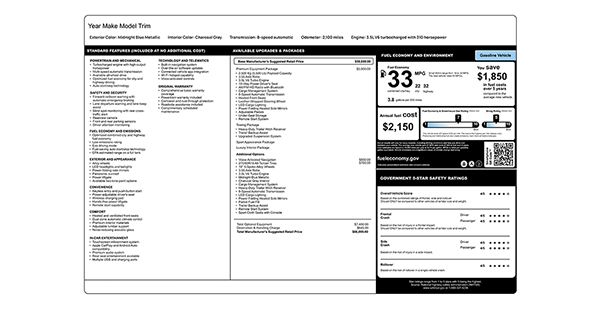
Sourced from 30+years of manufacturer build records via JD Power's ChromeData VIN Descriptions Service.
A window sticker shows how this VIN was built, not how it's been driven. Run a history check to know before you buy.


Every line on the window sticker traces to the manufacturer's build record for the entered VIN. This is the same licensed build data automakers and dealers rely on to configure and price vehicles.

What the factory recorded when your VIN was assembled. Trim, packages, options, and the original price.
Licensed build data pulled directly from the manufacturer's record. The same source automakers and dealers use.
Rendered and rebuilt from the manufacturer build record. Every value matches what left the factory.
One might look up a vehicle’s window sticker to find original details about the car as built. Buyers use it to confirm the trim level, options, features, and other original specifications before purchasing a new or used car, which is the most common use case. Owners, dealers, and collectors may also use it to confirm authenticity, determine value, compare features, or understand the vehicle’s configuration as it was manufactured. Access to the window sticker supports transparency and informed decisions.
No. Many people compare window stickers for several VINs when shopping for a car. Our Window Sticker Lookup has no search limits, restrictions, or account requirements, and it's free to use.
No, the window sticker describes the car as it was built, not as it has been driven. Reported accidents, damage, odometer readings, service history, and similar details come from a vehicle history report, which draws on DMV, insurance, and repair records. The two documents answer different questions, and a used car buyer would typically need both.
No. The Automobile Information Disclosure Act of 1958, known as the Monroney Act, prevents dealers from removing or altering the original window sticker before delivering the vehicle to the buyer.
A dealer addendum sticker is a second sticker a dealership adds that lists items such as dealer-installed packages, protection packages, or other adjustments like nitrogen-filled tires. Because dealers add these items, they don't appear on the original Monroney label. Comparing the addendum with the original window sticker can help you spot the difference and make an informed decision.
A window sticker and a Monroney label are essentially the same document. “Monroney label” is the official term, named after U.S. Senator Mike Monroney, whose work helped establish the federal vehicle-disclosure requirements introduced in 1958. “Window sticker” is the more common everyday term because the label is traditionally displayed on a new vehicle’s window when a dealership offers it for sale. Because a used vehicle may no longer have this physical label attached, shoppers, owners, and other users often perform a digital window sticker lookup to retrieve the original vehicle details. Today, people use the terms interchangeably to refer to the same document that provides original vehicle information such as pricing, fuel economy ratings, factory-installed options, and specifications.
You can find a vehicle’s VIN in several places, such as near the windshield on the driver’s side, on the certification label affixed to the driver’s side entry area, on certain engine components, and on sections of the vehicle’s frame. Wherever it appears, the VIN should be consistent across all locations. It should also match the VIN shown on official records, including the vehicle title, registration, and insurance documents, helping verify the vehicle’s identity and the accuracy of its documentation.


Compare pricing, specs, pictures, safety features and warranty coverages.
Compare Cars

Get accurate pricing and trade-in values for new and used vehicles.
Get Pricing

Easily compare quotes across multiple dealers and get the best price.
Get Quote

Run a BeenVerified history check before you buy.
Get Report(opens in a new tab)